Enemy Mine
"Two enemies. One planet. No way home."
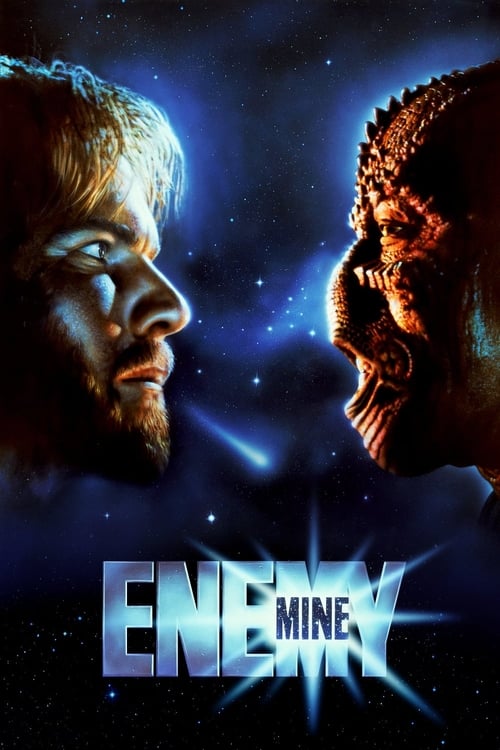
Imagine being the studio executive who greenlit a $40 million sci-fi epic where the main attraction is an Oscar-winning actor dressed as a humanoid lizard, hissing through five layers of latex and eventually giving birth to himself. In 1985, that was the reality of Enemy Mine. It was a colossal financial disaster for 20th Century Fox, arriving in theaters just as the Star Wars fever was cooling into a more cynical era of muscle-bound action heroes. Yet, if you grew up roaming the "Science Fiction" aisles of a local video store in the late 80s, the striking cover art—a human and an alien staring intensely at each other against a volcanic sky—likely burned a permanent image into your brain.

I recently revisited this one on a rainy Tuesday while my cat, Barnaby, spent the entire runtime aggressively kneading my thighs with his claws. Honestly, the physical discomfort of the "biscuits" being made in my lap felt strangely appropriate for a film that spends so much time focusing on the grit, grime, and physical struggle of survival.
The Oddest Couple in the Galaxy
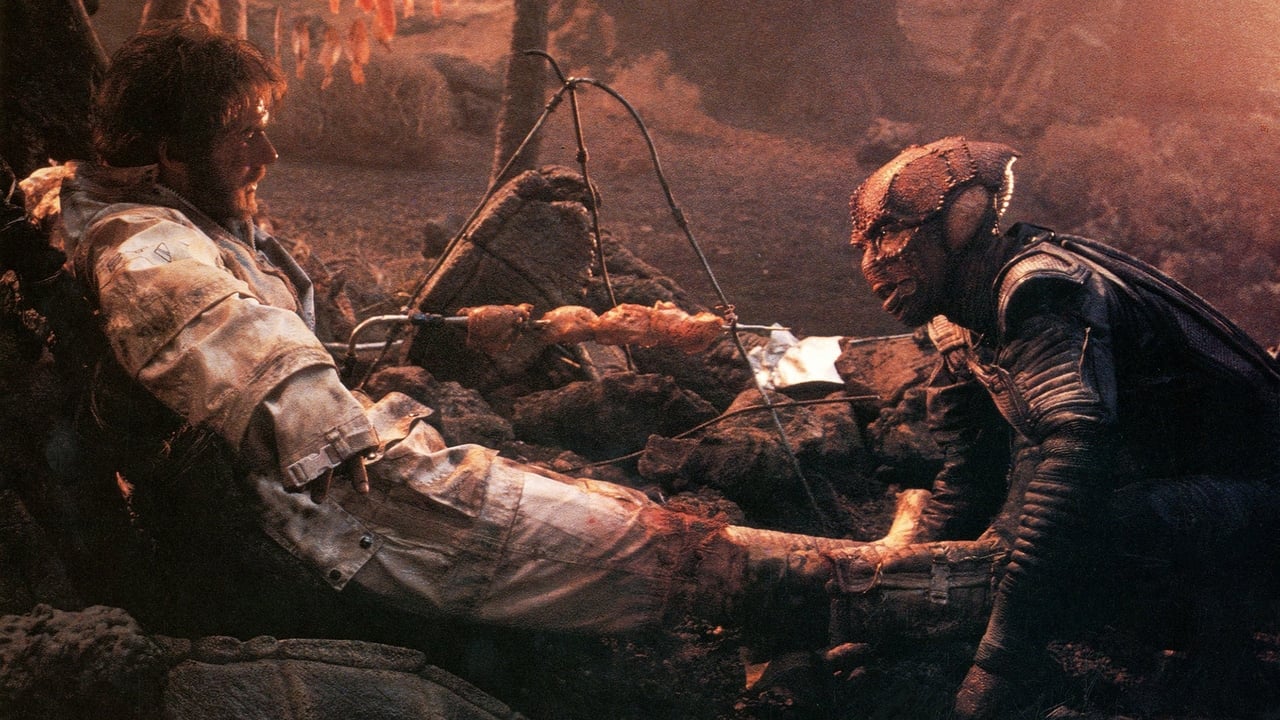
At its heart, Enemy Mine is a two-hander drama masquerading as a space opera. Dennis Quaid plays Willis Davidge, a hotshot pilot for the Interplanetary Earth Force who crashes on a desolate planet during a dogfight. He’s not alone; his enemy, a "Drac" named Jeriba Shigan (affectionately dubbed "Jerry"), has also gone down. In any other 80s flick, this would be the setup for a 100-minute hunt. Instead, director Wolfgang Petersen—fresh off the success of The NeverEnding Story—turns it into a study of forced intimacy.
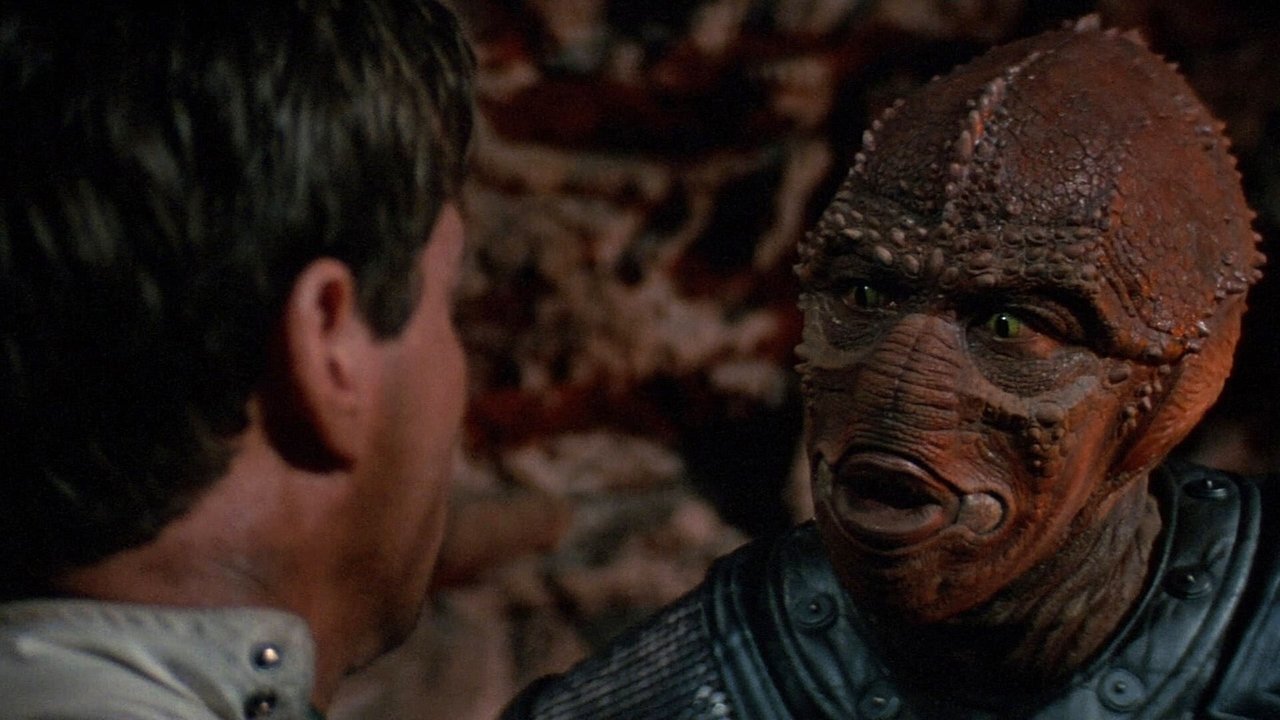
The chemistry here is what saves the movie from being a kitschy relic. Louis Gossett Jr. delivers an incredible performance as Jerry. It is easy to forget that beneath that reptilian makeup is the man who played the drill sergeant in An Officer and a Gentleman. He uses a strange, clicking vocalization and a bird-like tilt of the head to create a character that feels genuinely alien, yet deeply soulful. When Davidge tries to teach Jerry about Earth culture by describing Mickey Mouse, it’s not just comic relief; it’s a bridge being built. Watching Dennis Quaid transition from a screaming, xenophobic soldier to a man who basically becomes a surrogate father to an alien child is a surprisingly moving arc. It is basically a futuristic remake of The Defiant Ones but with more hermaphroditic lizard-birthing.
The Practical Magic of Lanzarote

One thing that immediately struck me is how tangible everything feels. This was the twilight of the Practical Effects Golden Age, and you can see every cent of that $40 million budget on the screen. The film was shot largely on the volcanic islands of Lanzarote and in the massive Bavaria Studios in Germany. There’s no CGI "weightlessness" here. When a giant pit-monster (a terrifyingly goopy animatronic) drags a character toward a toothy maw, you feel the tension because the actors are actually wrestling with a massive mechanical puppet in real sand.
The makeup by Chris Walas is the real MVP. While modern audiences might find the Drac design a bit "man-in-a-suit," the detail in Jerry’s skin—the translucent scales and the way the throat moves when he speaks—is a testament to pre-digital craftsmanship. It’s the kind of work that made 80s sci-fi feel lived-in. The production design captures that specific "used future" aesthetic that Blade Runner and Alien popularized, but adds a weird, prehistoric flavor that makes the planet Fyrine IV feel genuinely hostile.
The VHS Resurrection
So, why did this movie vanish from the cultural conversation? It’s a bit of a tonal "misfit." It starts as a war movie, turns into a survivalist drama, shifts into a story about parenthood, and ends as a commentary on the horrors of slavery (shoutout to Brion James, who shows up in the third act to play the most detestable space-miner in cinematic history). In 1985, audiences wanted Back to the Future or Rambo. They weren't quite ready for a philosophical drama about the commonality of all sentient life.

However, Enemy Mine found its true home on home video. I remember the specific "Key Video" red-bordered VHS box sitting on the shelf of my neighborhood rental spot for years, the tape eventually becoming so worn that the scenes of the meteor showers were barely visible through the tracking static. It was the perfect "discovery" movie—something your parents didn't necessarily talk about, but you found yourself mesmerized by on a Saturday afternoon broadcast. It’s a "small" story told on a massive canvas, and while the third-act shift into a more traditional action climax feels a bit rushed (likely due to studio notes), the emotional core remains intact.
Enemy Mine is a beautiful, weird, and occasionally clunky reminder of a time when studios were willing to spend blockbuster money on intimate character studies. It’s a film that dares to be sincere in an age of irony. If you can get past some of the 80s tropes and the somewhat abrupt ending, you’ll find a story that has more heart than almost anything in the modern multiplex. It’s a film that asks us to look past the scales and see the soul beneath, even if that soul belongs to someone who thinks Mickey Mouse is a religious icon.
Keep Exploring...
-
Starman
1984
-
Cocoon
1985
-

Innerspace
1987
-
Nineteen Eighty-Four
1984
-
The NeverEnding Story
1984
-
THX 1138
1971
-

WarGames
1983
-

La Jetée
1962
-

Solaris
1972
-

Outbreak
1995
-

Flash Gordon
1980
-

Escape to Victory
1981
-

Sophie's Choice
1982
-

Risky Business
1983
-
The Dead Zone
1983
-
The Outsiders
1983
-

The Right Stuff
1983
-

2010
1984
-

Red Dawn
1984
-

Star Trek III: The Search for Spock
1984