Re-Animator
"Death is just a temporary setback."
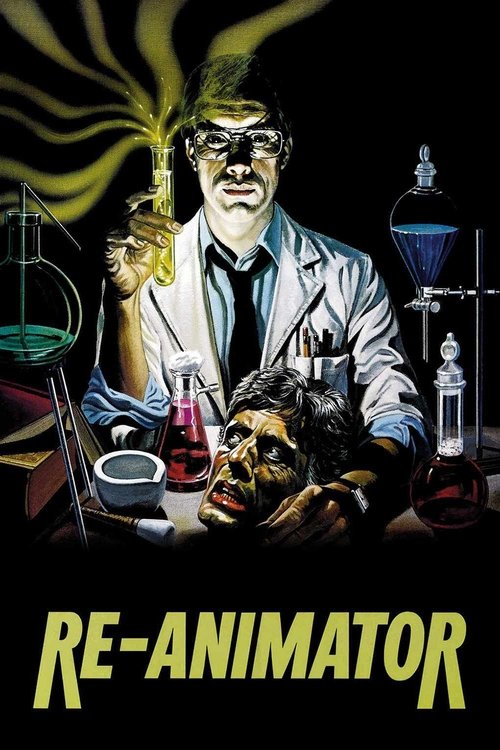
If you ever find yourself in a windowless basement with a glowing neon-green syringe and a very dead cat, you have two choices: call the police or call a screenwriter. In 1985, director Stuart Gordon chose the latter, and the result was a film that didn't just break the rules of horror—it performed a messy, unauthorized autopsy on them. I watched this most recent viewing on a Tuesday afternoon while my neighbor was loudly pressure-washing their driveway, the rhythmic thrum of the water acting as a bizarrely industrial soundtrack to the morgue scenes.

Re-Animator is the ultimate "Splatter-stick" comedy. It’s what happens when you take the gothic dread of H.P. Lovecraft, strip away the cosmic nihilism, and replace it with a gallon of Karo-syrup blood and the frantic energy of a Marx Brothers routine set in a funeral home. It’s a film that knows exactly how ridiculous it is, yet plays every single beat with a straight-faced intensity that makes the absurdity land twice as hard.
The Intensity of Herbert West
At the center of this hurricane is Jeffrey Combs. I’m convinced that if you looked up "commitment" in a cinematic dictionary, you’d just see a picture of Combs' wide, unblinking eyes behind a pair of thick-rimmed spectacles. As Herbert West, he doesn't just play a mad scientist; he plays a man who is genuinely annoyed that the laws of nature are getting in the way of his schedule. He’s arguably the most proactive protagonist in horror history—he doesn’t wait for the monster to show up; he makes the monster, realizes it’s a "disappointment," and then beats it to death with a shovel. Herbert West is the only relatable character here because he’s just a grad student trying to meet a deadline at any cost.
Opposite him is Bruce Abbott as Dan Cain, the "straight man" who slowly gets sucked into West’s orbit. Abbott does a fantastic job of looking increasingly exhausted, which is the only logical reaction to having your roommate store severed heads in your crisper drawer. Then there’s Barbara Crampton, who brings a necessary groundedness to Megan Halsey, even when the film descends into its most infamous and transgressive "head-giving" sequence. It’s a testament to the cast that the human stakes feel real even when a decapitated David Gale is telepathically commanding a literal army of the nude and undead.
Practical Magic in the Pre-CGI Trenches
What truly cements Re-Animator as a cornerstone of the 1980s is its dedication to the craft of the "gross-out." This was the golden age of practical effects, a time when makeup artists like John Naulin were basically modern-day alchemists. There is a texture to the gore in this film that modern CGI simply cannot replicate. When a body is ripped apart or a skull is crushed, there’s a wet, tactile squelch to it that makes you want to wash your hands after the credits roll.

The production was a masterclass in indie resourcefulness. With a budget of less than a million dollars, the crew had to get creative. That iconic glowing "reagent" that brings the dead back to life? It was actually the fluid from inside commercial glow-sticks, mixed with a little bit of highlighter ink to give it that radioactive pop. It’s a visual shorthand that became instantly iconic. In the 80s, if you saw that shade of green on a VHS box at your local rental shop, you knew you were in for the "good stuff."
Speaking of VHS, Re-Animator was a titan of the video store era. This was a film that thrived on word-of-mouth and the "Unrated" sticker. Because it was released without a rating (the filmmakers refused to cut it down for an R), it carried a certain forbidden-fruit energy. Finding this tape tucked behind a copy of Friday the 13th Part V felt like discovering a secret occult text. The score by Richard Band also helps—it’s a cheeky, legally-distinct homage to Bernard Herrmann’s Psycho theme that tells the audience right away: Yes, we’re doing this, and yes, we know it’s crazy.
A Legacy of Limbs and Laughs
What strikes me most about re-watching this today is how lean it is. At 86 minutes, there isn’t a single ounce of fat on its re-animated bones. Stuart Gordon (who would go on to do the equally weird From Beyond) brought a theatrical sensibility to the blocking and pacing. He understood that horror and comedy both rely on the same thing: timing. The "dead cat" sequence in the basement is a perfect example of a joke that builds into a scare, then loops back around to a punchline involving a microwave.
It’s easy to dismiss 80s horror as just hairspray and synthesizers, but Re-Animator has a mean streak of wit that keeps it feeling fresh. It subverts the "God complex" trope of sci-fi by making the quest for eternal life look like a clumsy, back-alley brawl. It’s essentially a rom-com where the third wheel happens to be a decapitated head in a medical tray, and honestly, I wouldn’t have it any other way.
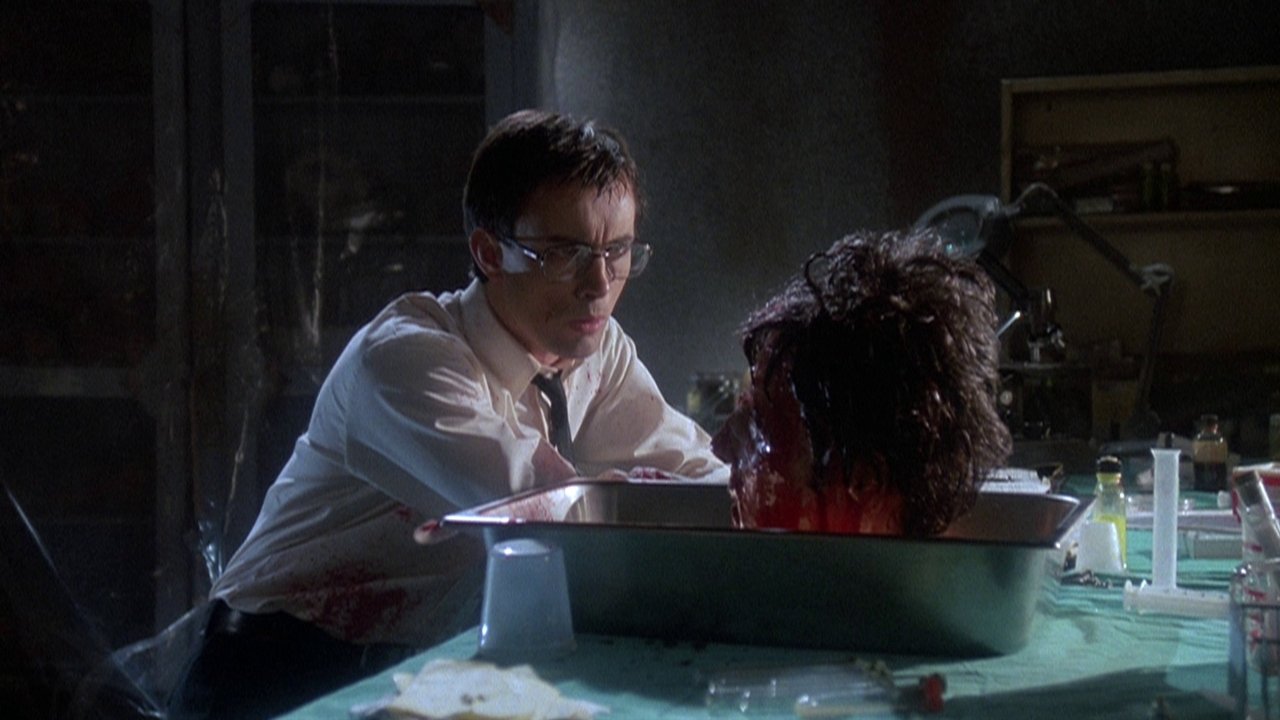
Re-Animator remains the gold standard for how to balance gore and guffaws without losing the soul of either. It’s a frantic, messy, and brilliantly acted piece of independent cinema that proved you don't need a massive budget to make a massive impact—just a lot of fake blood and the right leading man to sell the madness. Whether you’re a Lovecraft purist or just someone who enjoys seeing a brain-dead zombie get checked into a locker, this is essential viewing. Just maybe don't eat spaghetti while you watch it.
Stuff You Didn't Notice
The Syringe Dilemma: During the famous scene where West injects the corpse in the morgue, Jeffrey Combs accidentally hit Bruce Abbott with the needle. It wasn't supposed to happen, but Abbott stayed in character despite the puncture. The Head Game: To film the scenes where David Gale’s decapitated head is talking, they built a hole in a table for the actor to sit under, but they also used a puppet for the wider shots. The transition is so seamless for 1985 that it still tricks the eye. A "Psycho" Influence: Composer Richard Band was actually told by the producers to make the music sound like Psycho*. He leaned into it so hard that some critics at the time thought it was a parody, which fit the movie’s tone perfectly anyway.
Keep Exploring...
-
Bad Taste
1987
-
Critters
1986
-

Killer Klowns from Outer Space
1988
-
Evil Dead II
1987
-
The Texas Chainsaw Massacre 2
1986
-
The Rocky Horror Picture Show
1975
-
Creepshow
1982
-
Gremlins
1984
-
Little Shop of Horrors
1986
-

Short Circuit
1986
-
Innerspace
1987
-

The Lost Boys
1987
-

Back to the Future Part II
1989
-

Bill & Ted's Excellent Adventure
1989
-

Honey, I Shrunk the Kids
1989
-

Scanners
1981
-
Time Bandits
1981
-
Tremors
1990
-

Invasion of the Body Snatchers
1978
-
Police Story
1985