The Return of the Living Dead
"The dead are hungry, and they don't care about your headshots."

The air in the Uneeda Medical Supply warehouse smells like dust and formaldehyde, but it’s the silence that really gets to you. I first watched this on a laptop with a cracked screen while eating cold leftover pepperoni pizza, and honestly, the digital distortion on the screen made the shadows in that basement look ten times more oppressive. While The Return of the Living Dead is often celebrated as the ultimate 1980s "punk rock" horror party, revisiting it today reveals something much grimmer beneath the neon-soaked surface.
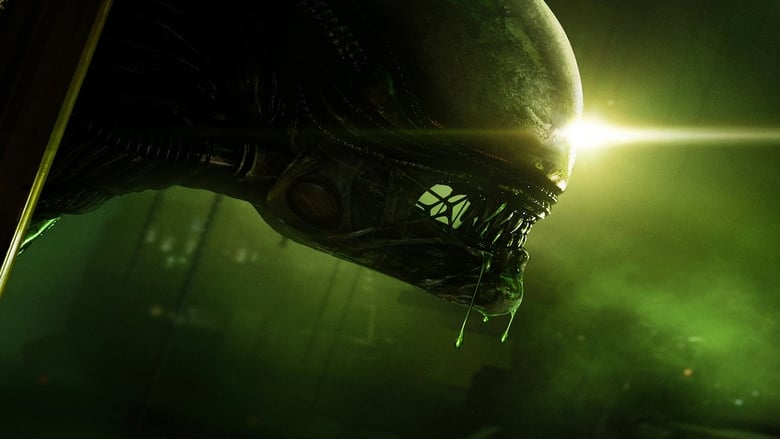
Dan O'Bannon, the man who gave us the claustrophobic dread of Alien (1979), didn't just want to make people jump; he wanted to make them feel the weight of an inescapable, rotting end. Most zombie films offer a glimmer of hope—a sturdy mall, a boat, a well-aimed bullet to the brain. O'Bannon looks you dead in the eye and tells you that hope is a lie. In this universe, the zombies are smart, they can talk, and shooting them in the head just makes them angry.
The Existential Ache of the Undead
The plot kicks off with the kind of workplace incompetence that usually just results in a HR meeting, but here leads to the apocalypse. When Frank (James Karen) tries to show off for the new hire, Freddy (Thom Mathews), he accidentally ruptures a military canister containing 2-4-5 Trioxin. The gas doesn't just wake the dead; it reanimates everything.
There is a sequence halfway through the film that still haunts me more than any jump scare. The "Half-Corpse"—a practical effects marvel of withered skin and twitching spinal cord—is strapped to a table and questioned. When asked why she eats people, she doesn't growl. She explains, in a raspy, agonizing whisper, that she can feel herself rotting. The "brains" aren't just food; they are a chemical hit that "makes the pain go away." It’s a devastatingly dark take on the genre. Suddenly, the monsters aren't just mindless drones; they are sentient victims of a biological curse, forced to murder just to numb the sensation of their own decomposition.
James Karen and Thom Mathews deliver performances that transition from comedic bumbling into genuine, shivering terror. As they realize they are slowly "turning" while still conscious, the film shifts into a body-horror tragedy. Watching them realize their own body temperatures are dropping to room temperature is far more unsettling than any of the gore.
Practical Gore and Punk Rebellion
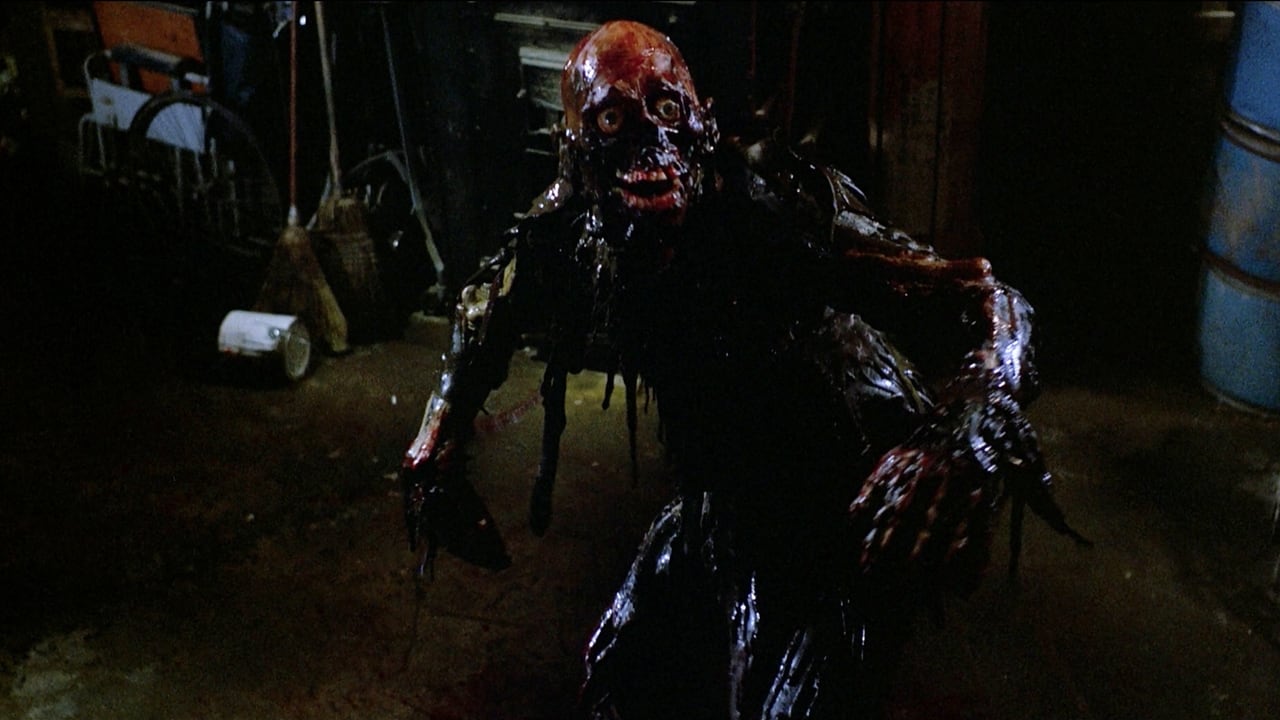
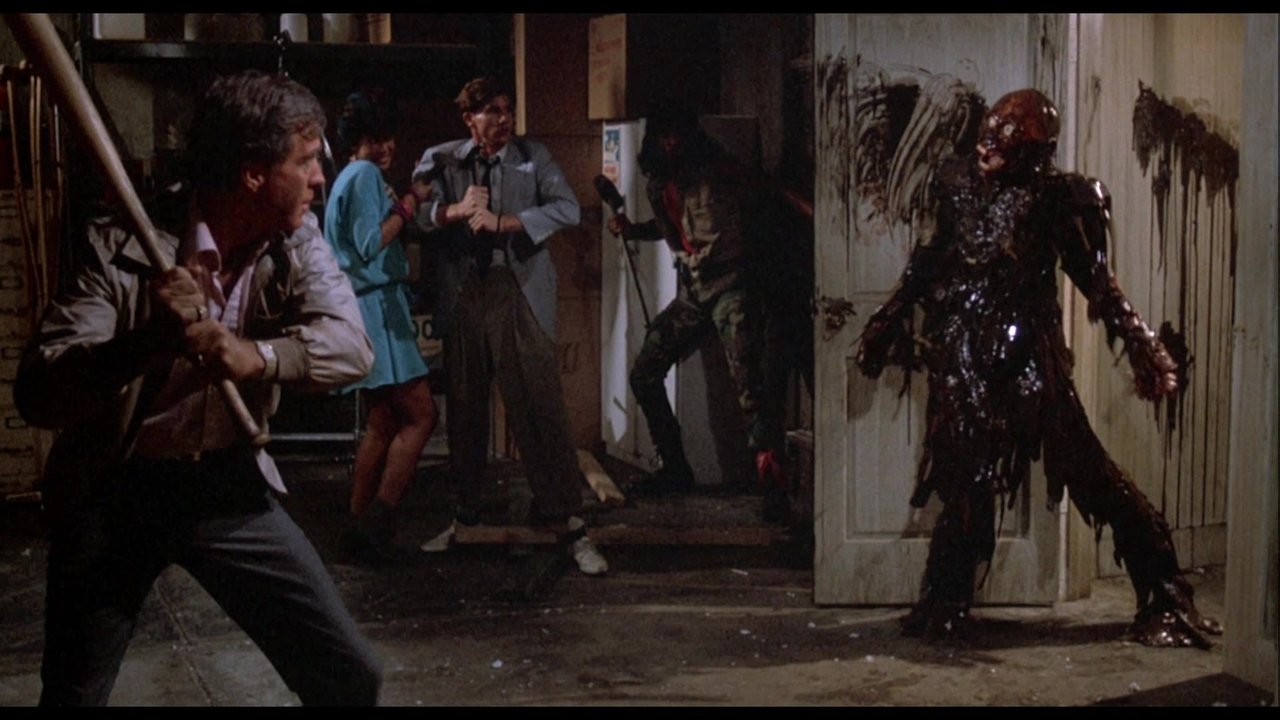
From a craft perspective, the film is a masterclass in mid-80s ingenuity. This was the golden age of "doing it for real," and the makeup effects by Bill Munns and his team (despite a notoriously troubled production) remain staggering. The "Tarman"—the gooey, skeletal creature that emerges from the first canister—is perhaps the most iconic zombie in cinema history. Played by puppeteer Allan Trautman, the character moves with a fluid, uncanny jerkiness that CGI simply cannot replicate. It looks wet, it looks ancient, and it looks hungry.
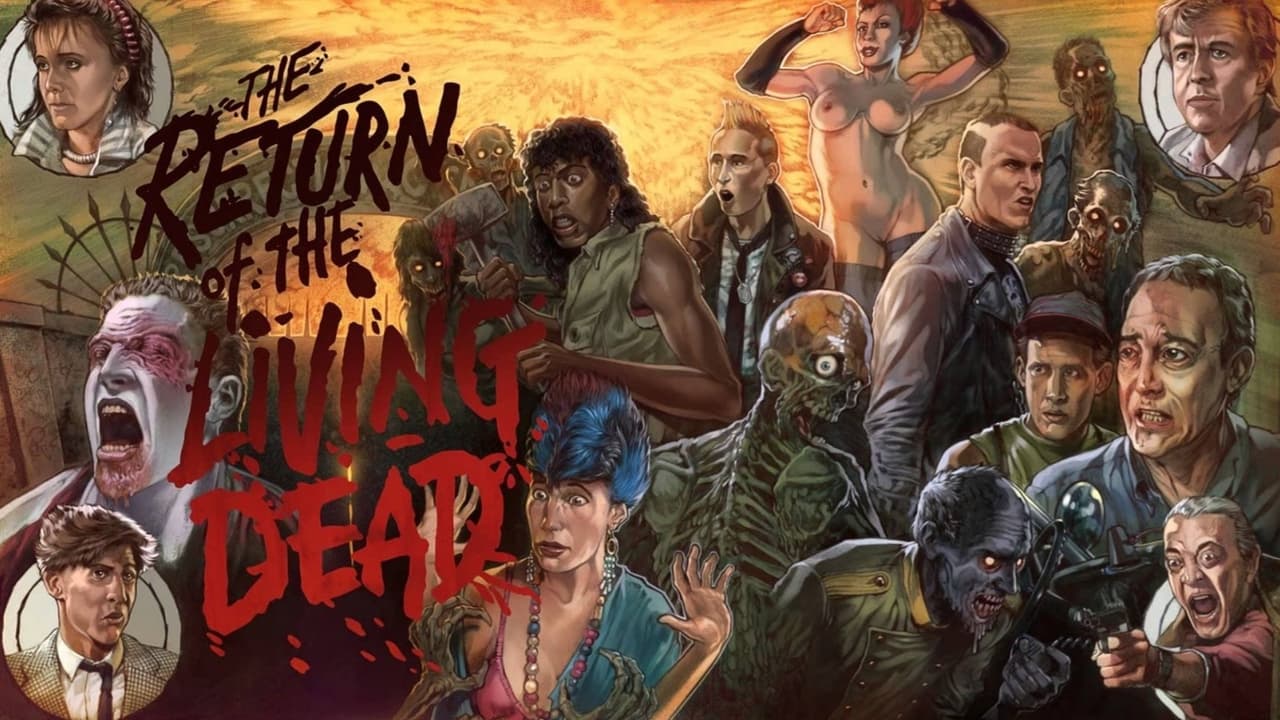
The film's "New Hollywood" rebellious streak is fueled by its punk-rock soundtrack and its cast of misfits. While the warehouse workers try to contain the leak, a group of punks—including Spider (Miguel A. Núñez Jr.) and the doomed Trash (Linnea Quigley)—are partying in a nearby cemetery. It’s a collision of subcultures that feels authentically 1985. The film captured that specific Reagan-era anxiety: the fear that the "adults" in charge (represented by Clu Gulager's Burt) have absolutely no idea what they’re doing, and that the military's solution to every problem is a scorched-earth policy.
The Midnight Legacy
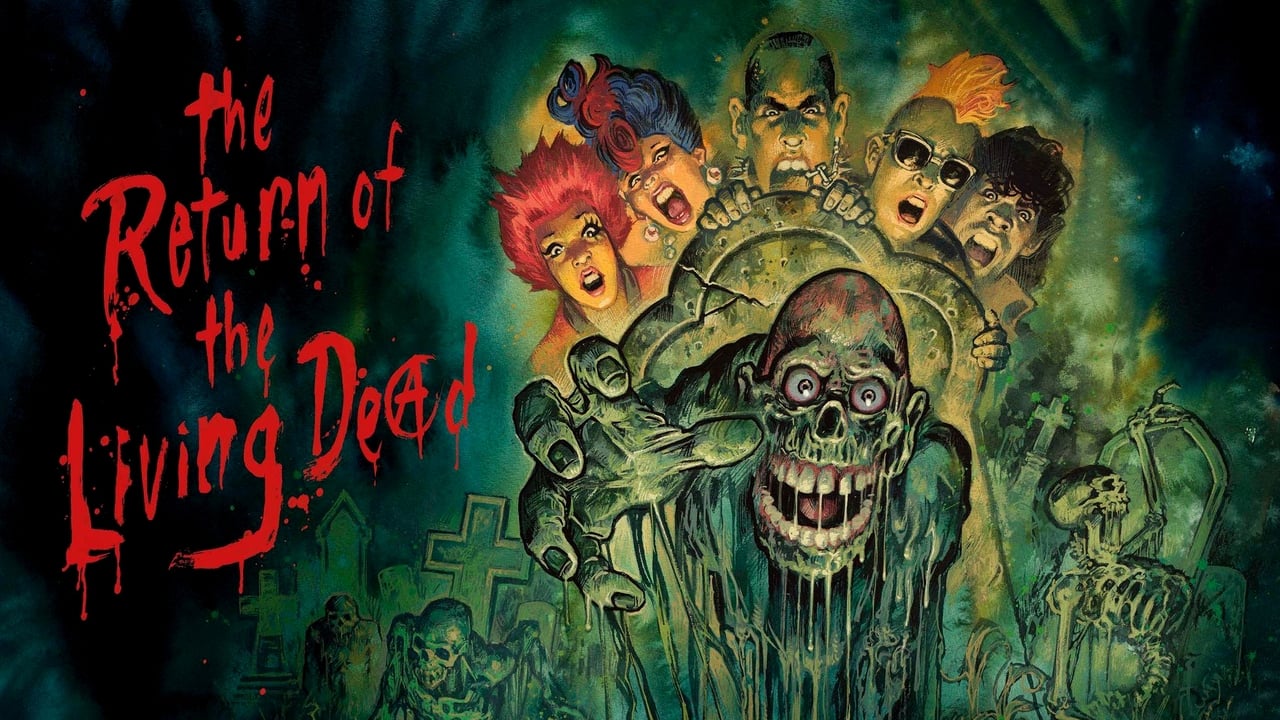
The journey of The Return of the Living Dead from a box-office "okay" to a cult deity happened largely in the aisles of local video stores. I remember the VHS box art vividly—that skeleton with the punk hair and the bright, neon-pink logo. It promised a party, but delivered a nightmare. It’s the kind of film that fans would trade stories about at school, obsessively debating the "rules" of these new, unstoppable ghouls.
Behind the scenes, the film was born out of a bitter divorce. John Russo, who co-wrote Night of the Living Dead (1968) with George A. Romero, retained the rights to the "Living Dead" title, while Romero moved on to his "Dead" series (Dawn of the Dead, Day of the Dead). This legal split allowed O'Bannon to take the genre in a completely different, more cynical direction. It’s a film that actively mocks the Romero rules, even having the characters mention the 1968 movie as a "true story" that got the details wrong.
Even the production trivia feels appropriately chaotic. The "cadaver" that Frank and Freddy accidentally reanimate was actually a real medical model that the crew covered in latex and "slime." During the graveyard scenes, the "rain" used by the production was actually a chemical mix that caused the actors' skin to itch and break out. That look of genuine distress on Thom Mathews’ face? It wasn't all acting; the man was likely being chemically sanded in real-time.
The final act of the film is a masterstroke of nihilism. As the survivors realize that every attempt to stop the spread only makes it worse—cremating the bodies just puts the gas into the clouds, creating toxic rain—the scale of the disaster becomes cosmic. The ending is a cold, hard slap to the face that lingers long after the punk-rock credits roll. It’s a perfect blend of high-concept horror and 80s cynicism, proving that sometimes, the party really does end in tears and radioactive fallout.
Keep Exploring...
-
An American Werewolf in London
1981
-
Return of the Living Dead III
1993
-

Fright Night
1985
-
The Rocky Horror Picture Show
1975
-
The Lost Boys
1987
-

The Thing
1982
-
The Fly
1986
-
Raising Arizona
1987
-
The Omen
1976
-
Videodrome
1983
-

Re-Animator
1985
-
Critters
1986
-
Bad Taste
1987
-
Evil Dead II
1987
-
Killer Klowns from Outer Space
1988
-
Alien
1979
-

The Evil Dead
1981
-

A Nightmare on Elm Street
1984
-
After Hours
1985
-

Day of the Dead
1985