Sleeping with the Enemy
"His love is a life sentence."

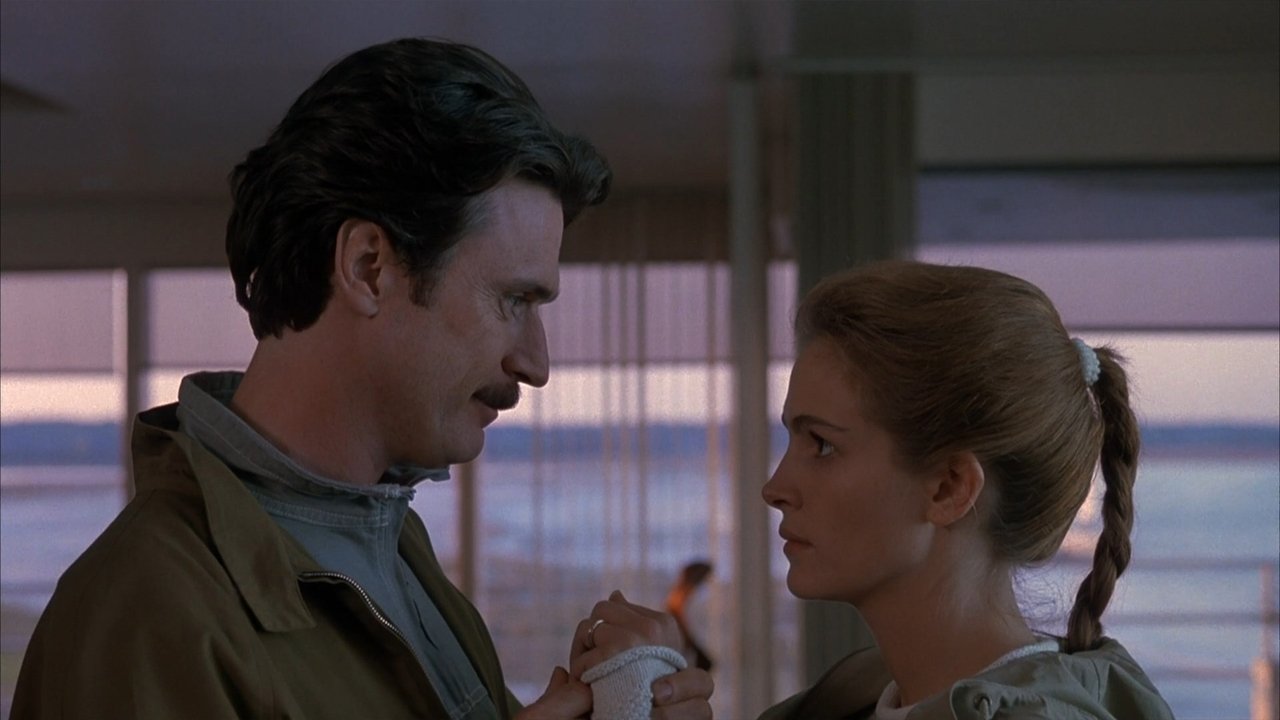
If you ever find yourself in a bathroom where the hand towels are perfectly aligned and the edge of the toilet paper is folded into a crisp little triangle, run. Don’t wait for a polite goodbye; just climb out the window. I realized this thirty years ago thanks to Julia Roberts and a very intense man with a mustache, and honestly, it’s a survival tip that has never failed me. I recently rewatched Sleeping with the Enemy on a grainy DVD I found at a garage sale—the kind where the previous owner clearly used the disc as a coaster for a very sweaty glass of iced tea—and it’s fascinating how this film occupies a specific, polished corner of early 90s pop culture.

Released in February 1991, this wasn't just a movie; it was a coronation. Julia Roberts had just become the biggest star on the planet with Pretty Woman (1990), and the industry was desperate to see if she could carry a "serious" thriller. Spoiler alert: she could, and she did it to the tune of $175 million.
The Art of the Yuppie Nightmare
The first act of Sleeping with the Enemy is a masterclass in domestic dread. Directed by Joseph Ruben (who already knew his way around a suburban creep-fest with The Stepfather), the film introduces us to Laura and Martin Burney. They live in a glass-and-steel fortress on Cape Cod that looks like it belongs in an architectural digest for people who hate joy.
Patrick Bergin plays Martin, and he is terrifying precisely because he looks like the guy who would offer you a great deal on a high-yield savings account. He’s handsome, wealthy, and utterly psychotic. His obsession with order—specifically the alignment of canned goods in the pantry—is the kind of character shorthand that 90s thrillers loved. It’s effective, even if the third act turns into a slasher movie where the killer's only weapon is an obsessive-compulsive need to straighten hand towels.
When Laura fakes her death during a stormy sailing trip (a sequence that features some surprisingly solid practical stunt work), the movie shifts gears. She moves to Iowa, changes her name to Sara, and starts a "normal" life. This is where the film leans into its most "movie-ish" tropes, including a montage where she learns to love again while wearing oversized sweaters that probably cost more than my first car.
Performance and the Goldsmith Glow

Julia Roberts is doing a lot of heavy lifting here. While the script by Ronald Bass (who won an Oscar for Rain Man) occasionally veers into melodrama, Roberts keeps it grounded. You see the flickering of her trauma even when she’s trying to smile at her new neighbor, Ben, played by Kevin Anderson. Anderson is fine as the "good guy" foil, though he’s mostly there to show us that some men actually allow their towels to hang slightly crooked.
What really elevates the film, however, is the score. The legendary Jerry Goldsmith (the genius behind the music for Alien and The Omen) provides a haunting, melancholic theme that suggests tragedy even when the sun is shining. In an era where many thrillers were starting to rely on synthesized beats, Goldsmith’s orchestral approach gives the movie a weight it might not otherwise have earned. It’s a reminder of a time when even "mid-budget" thrillers felt like prestige productions.
Looking back, it’s wild to think this film knocked Home Alone off its #1 spot at the box office. It arrived at the height of the "domestic thriller" craze, sandwiched between Fatal Attraction and The Hand That Rocks the Cradle. It’s a subgenre that barely exists in theaters anymore, having mostly migrated to the "Recommended for You" section of Lifetime or Netflix.
Trivia for the Watercooler
If you want to understand the sheer scale of the "Julia Roberts Peak," consider the production trivia. Julia Roberts was actually only 22 when she filmed this. Think about that: carrying a massive studio thriller and out-earning almost every veteran in Hollywood before you can legally rent a car without an extra fee.

The role of Laura was originally offered to Kim Basinger (fresh off Batman), who turned it down. While Basinger would have brought a different kind of fragility, Roberts brought that signature "America’s Sweetheart" relatability that made the audience’s protective instincts kick into overdrive.
Another fun detail: that beautiful, modern Cape Cod house? It wasn't a real house. It was a shell built specifically for the film in North Carolina. The production team had to deal with constant weather issues, but John Lindley’s cinematography makes the result look like a million-dollar dream that slowly curdles into a prison.
Sleeping with the Enemy is a quintessential 1991 experience. It’s glossy, it’s a bit manipulative, and the logic of the final confrontation requires you to ignore several laws of physics and police procedure. But as a vehicle for a star at the absolute zenith of her powers, it’s undeniably effective. It captures a moment when Hollywood believed you could build a blockbuster entirely on the strength of a character’s fear and a protagonist's resilience. It may not be a deep dive into the psychology of abuse, but as a high-stakes game of hide-and-seek, it still makes me want to double-check the locks on my front door—and maybe mess up my towel rack just to be safe.

Keep Exploring...
-

The Good Son
1993
-

The Pelican Brief
1993
-

The Forgotten
2004
-

Patriot Games
1992
-

Ghost
1990
-

Cape Fear
1991
-

A Perfect World
1993
-

In the Line of Fire
1993
-

The Firm
1993
-

The Net
1995
-

A Time to Kill
1996
-

Stepmom
1998
-

Clear and Present Danger
1994
-

Disclosure
1994
-

Outbreak
1995
-

Dangerous Minds
1995
-

The Talented Mr. Ripley
1999
-

The Beach
2000
-

Traffic
2000
-

Panic Room
2002