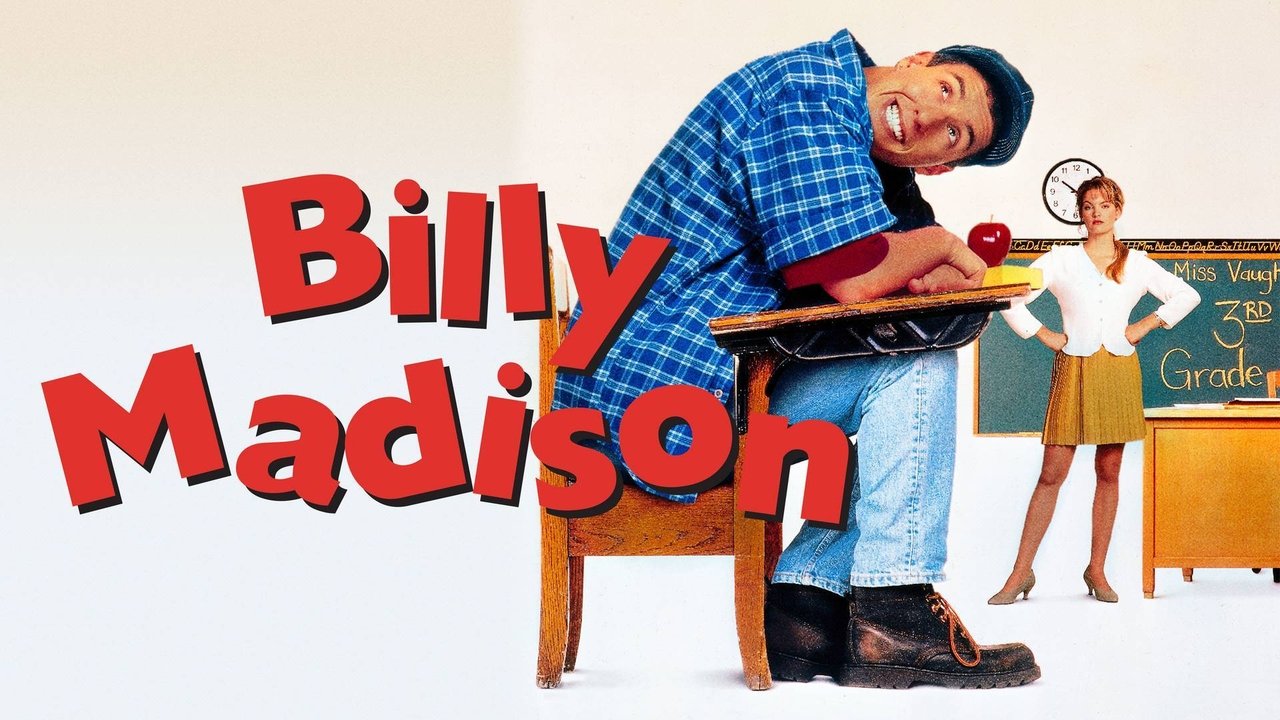
Billy Madison
"Grade school was never this weird."
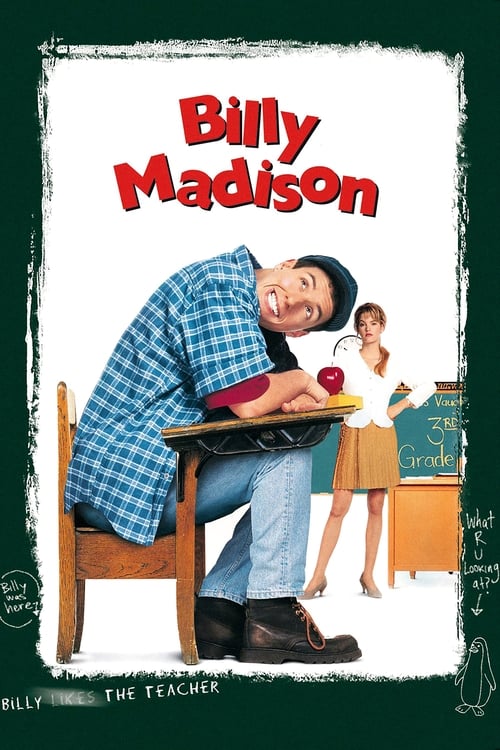
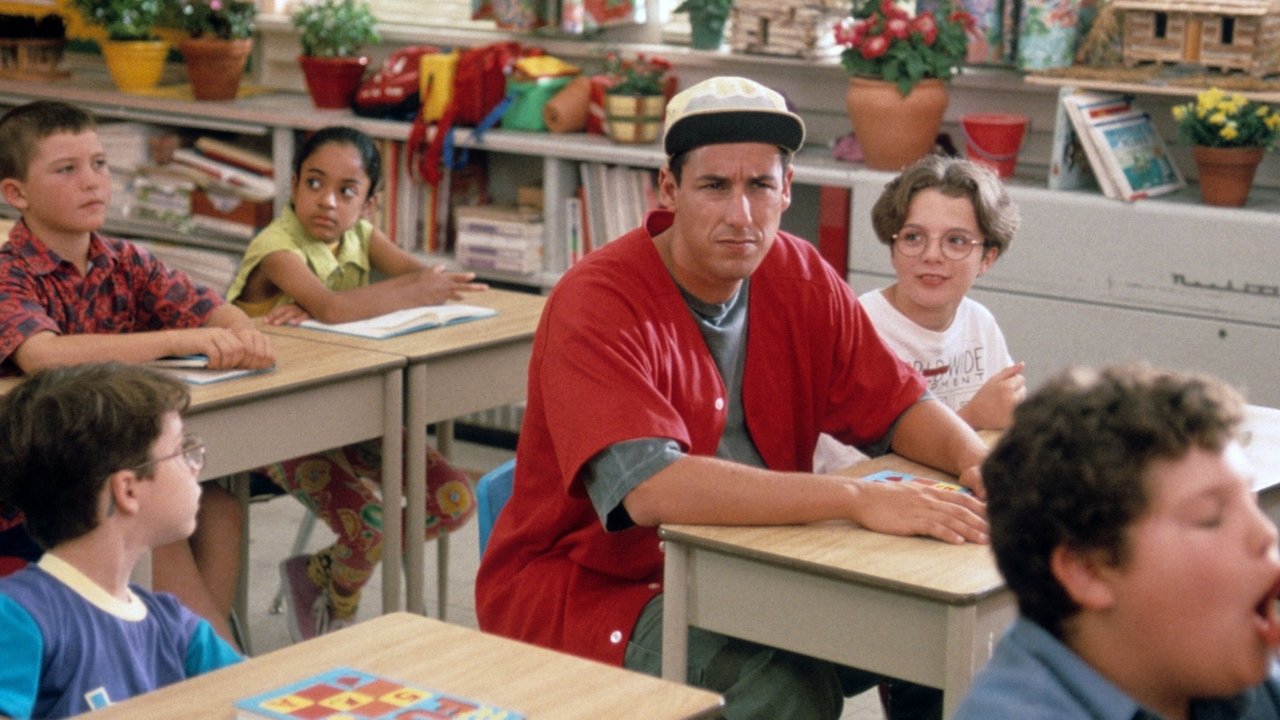
There is a moment early in Billy Madison where a 27-year-old man, sitting in a motorized bathtub, starts an impassioned argument with a bottle of shampoo and a bottle of conditioner. He’s debating which one is better for the hair while making them "fight" like action figures. In 1995, critics looked at this and saw the end of civilization. I looked at it and realized I was witnessing the birth of a very specific, very loud, and very lucrative kind of comedic god.
I recently revisited this one on a scratched DVD while eating a bag of slightly stale pretzel sticks that tasted like the back of a pantry, and honestly, the film’s chaotic energy matched the snack perfectly. Billy Madison isn't just a movie; it’s a time capsule of that mid-90s transition where Saturday Night Live stars were being shot out of a cannon into the multiplexes. It was the first real test of whether Adam Sandler’s "man-child with rage issues" persona could carry ninety minutes of celluloid. The answer, surprisingly, is yes—but only because the movie is far weirder than anyone remembers.
The Architect of Absurdity
While it’s easy to dismiss this as "dumb" comedy, there is a structural weirdness here that feels closer to a surrealist fever dream than a standard studio sitcom. Adam Sandler, along with his long-time writing partner Tim Herlihy, crafted a world where a giant penguin stalks the protagonist, lunch ladies serve "Sloppy Joes" with a side of pure malice, and a family called the O'Doyles is genetically predisposed to chanting their own name before driving off cliffs.
Tamra Davis, the director who had previously worked with Chris Rock on CB4, manages to capture the anarchy without letting it spin entirely out of control. There’s a visual flatness to the movie that screams "mid-90s budget," but it works in the film’s favor. It feels grounded just enough that when Billy starts hallucinating or bursts into a choreographed musical number about graduating the third grade, the contrast hits harder. Billy Madison is basically a live-action Looney Tunes short for people who think fart jokes are high art.
Yuppies, Blobs, and SNL Royalty
The secret weapon of Billy Madison isn't actually Adam Sandler; it’s the people surrounding him who are forced to react to his insanity. Bradley Whitford, long before he was winning Emmys on The West Wing or being a terrifying suburbanite in Get Out, is the quintessential 90s yuppie villain. He plays Eric Gordon with such greasy, punchable perfection that you genuinely want to see him lose a trivia contest to a guy who thinks "The Puppy Who Lost His Way" is a literary masterpiece.
Then you have the supporting bench. The late, great Norm Macdonald shows up just to be... well, Norm Macdonald. He spends most of the movie lying on a lawn chair, looking like he wandered onto the wrong set, and yet his presence adds a layer of dry, cynical wit that balances Billy’s screaming. And we have to talk about Josh Mostel as Principal Max Anderson. The "Revolting Blob" backstory is one of those bizarre subplots that would never make it past a modern studio focus group, yet here it is, taking up five minutes of screen time for no reason other than a weird payoff in the final act.
One bit of trivia I’ve always loved: during the dodgeball scene, Tamra Davis reportedly told Adam Sandler to take it easy on the kids. Instead, he absolutely hammered them. Those kids aren’t acting; they are genuinely terrified of a grown man hurling red rubber balls at their heads. It’s that edge of genuine, unhinged aggression that makes early Sandler movies feel different from the more "family-friendly" stuff he’d move toward later in his career with films like Bedtime Stories.
A Product of the VHS Revolution
Looking back from the era of streaming, Billy Madison feels like the ultimate "Video Store" movie. It’s the kind of film that built its legend through repeated viewings on VHS, where you’d rewind the "Academic Decathlon" speech a dozen times until you could recite the moderator’s legendary insult word-for-word. You know the one: "Everyone in this room is now dumber for having listened to it."
It’s a film that doesn't care about logic. Why is there a giant penguin? Why does Bridgette Wilson-Sampras’s character, Veronica Vaughn, eventually fall for a guy who acts like a literal toddler? It doesn't matter. The movie operates on "funny-first" logic. It captures that 1995 cultural moment where the high-gloss artifice of the 80s was being replaced by something shaggier, dumber, and much more cynical. It’s not a "masterpiece" by any traditional metric, but as a piece of comedic infrastructure, it paved the way for everything from Happy Gilmore to the entire Apatow-adjacent boom of the 2000s.
The film is a loud, messy, and occasionally brilliant showcase for a performer who knew exactly what his audience wanted before they did. It’s a testament to the fact that sometimes, the most entertaining thing a person can do is act like a total moron for 90 minutes. If you haven't seen it since the days of dial-up internet, it’s worth a revisit—if only to see Bradley Whitford get his comeuppance via a well-placed flaming bag of dog waste. It might not make you any smarter, but you certainly won't be bored.
Keep Exploring...
-
Big Daddy
1999
-
Happy Gilmore
1996
-
The Waterboy
1998
-
The Wedding Singer
1998
-
Little Nicky
2000
-

Men, Women & Children
2014
-

The Cobbler
2014
-
Mr. Deeds
2002
-

Spanglish
2004
-
Bedtime Stories
2008
-
You Don't Mess with the Zohan
2008
-

Funny People
2009
-

Grown Ups
2010
-

Arachnophobia
1990
-

Cry-Baby
1990
-

Dick Tracy
1990
-

DuckTales: The Movie - Treasure of the Lost Lamp
1990
-
Problem Child
1990
-
Bill & Ted's Bogus Journey
1991
-
Father of the Bride
1991