Amistad
"A ship, a revolt, and a nation’s soul."
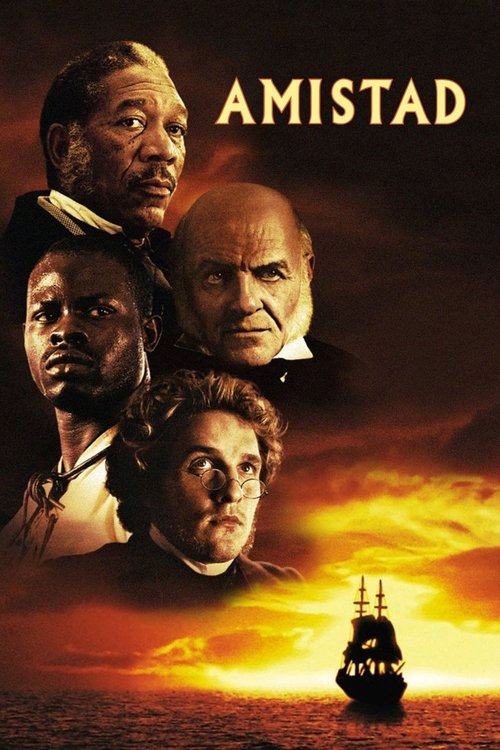
I’ll never forget the first time I saw the opening five minutes of Amistad. It was 1998, and I was watching a rented VHS in my basement while trying to fix a leaky faucet in the adjacent laundry room. I had the volume cranked up, and the sound of the storm on screen blended with the rhythmic drip-drip-drip of my plumbing. Suddenly, there’s a flash of lightning, and we see Djimon Hounsou’s face—eyes wide, muscles tensed, a man literally clawing his way out of a nightmare. I stopped messing with the wrench and just sat on the cold floor, mesmerized.
The Spielberg Pivot
Looking back, 1997 was a strange year for Steven Spielberg. He was in the middle of a massive creative transition. On one hand, he was still the king of the summer blockbuster, having just released The Lost World: Jurassic Park. On the other, he was clearly hungry to be taken seriously as a historian following the success of Schindler’s List. Amistad is the "middle child" of this era—squeezed between dinosaurs and the world-shaking impact of Saving Private Ryan a year later.
Because it’s sandwiched between those giants, Amistad often gets relegated to the "half-forgotten" pile. It’s a movie that people remember existing, but rarely revisit. That’s a shame, because while it has some of that 90s "prestige" polish that can feel a bit heavy-handed today, it’s also a daring, brutal, and deeply felt piece of filmmaking. Working again with cinematographer Janusz Kamiński (who gave us that gritty, high-contrast look in Schindler’s List), Spielberg captures the horrors of the Middle Passage with a raw intensity that most directors wouldn't have the guts to show today.
A Collision of Acting Heavyweights
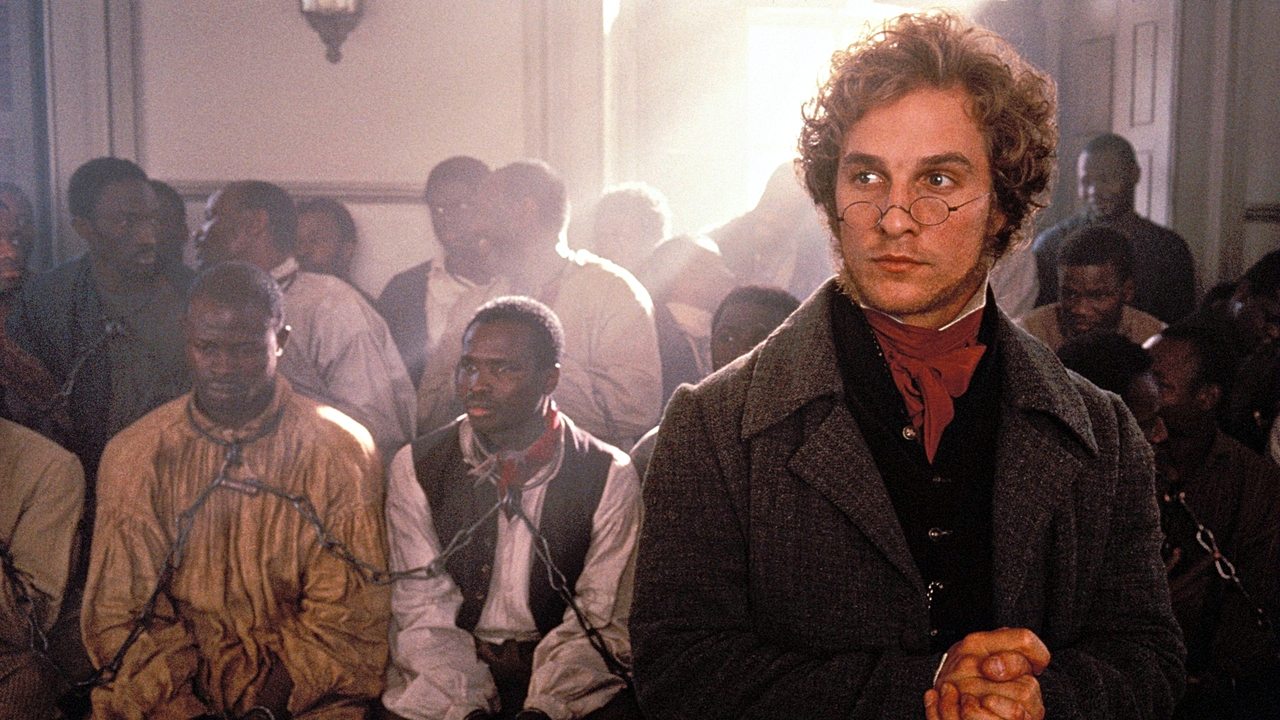
The film is essentially a legal procedural wrapped in a historical epic. After the revolt on the ship, the African captives, led by Cinque (Djimon Hounsou), end up in Connecticut, where a messy legal battle ensues to determine if they are "property" or free human beings.
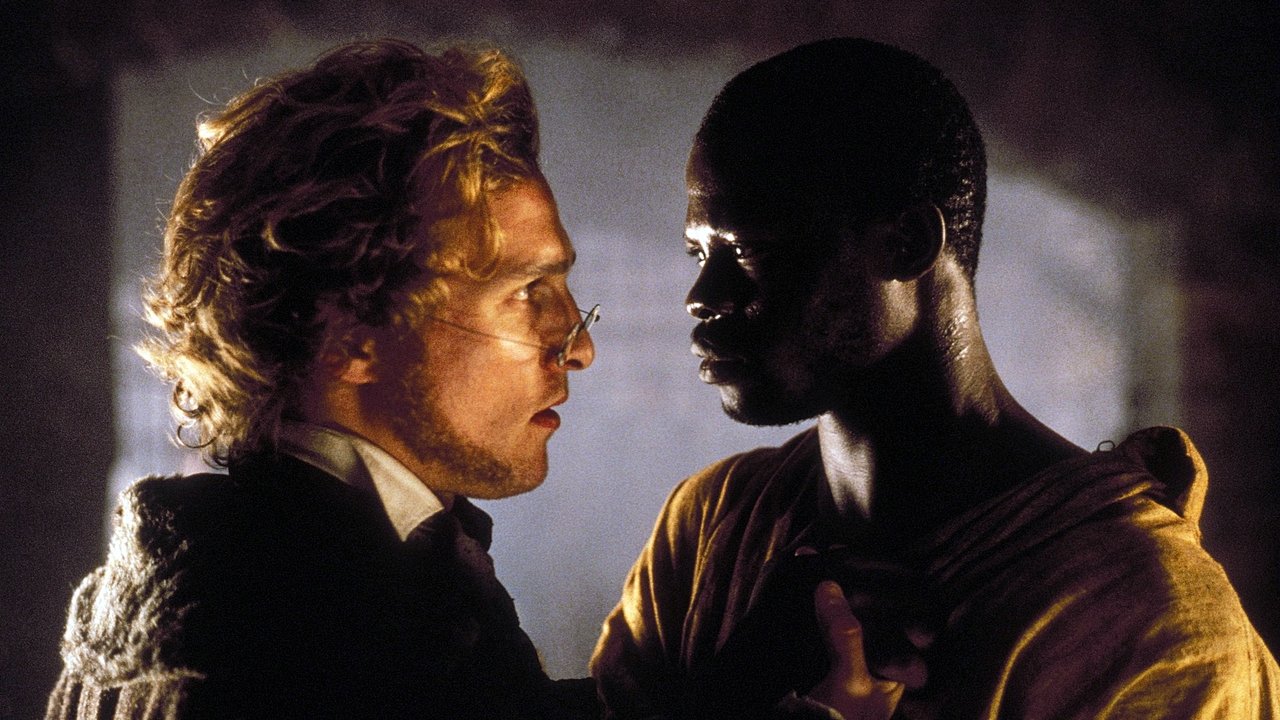
For my money, this is the performance that should have made Djimon Hounsou a superstar overnight. He has very little dialogue in English, but his presence is gravitational. You feel his confusion, his rage, and his dignity in every frame. Opposite him, we have Matthew McConaughey as Roger Sherman Baldwin. This was "Early McConaughey," before the rom-com era and long before the "McConaissance." He plays a scrappy property lawyer who looks like he hasn't slept or brushed his hair in a week, and I actually miss this version of him—he brings a nervous, intellectual energy that balances the heavier moments.
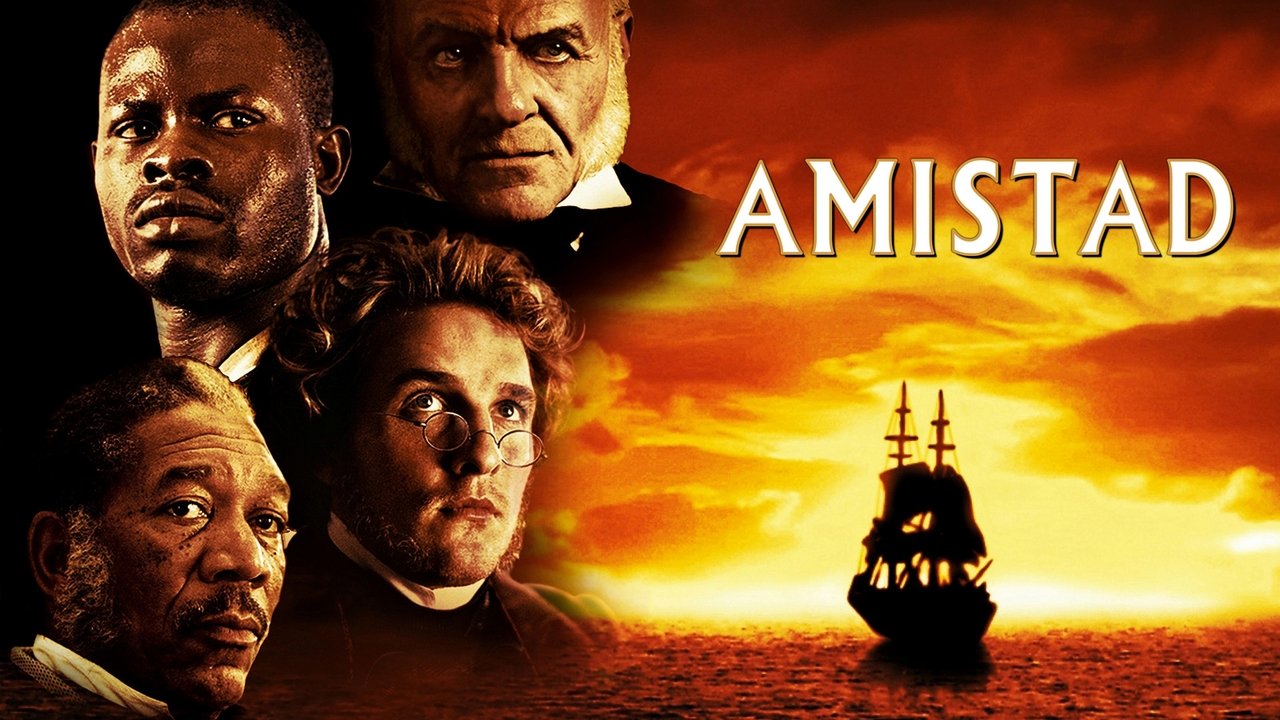
Then, of course, there’s the late-game entry of Anthony Hopkins as John Quincy Adams. He spends most of the movie puttering around a greenhouse, looking like a grumpy hobbit, until he’s called to the Supreme Court. His 11-minute closing argument is the kind of acting "big swing" that only someone of his caliber can pull off. It’s theatrical, sure, but in the context of a 90s drama, it’s the equivalent of a walk-off home run. Morgan Freeman also shows up as abolitionist Theodore Joadson, though I’ll be honest: the movie doesn't really know what to do with him other than have him look concerned in well-tailored suits.
Why It Vanished (And Why to Find It)
So, why did Amistad fall off the map? I think it’s because it’s a difficult "hang." It’s 155 minutes long, and the middle hour is a lot of men in wigs arguing about maritime law. The court scenes are basically 'Law & Order: 1839,' and that's where the movie loses some steam. It lacks the propulsive action of Spielberg’s other works, and it doesn't have the "heroic" ending we usually expect from Hollywood historical dramas—it’s a victory, but one tinged with the looming shadow of the Civil War.
However, there’s a lot here that still feels incredibly modern. The way the film explores the "corporatization" of human rights—how the politicians (like Nigel Hawthorne’s Martin Van Buren) view the lives of the captives through the lens of reelection and trade—feels depressingly relevant.
Interestingly, the ship used in the film was a meticulously built replica named the Amistad (and later the Pride of Baltimore II). Spielberg, ever the fan of practical effects, insisted on filming on the open water whenever possible. You can feel that salt spray and the claustrophobia of the lower decks. It’s a level of craft we’re losing in the era of green-screen volume sets.

If you can get past the slightly dated, "we-are-making-A-Great-Movie" tone that permeated late-90s Oscar bait, there is a powerful, human story at the core of Amistad. It’s a film about the struggle to be heard when you literally don't speak the language of your oppressors. It’s worth watching for Djimon Hounsou’s face alone, and for the reminder that even a "minor" Spielberg effort is usually more technically impressive than most directors' career peaks. Grab some popcorn, settle in for a long evening, and maybe keep a wrench nearby just in case you need an excuse to sit on the floor and stare at the screen.
Stuff You Didn't Notice
Djimon Hounsou was actually a model in Paris before this, discovered by Thierry Mugler. He allegedly didn't know who Spielberg was when he first auditioned. The film’s score by John Williams is surprisingly restrained. Instead of a sweeping hero theme, he uses a West African-inspired choral piece called "Dry Your Tears, Afrika" which is genuinely one of his most beautiful, underrated compositions. * Anthony Hopkins reportedly memorized the entire 11-minute Supreme Court speech in one go, impressing the crew so much that they finished the scene ahead of schedule.
Keep Exploring...
-
Kiss the Girls
1997
-
In the Valley of Elah
2007
-
Kill the Messenger
2014
-
K-19: The Widowmaker
2002
-
Quiz Show
1994
-
Munich
2005
-
Lincoln
2012
-
Glengarry Glen Ross
1992
-
Malcolm X
1992
-
The Player
1992
-
Alive
1993
-
Batman: Mask of the Phantasm
1993
-
The Client
1994
-
Courage Under Fire
1996
-
Breakdown
1997
-
Selena
1997
-
Wild Things
1998
-
Arlington Road
1999
-
Finding Forrester
2000
-

The Gift
2000