Ask Me If I'm Happy
"The punchline is love, the tragedy is timing."
There’s a specific kind of silence that only exists between three best friends who haven't spoken in three years. It’s heavy, it’s awkward, and it’s usually parked in the front seat of a car during a long, uncomfortable drive. I first watched Ask Me If I'm Happy (Chiedimi se sono felice) on a flickering CRT television in a cramped apartment in Rome, eating a pizza that was roughly 40% crust and 60% regret. Maybe it was the lukewarm mozzarella, but the film’s blend of slapstick absurdity and crushing adult melancholy hit me harder than a stray soccer ball to the face.
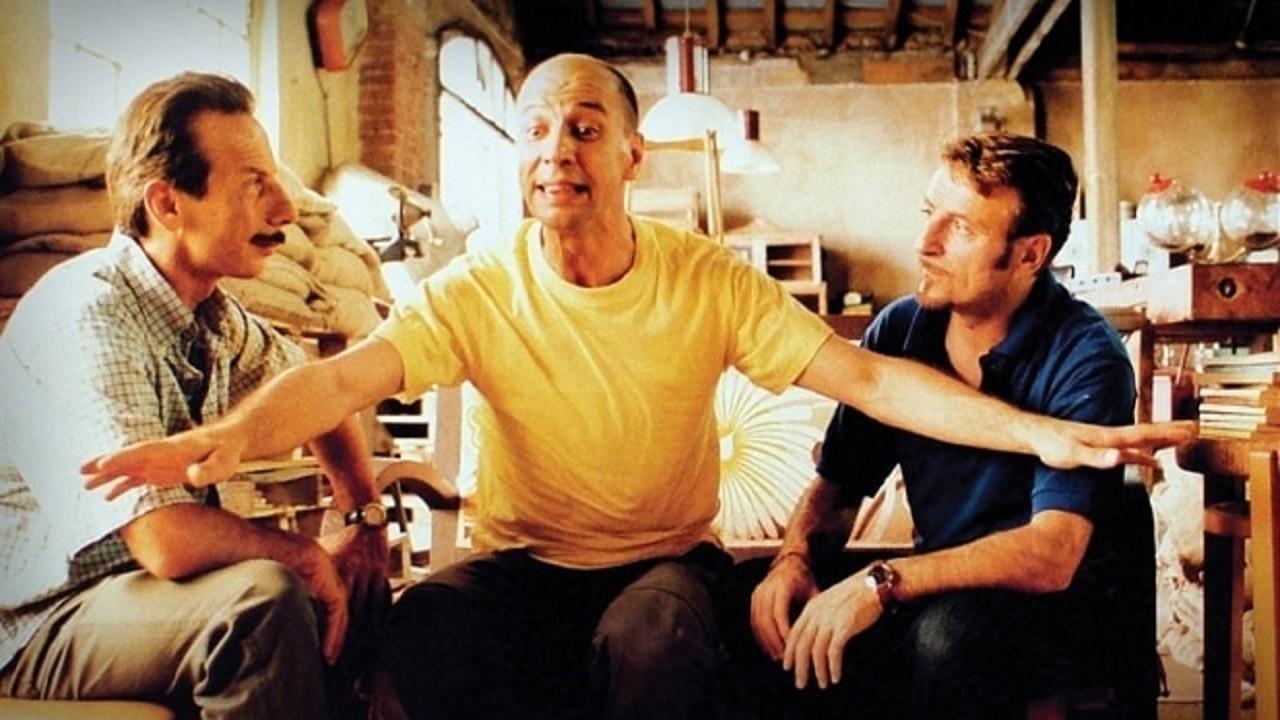
While international audiences were swooning over the digital sheen of Gladiator or the high-concept puzzles of Memento in 2000, the Italian comedy trio of Aldo Baglio, Giovanni Storti, and Giacomo Poretti—known simply as Aldo, Giovanni, and Giacomo—were busy perfecting a much older art form: the tragicomedy of the everyman. This film is arguably their peak, a moment where their theatrical chemistry merged perfectly with a story that dared to ask if laughter is enough to sustain a life.
The Nose and the Heart
The setup is deceptively simple, mirroring the "Sundance era" tropes of the late 90s. We meet the trio as three struggling aspirants in Milan. Aldo Baglio is the eccentric bit-player who thinks he’s a genius; Giovanni Storti is the obsessive-compulsive stickler for rules; and Giacomo Poretti is the neurotic romantic. They spend their days working dead-end jobs—Aldo as a literal "living mannequin"—while dreaming of staging Rostand's Cyrano de Bergerac.
The choice of Cyrano isn't just a plot device; it’s the film’s philosophical backbone. Like Cyrano, these men are hiding behind metaphors, too afraid to confront their own inadequacies. When they all fall, in various ways, for Marina Massironi (a staple of their early work who provides the film’s necessary emotional anchor), the comedy of errors shifts into something far more jagged. The trio’s dynamic here is essentially the Beatles' 'White Album' of Italian comedy—you can feel the individual brilliance, but there’s a looming sense that the collective can't survive the weight of real life.
Timing is a Cruel Mistress
Comedy is often defined by rhythm, and director Massimo Venier understands that the funniest moments are often the ones that breathe. There’s a legendary scene involving a late-night sandwich—the "panino"—that perfectly encapsulates their genius. It’s five minutes of improvised bickering over ingredients that tells you more about their friendship than ten pages of exposition. It’s physical, it’s verbal, and it’s purely observational.
However, the film’s "Modern Cinema" DNA shows in its non-linear structure. We jump between the sun-drenched, optimistic past and a grey, frosty present where Giovanni and Giacomo travel to Sicily because Aldo is purportedly on his deathbed. Looking back, this "three years later" device was a common Y2K-era trope—the sudden realization that the 90s party was over and the new millennium required a different kind of maturity. The film handles this transition with a grace that most comedies lack, never letting the "dying friend" trope become too saccharine.
Why It Vanished (And Why to Find It)
Outside of Italy, this film is a ghost. It suffered from the classic "cultural translation" barrier of the early 2000s; before streaming democratized global cinema, if a movie wasn't a "prestige" foreign film like Life is Beautiful, it rarely made it past the festival circuit. It also lacks the flashy CGI breakthroughs of its contemporaries, relying instead on the "Indie Renaissance" vibe of character-driven storytelling. Aldo is essentially the human embodiment of a golden retriever with an existential crisis, and that’s a performance that doesn’t need a digital polish to work.
There’s a beautiful, understated score by Samuele Bersani that stitches the eras together, giving the film a poetic, almost European arthouse feel that balances out the moments where Aldo Baglio is screaming at a bicycle. It’s a movie that rewards those who appreciate the "theatre-kid" energy of a troupe that has spent decades learning exactly how to annoy each other for the audience's benefit. Giovanni’s pedantry is the secret engine of Italian comedy, and seeing it clash with the chaotic world around him remains a timeless joy.
If you can find a copy—likely buried in the "Foreign" section of a digital library or an old DVD bargain bin—grab it. It’s a reminder that at the turn of the millennium, cinema wasn't just about big franchises or tech leaps; it was still, at its best, about three idiots trying to put on a play and failing to realize that the play was their life. It’s funny, it’s heartbreaking, and it’s a masterclass in ensemble timing.
Keep Exploring...
-
Have You Met Claudia?
2004
-
That's Life
1998
-

Three Men and a Leg
1997
-
The Legend of Al, John and Jack
2002
-

The Rich, the Pauper and the Butler
2014
-

I Hate Summer
2020
-

The Santa Claus Gang
2010
-
A Dog's Will
2000
-
My Cousin Vinny
1992
-
Fear City: A Family-Style Comedy
1994
-
Instructions Not Included
2013
-

Dilwale Dulhania Le Jayenge
1995
-
The Dinner Game
1998
-

10 Things I Hate About You
1999
-
All About My Mother
1999
-
Good Bye, Lenin!
2003
-

Sun In Buckets
2013
-
The Postman
1994
-
A Goofy Movie
1995
-

Mallrats
1995