Kiss of the Dragon
"One needle. One cop. No way out."

By the time 2001 rolled around, the "Matrix Effect" had officially infected every corner of the action genre. You couldn't walk into a multiplex without seeing a hero suspended by visible wires, performing gravity-defying backflips in slow motion while the camera spun in a 360-degree circle. It was cool for a minute, but as a martial arts fan, I was starting to miss the sound of a real fist hitting a real jaw. Enter Jet Li and his Parisian blood-letting spree, Kiss of the Dragon. Released during that strange transitional window where DVD extras were becoming a religion and digital color grading was turning every movie either neon green or cold blue, this film felt like a deliberate, aggressive slap in the face to the "wire-fu" trend.

I actually watched this for the third time last Tuesday while my neighbor was loudly power-washing his driveway, and the rhythmic thwack-thwack-thwack of the water actually synced up perfectly with the fight scenes. It was arguably the most immersive 4D cinema experience I’ve had in years.
The Anti-Matrix Philosophy
What makes Kiss of the Dragon stand out in the Jet Li filmography isn’t just the brutality; it’s the restraint. After the hip-hop-infused, CGI-heavy Romeo Must Die, Jet Li reportedly listened to the fans who wanted to see him move at full speed without the digital safety nets. He teamed up with producer/writer Luc Besson (The Professional, The Fifth Element) to create something that felt like a 1970s gritty crime thriller masquerading as a modern martial arts flick.
The action, choreographed by the legendary Corey Yuen (Transporter, High Risk), is some of the crispest of the era. There’s a specific sequence in a police training hall—where Li’s character, Liu Jian, takes on dozens of black belts—that serves as a masterclass in spatial awareness and rhythm. There’s no shaky-cam here, no frantic editing to hide a lack of skill. It’s just Jet Li moving like a predatory cat in a room full of mice. I love that the film trusts the audience to actually see the hits land. The plot has the structural integrity of a wet paper bag, but in a movie where a man is defeated by a well-placed acupuncture needle to the brain stem, I’m not exactly looking for Aaron Sorkin-level dialogue.
A Brutal Paris and a Broken Hero
Unlike the romanticized version of Paris we usually get, director Chris Nahon and cinematographer Thierry Arbogast give us a city that looks like it’s suffering from a permanent hangover. It’s gray, damp, and dangerous. This is the EuropaCorp aesthetic in its infancy—fast-paced, slightly mean-spirited, and obsessed with "The Man" being the ultimate villain.
Speaking of villains, Tchéky Karyo (who played the mentor in Bad Boys) is absolutely unhinged as Richard, the corrupt French detective. He is a villain who behaves like he’s trying to win an Olympic gold medal for being a jerk. He kicks his subordinates, snorts drugs off his desk, and screams at the top of his lungs. He’s the perfect foil for Jet Li, who plays Liu Jian with a stoic, almost silent intensity.
Then there’s Bridget Fonda. It’s easy to forget she was in this, as it was one of her final major roles before retiring from acting. She plays Jessica, an American girl forced into a life on the streets by Richard. Her performance is surprisingly raw and vulnerable for an action movie. Usually, the "damsel" in these films is just a plot device, but Bridget Fonda brings a genuine sense of tragedy to the role. The scene where she explains her situation to Jet Li in a cramped hideout provides a much-needed emotional anchor, making the eventual explosion of violence in the third act feel earned rather than just obligatory.
The Art of the Practical
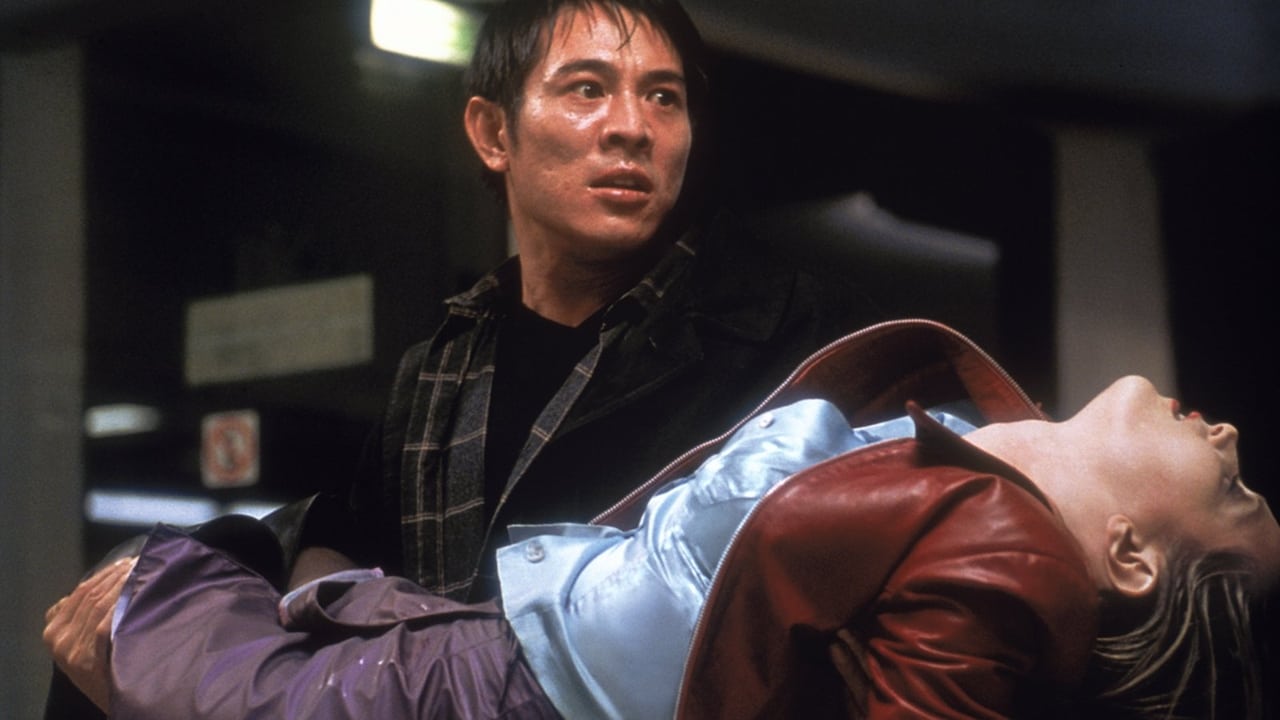
Looking back from an era where the MCU turns every fight into a pixelated blur, Kiss of the Dragon feels refreshingly physical. There’s a moment involving a laundry chute, a grenade, and a very unfortunate hotel room that still makes me grin. It’s that early-2000s sweet spot where the stunts were still largely practical, but the camerawork was starting to get more adventurous.
One of the coolest details about the production is that Jet Li actually had to slow down his movements because the cameras couldn’t capture his hands clearly at his natural speed. In an era where we often use technology to make actors look faster, they had to use it to make the world’s greatest martial artist look "normal." That’s a flex you just don’t see anymore.
The film also captures that post-9/11 anxiety that was just starting to bubble up—a distrust of authority, the idea of a "stranger in a strange land," and the brutal efficiency required to survive a system rigged against you. It doesn't have the "Y2K tech-fetishism" of The Matrix, but it has the cold, hard edge of the new millennium.
Kiss of the Dragon is a lean, mean, 98-minute reminder of why Jet Li became a global icon. It lacks the poetic beauty of Hero or the historical weight of Once Upon a Time in China, but as a pure "one-man-army" urban thriller, it hits exactly where it needs to. It’s a relic of a time when action movies were allowed to be simple, R-rated, and physically painful to watch. If you haven't revisited this one since the days of Blockbuster rentals, it's time to let the dragon bite again.
Keep Exploring...
-

Romeo Must Die
2000
-
War
2007
-
The Transporter
2002
-
Breakdown
1997
-
Shaft
2000
-
Undisputed II: Last Man Standing
2006
-
United 93
2006
-
District 13: Ultimatum
2009
-
The One
2001
-
Cradle 2 the Grave
2003
-

The Long Kiss Goodnight
1996
-
The Siege
1998
-

U.S. Marshals
1998
-
Payback
1999
-
Along Came a Spider
2001
-
Blood Work
2002
-
Basic
2003
-
The Hunted
2003
-
District B13
2004
-
Assault on Precinct 13
2005