Shaolin Soccer
"Kung fu meets the beautiful, bouncing game."
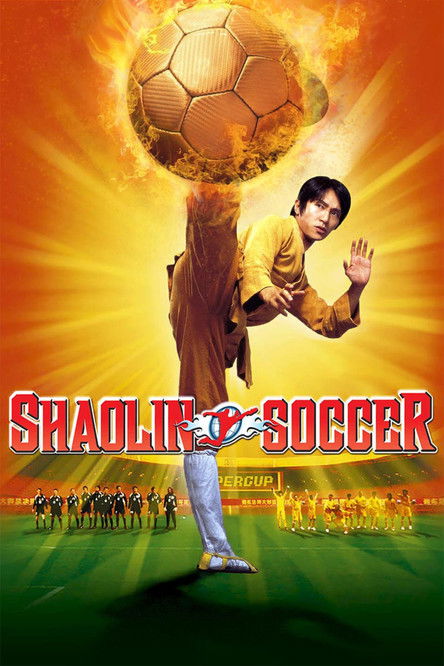
Imagine a world where the laws of physics aren’t just broken—they’ve been served divorce papers and replaced by the sheer, unadulterated willpower of a man who believes "everything is kung fu." Long before the Marvel Cinematic Universe figured out how to make a man fly with a $200 million budget, Stephen Chow was doing it with a soccer ball, a few crates of beer, and enough CGI to make a 2001 processor sweat. Shaolin Soccer didn't just break the box office in Hong Kong; it shattered the western perception that martial arts movies had to be either grimly serious or "ballet with bruises."
I first watched this film on a scratched-up, region-free DVD while recovering from a wisdom tooth extraction, and let me tell you, laughing that hard with a mouth full of gauze is a unique form of torture I’d gladly endure again. It’s the kind of movie that feels like a fever dream curated by someone who watched too much Captain Tsubasa and decided that reality was a mere suggestion.
The Gritty Absurdity of Mo Lei Tau
The film follows Sing (Stephen Chow), a Shaolin practitioner whose "Mighty Steel Leg" is wasted on picking up trash. He meets Fung (Richard Ng Man-Tat), a disgraced former soccer star known as "Golden Leg," who was crippled years ago by the arrogant Hung (Patrick Tse Yin). Together, they recruit Sing’s brothers—a group of disillusioned men working dead-end jobs who have forgotten their martial arts roots.
This is the peak of "Mo Lei Tau"—the Hong Kong "nonsense" comedy style that Stephen Chow perfected. It’s a blend of high-speed puns, slapstick, and sudden, jarring shifts into sincerity. When the brothers first reunite, they don't just agree to play; they have to rediscover their "spirit." This leads to a sequence at a nightclub involving Sing and Wong Yat-Fei (as Iron Head) performing a lounge act that is easily the most embarrassing and glorious thing ever committed to celluloid. The genius of Stephen Chow is his ability to look utterly pathetic one moment and like a literal god the next.
CGI as a Creative Weapon, Not a Crutch
Released in 2001, Shaolin Soccer stands as a fascinating artifact of the early digital revolution. While Hollywood was using CGI to make dinosaurs look real in Jurassic Park, Chow was using it to turn soccer balls into flaming tigers and make players spin like human tornadoes. Looking back from an era of "perfect" digital effects, the CGI here is unapologetically cartoonish. It’s not trying to fool you into thinking it’s real; it’s trying to show you how a Shaolin monk feels when he kicks a ball.
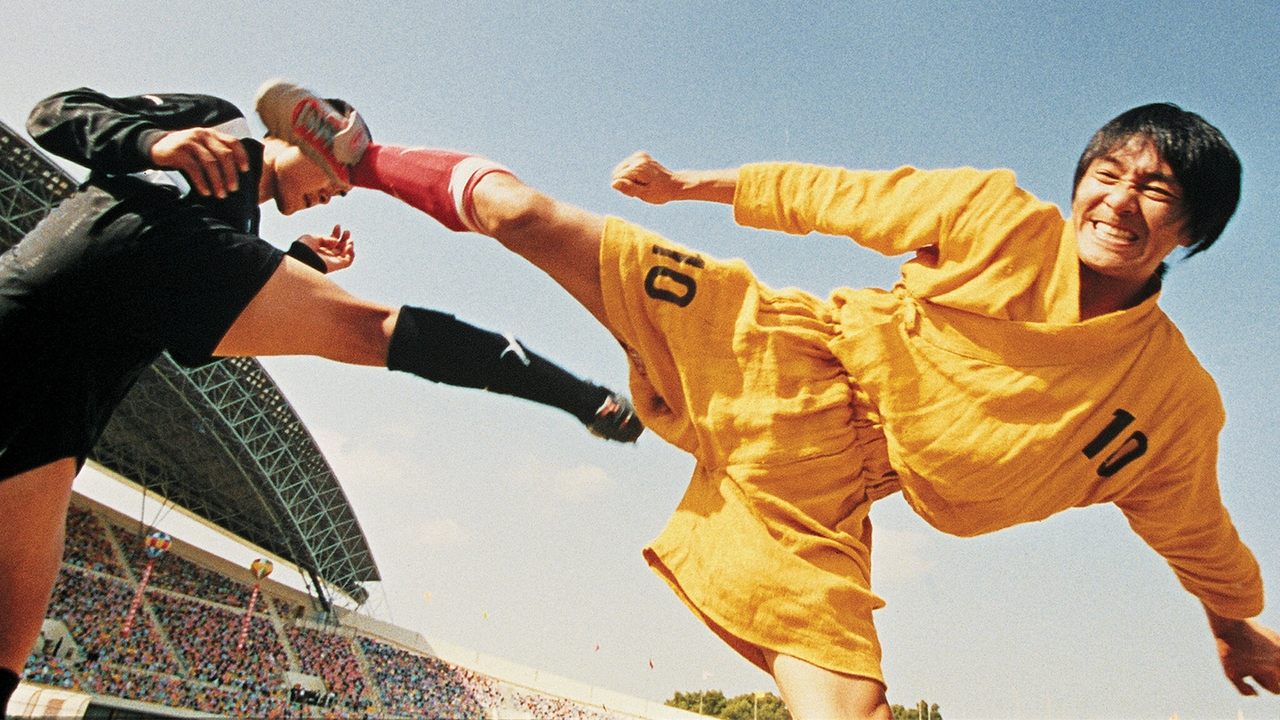
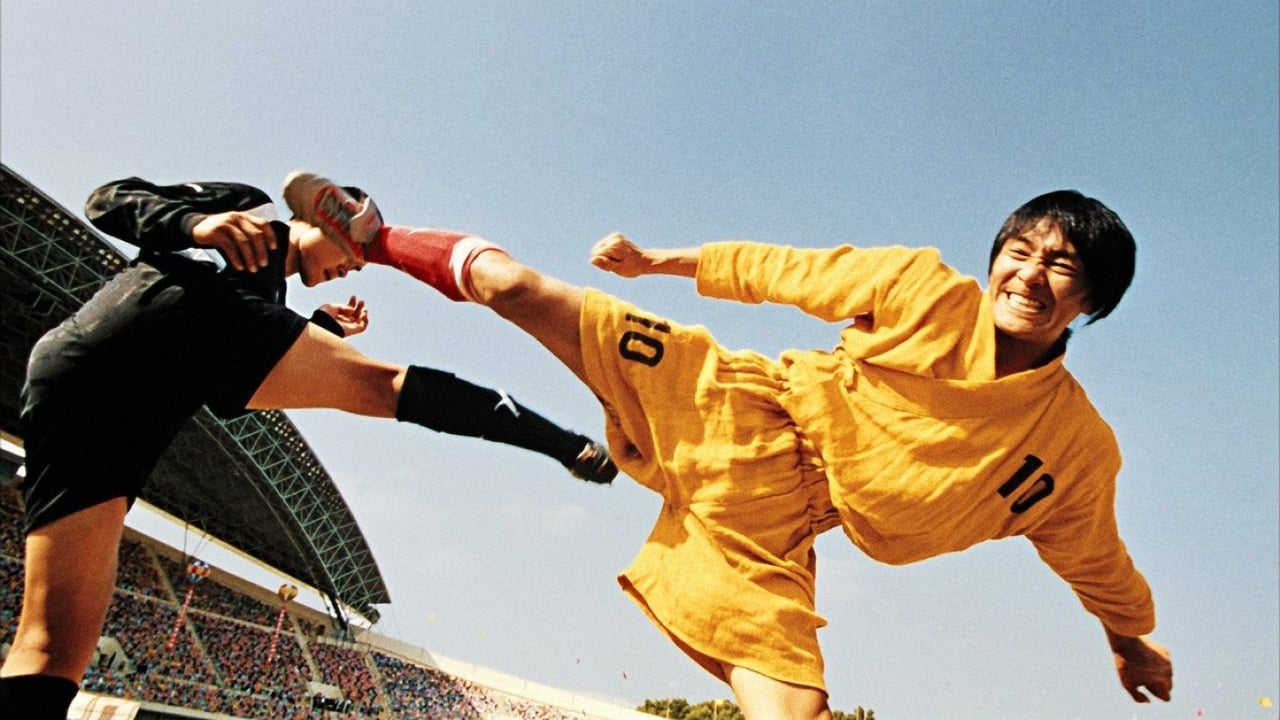
The action choreography is a masterclass in escalation. Each match gets progressively more insane, culminating in a finale against "Team Evil"—a squad literally injected with American "super-soldier" serum. The cinematography by Andy Kwong Ting-Wo captures the grit of the dusty practice fields before exploding into a kaleidoscopic mess of color and motion during the tournament. It was a bridge between the wire-fu of the 90s and the digital playgrounds of the future.
What often gets lost in the spectacle is the performance of Zhao Wei as Mui, the tai chi-practicing baker. Her character arc, involving self-esteem and a truly unfortunate makeover, provides the film’s emotional anchor. When she appears in the final match with a shaved head (which was actually a very obvious prosthetic that Chow mocked in the script), it’s both hilarious and weirdly heroic.
The "Miramax" Struggle and Cult Legacy
For those of us who lived through the DVD culture of the early 2000s, Shaolin Soccer was a legend before it was an official release. Miramax—and specifically Harvey Weinstein—bought the US rights and then sat on them for years, unsure of how to market a movie that didn't fit into a neat little box. They wanted to cut it down, dub it, and strip it of its cultural specificity. This back-and-forth meant that many fans’ first experience was through high-quality imports or "grey market" copies.
The film also serves as a poignant farewell to the legendary Richard Ng Man-Tat, who played the coach. His chemistry with Chow was the backbone of some of the greatest comedies in HK cinema history, and seeing him play the broken, hobbling mentor here adds a layer of genuine pathos.
One of the most enduring tributes in the film is Danny Chan (as "Empty Hand"), the goalie who looks, moves, and dresses exactly like Bruce Lee. In any other movie, this would be a cheap gag. In Shaolin Soccer, it’s a sincere homage. When he’s carried off the field on a stretcher while maintaining the iconic Bruce Lee pose, it’s a perfect encapsulation of the film: a love letter to the legends of the past, written in the neon ink of the future.
Ultimately, Shaolin Soccer works because it is fundamentally about the underdog. It’s a movie that argues that no matter how much the world beats you down—no matter if you’re a dishwasher, a clerk, or a "garbage man"—there is a hidden power within you waiting to be kicked into the back of a net. It is 113 minutes of pure, joyful adrenaline that reminds us why we go to the movies in the first place: to see the impossible look easy. Don't worry about the dated CGI; just let the "Iron Head" song get stuck in your brain and enjoy the ride.


Keep Exploring...
-

Kung Fu Hustle
2004
-

Taxi
1998
-
Lethal Weapon 4
1998
-

Three Kings
1999
-
Shanghai Noon
2000
-
Bad Boys II
2003
-

Sinbad: Legend of the Seven Seas
2003
-
The Rundown
2003
-
Tremors
1990
-
Hot Fuzz
2007
-
Machete
2010
-

Attack the Block
2011
-
The Family
2013
-
Last Action Hero
1993
-
Grosse Pointe Blank
1997
-
Rush Hour
1998
-
Who Am I?
1998
-
Taxi 2
2000
-
Jackass: The Movie
2002
-
Johnny English
2003