Bend It Like Beckham
"Tradition is about to get kicked."

I remember exactly where I was the first time I saw Bend It Like Beckham. It wasn't in a posh cinema; it was on a grainy VHS tape my cousin had recorded off the telly, watched while I was nursing a mild fever and eating a piece of toast that was definitely burnt on one side. Even through the haze of a cold, the energy of Gurinder Chadha’s London leaped off the screen. It felt like a secret I’d been let in on—a world of vibrant saris, frantic kitchen gossip, and the rhythmic thwack of a football hitting a garage door.

Looking back from the vantage point of two decades, it’s easy to forget how much of a seismic shift this film represented. In 2002, the "Indie Crossover" was the holy grail of filmmaking. We were moving away from the gritty, cynical 90s and into a new millennium that felt, for a brief moment, genuinely global. Bend It Like Beckham didn’t just participate in that shift; it sprinted past the defenders and scored the winning goal. It took the hyper-specific experience of a Punjabi girl in Hounslow and made it feel as universal as a David Beckham free kick.
The Magic of the Indie Hustle
What blows my mind every time I revisit this is the sheer economy of the production. Shot on a shoestring budget of roughly $3.5 million, this was a true passion project for Gurinder Chadha (who later gave us the charming Blinded by the Light). You can feel that "make it work" energy in every frame. The production couldn't afford a massive stadium of extras for the big finale, so they used clever angles and genuine atmosphere to sell the stakes.
There’s a legendary bit of trivia that always makes me chuckle: the US distributors actually wanted to change the title to Move It Like Mile because they didn't think American audiences knew who David Beckham was. Thank goodness Chadha stood her ground. That title is more than a name-drop; it’s a metaphor for navigating life. You can’t go straight through the obstacles; you have to curve your path around them.
The film’s success—raking in over $76 million—is the ultimate "underdog wins" story. It proved that you didn't need a CGI-heavy blockbuster budget to capture the world's imagination. You just needed a script that felt like a real conversation and a cast that looked like they were actually having the time of their lives.
A Masterful Balancing Act of Culture and Cleats

At its heart, this is a drama about the friction between who we are and who our parents want us to be. Parminder Nagra, who many of us would later come to love in ER, is nothing short of a revelation as Jess. She brings this quiet, simmering defiance to the role that never feels bratty. When she looks at that poster of Beckham on her wall, she’s not just a fan; she’s a disciple looking for a miracle.
But for me, the secret weapon of the film is Anupam Kher as Mr. Bhamra. While the "strict immigrant father" is a trope we’ve seen a thousand times, Kher (a titan of Indian cinema with hundreds of credits) gives the character such weary, protective depth. His monologue about his own experiences with racism on the cricket pitch in England is the emotional anchor of the movie. It explains his fear without making him a villain. I honestly think the romance with Joe is the least interesting part of the movie compared to the rich, complicated love Jess has for her father.
Then there’s Keira Knightley, in the role that effectively launched her into the stratosphere just before she boarded the Black Pearl in Pirates of the Caribbean. As Jules, she provides the perfect foil—another girl trapped by expectations, though hers are of the "traditional feminine" variety enforced by her hilariously fretful mother. The chemistry between Nagra and Knightley feels authentic; they’re two outsiders who find a home on the pitch.
The DVD Era and the "Beckham" Glow
Re-watching this today, it screams early 2000s in the best way possible. The fashion—those low-rise tracksuits and zig-zag headbands—is a total time capsule. It also reminds me of the golden age of DVD culture. I remember the special features on the disc being a goldmine, showing how the girls actually had to go through a rigorous three-month football boot camp to look like they knew what they were doing.

The film also captures a very specific pre-social media innocence. There are no smartphones, no viral clips; just a girl trying to get a scout to notice her in a park. It’s a drama that relies on physical presence and missed connections. The mid-2000s trend of "feel-good" multiculturalism sometimes felt forced, but here it feels earned because it doesn't shy away from the awkwardness or the genuine pain of cultural misunderstanding.
Even the soundtrack, a brilliant blend of bhangra beats and early-aughts pop, serves as a bridge between two worlds. It’s a film that invites you in, feeds you some Aloo Gobi, and then challenges you to keep up on a fast break. It’s colorful, it’s loud, and it’s unapologetically sincere.
Bend It Like Beckham is one of those rare films that manages to be a crowd-pleaser without losing its soul. It’s a snapshot of a turning point in cinema where independent voices were finally getting a seat at the table, and it remains a masterclass in how to tell a "small" story with huge heart. Whether you’re a football fan or someone who has just felt like a bit of an odd duck in your own family, this one still hits the top corner of the net. It’s a joyful, essential piece of the 2000s canon.

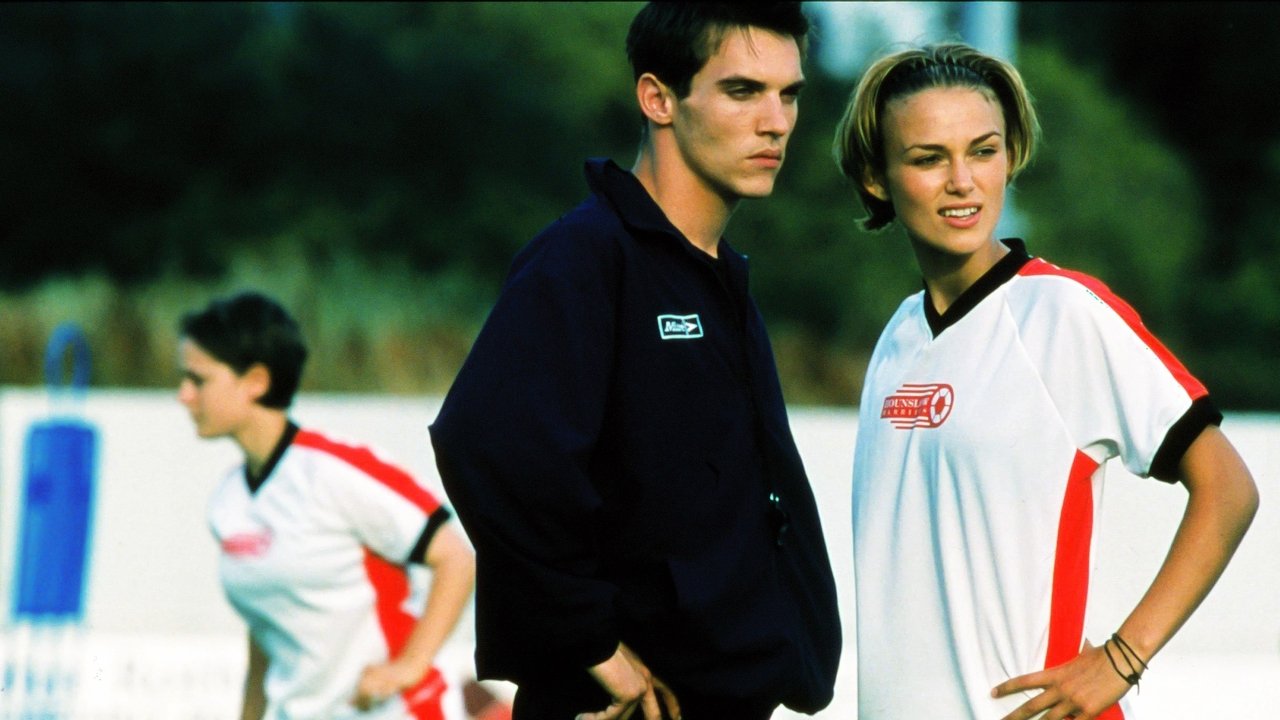
Keep Exploring...
-

Chasing Amy
1997
-
Buffalo '66
1998
-
Secretary
2002
-
Garden State
2004
-

High School Musical
2006
-

Beginners
2011
-

The First Time
2012
-

Don Jon
2013
-

The Spectacular Now
2013
-

A Good Year
2006
-
Imagine Me & You
2006
-
Sliding Doors
1998
-

Bridget Jones's Diary
2001
-

Love Actually
2003
-

Cashback
2007
-
Four Weddings and a Funeral
1994
-
Stepmom
1998
-
Blast from the Past
1999
-

Never Been Kissed
1999
-
Chocolat
2000