The Tuxedo
"Dress for the job you don't actually have."
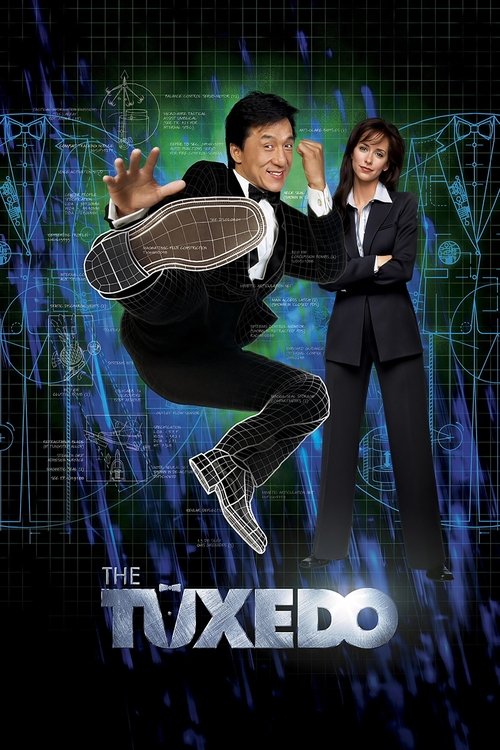
Imagine taking the world's most gifted physical comedian—a man who once slid down a skyscraper’s exterior without a harness—and telling him he’s not allowed to be good at fighting unless he’s wearing a magic set of penguin suits. That is the foundational irony of The Tuxedo, a 2002 relic that feels like a time capsule from the exact moment Hollywood decided that "high-concept" was a synonym for "heavyweight CGI."
I once watched this on a portable DVD player while waiting for a delayed flight in 2004, and the battery died exactly when James Brown made his cameo, leaving me in a state of spiritual limbo for three hours. Looking back, that feels like the correct way to experience this movie: in fits and starts, fueled by early-2000s electronics that were trying their best but weren't quite there yet.
A Masterpiece of "Why Not?" Logic
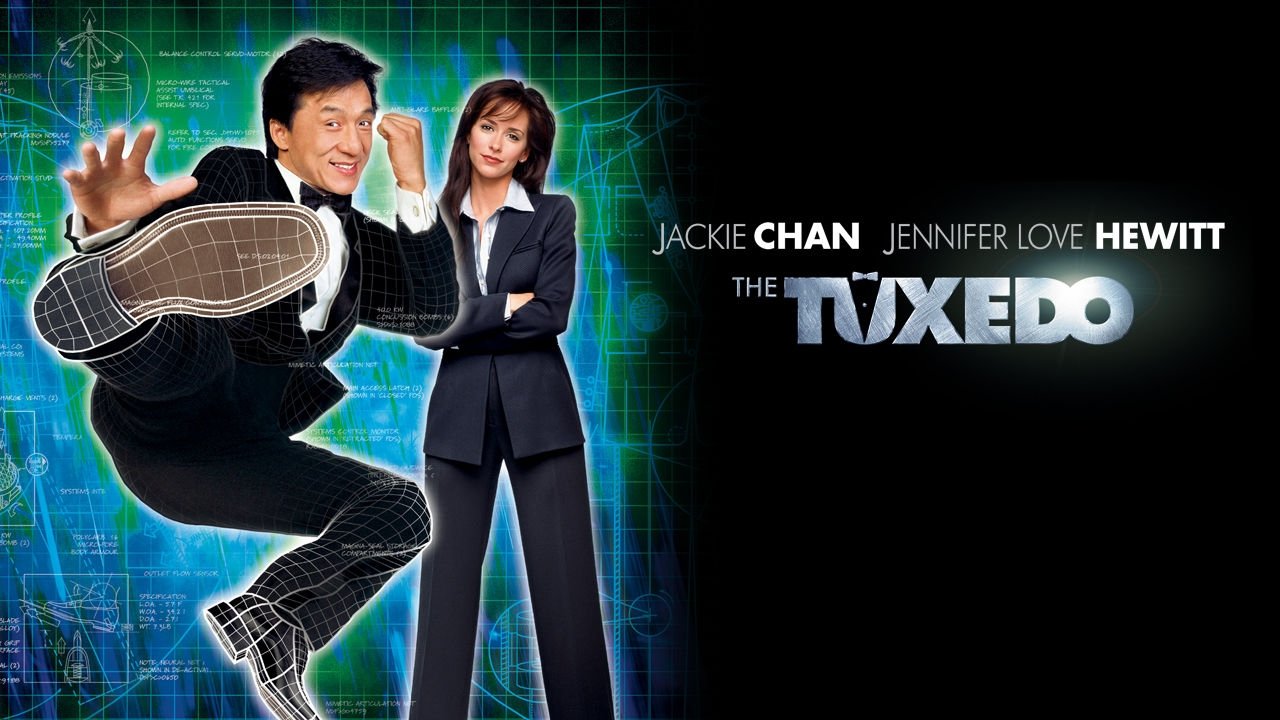
Jackie Chan plays Jimmy Tong, a taxi driver with a lead foot and a crush on an art gallery employee who clearly doesn't know he exists. Through a series of events that only happen in movies produced by John H. Williams (the guy who brought us Shrek), Jimmy becomes the chauffeur for Clark Devlin. Played by a pre-Lucius Malfoy Jason Isaacs (who seems to be having a blast playing a parody of James Bond), Devlin is a super-spy with a secret: he’s only a legend because of his $2 million tuxedo.
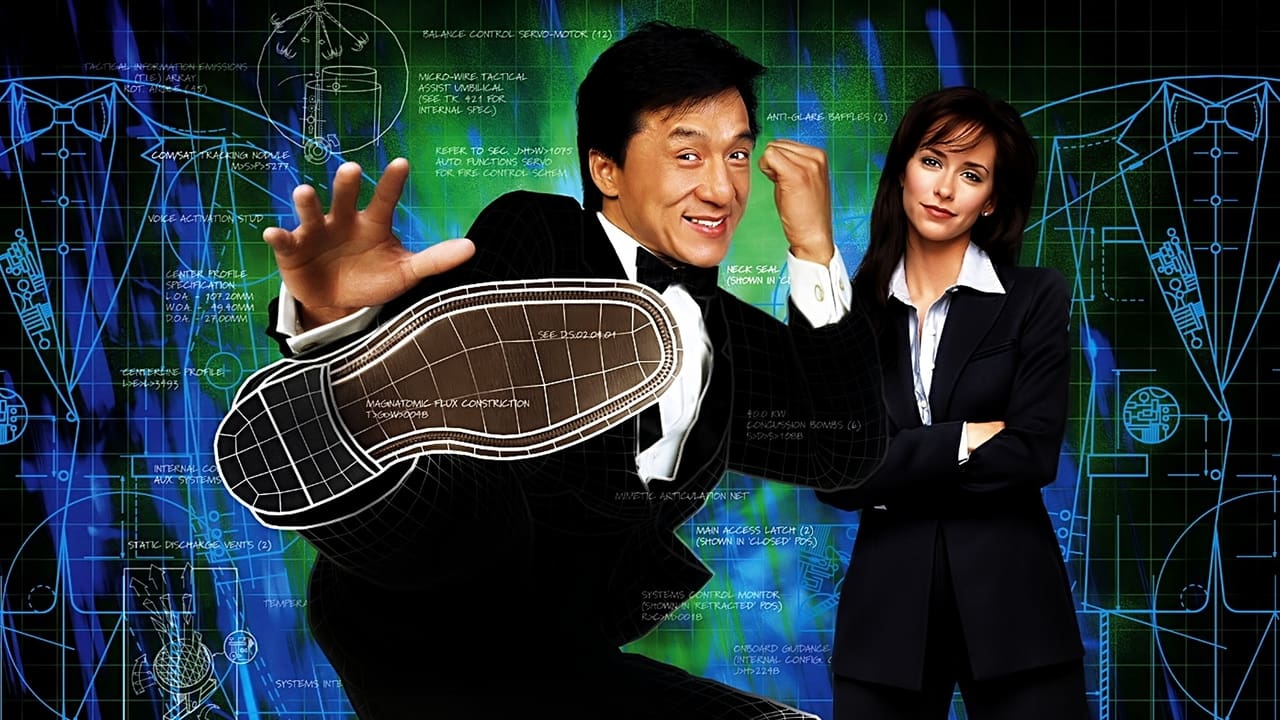
When Devlin is sidelined by a skateboard bomb (classic 2002), Jimmy puts on the suit and suddenly finds himself capable of wall-running, breakdancing, and martial arts mastery. This is where the film hits its biggest snag for purists: watching Jackie Chan use CGI to move is like watching a master chef use a microwave. We go to a Jackie Chan movie to see the impossible done for real. Here, director Kevin Donovan asks us to marvel at "The suit" doing the work, which effectively nerfs the very thing that made Chan a global icon.
Gadgets, Gags, and Green Screens
The film thrives, however, in its sheer commitment to being a "Modern Cinema" transition piece. It was filmed during that awkward puberty for digital effects, where CGI was becoming affordable enough to use for punchlines but still looked a bit like a PlayStation 2 cutscene. Yet, there’s a charm to the gadgets. This was the era of Spy Kids and The Matrix, where tech anxiety was being replaced by tech-fetishism. The tuxedo itself is a Swiss Army Knife of silk, and the way Jimmy struggles to control its different "modes" (from "Mambo" to "Combat") allows Chan to do what he does best: reactive, panicky physical comedy.
He’s paired with Jennifer Love Hewitt as Del Blaine, a rookie agent who thinks Jimmy is the real Devlin. Coming off her slasher-fame in I Know What You Did Last Summer, Hewitt plays the "straight man" with a high-strung energy that frequently borders on the cartoonish. Her chemistry with Chan is less "romantic spark" and more "two people trying to finish a frantic escape room together," which actually works for the movie’s lighthearted tone. They spend a lot of time chasing down Dietrich Banning (Ritchie Coster), a villain whose plan involves poisoning the world’s water supply with a bacteria that makes people thirsty to death. It’s the kind of plot that Peter Stormare (the eccentric Dr. Simms here) usually shows up in to explain with a weird accent, and he does not disappoint.
The Suit's Secret History
What's fascinating about The Tuxedo is the production chaos that mirrors the film's frenetic energy. Apparently, the original script was much darker and more of a "serious" spy thriller, but once Jackie Chan was cast, the studio leaned hard into the comedy. Chan was initially hesitant about the suit concept—he felt it was "cheating" to have a suit do the stunts. To compromise, the production still allowed him to choreograph some of the brawls, even if the final edit smothered them in wire-work and digital touch-ups.
The James Brown cameo remains one of the greatest "how did they get him?" moments of the decade. Turns out, the Godfather of Soul was a massive fan of Chan's earlier Hong Kong work, like Drunken Master, and agreed to the scene just to meet him. It’s an infectious bit of fun that keeps the movie from feeling like a purely corporate product. Despite being a box office "meh" at the time, it found a second life on DVD. This was the era where "Special Features" were king, and I remember the "deconstructed stunts" featurette being arguably more entertaining than the movie itself, showing the sheer amount of work Jennifer Love Hewitt put into her own wire-stunts just to keep up with her co-star.
Ultimately, The Tuxedo is the cinematic equivalent of a sugar-rush headache. It’s loud, brightly colored, and makes very little sense if you think about it for more than three seconds. But in an age where action movies are often dour, three-hour epics about the weight of the world, there’s something genuinely refreshing about a 98-minute romp where the biggest problem is a cab driver not knowing how to use his pants.
The Tuxedo isn't the best entry in Jackie Chan’s Hollywood filmography—that honor stays with Rush Hour—but it’s a fascinating look at the industry's early obsession with digital assistance. It captures a specific Y2K-adjacent optimism where technology was supposed to make us all superheroes, provided we could afford the dry cleaning. It’s a breezy, silly weekend watch that reminds us of a time when movie villains were just guys who hated water and movie stars were willing to look ridiculous for a laugh.
Keep Exploring...
-
Lake Placid
1999
-
The Brothers Grimm
2005
-
Lethal Weapon 4
1998
-
Shanghai Noon
2000
-

Rush Hour 3
2007
-
The Medallion
2003
-
Shanghai Knights
2003
-
Around the World in 80 Days
2004
-
Get Smart
2008
-
Killers
2010
-
RED 2
2013
-

Mystery Men
1999
-
Osmosis Jones
2001
-
Men in Black II
2002
-
Bad Boys II
2003
-
The Rundown
2003
-
Mr. & Mrs. Smith
2005
-
Journey to the Center of the Earth
2008
-
Godzilla
1998
-
Hollow Man
2000