Body of Lies
"The war on terror is a shell game."
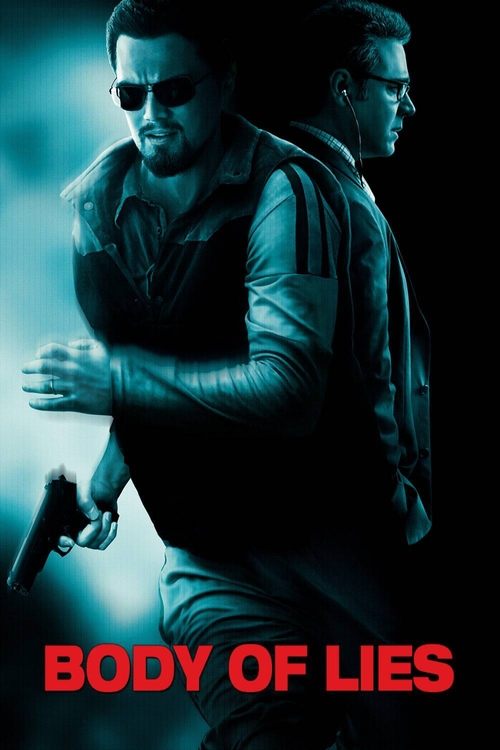
There is a specific kind of irritation that arises from watching Russell Crowe eat a bowl of breakfast cereal while casually negotiating a kidnapping over a Bluetooth headset. As Ed Hoffman, a high-level CIA strategist who manages global crises from his suburban driveway, Crowe embodies the ultimate "boss from hell" for the 21st century. While he’s dropping his kids off at soccer practice, his boots-on-the-ground operative, Roger Ferris (played with a desperate, sweaty intensity by Leonardo DiCaprio), is literally being hunted through the dusty back alleys of Amman.
I watched this film again last Tuesday while nursing a lukewarm cup of peppermint tea that I’d forgotten to steep, and that sense of cold, detached management clashing with hot, chaotic reality still feels remarkably sharp. Released in 2008, Body of Lies arrived at the tail end of a massive wave of post-9/11 thrillers like Syriana (2005) and The Kingdom (2007). It’s a film that captures a very specific "Modern Cinema" anxiety: the transition from old-school spycraft to the era of total satellite surveillance.
The Eye in the Sky and the Dirt on the Ground
Ridley Scott (the man behind Gladiator and Black Hawk Down) has always been a master of "The Look." In Body of Lies, that look is defined by the high-altitude perspective. We spend a lot of time staring at grainy, black-and-white satellite feeds that track DiCaprio like an ant in a maze. It’s a chilling visual metaphor for how the West tried to fight a digital war against an analog enemy.
The action isn't the "superhero" variety we’ve become accustomed to in the MCU era. It’s jagged, messy, and loud. When a safe house explodes or a car chase breaks out, the camera doesn’t glide; it stutters. Scott and cinematographer Alexander Witt (who worked on Spectre) use long lenses to make the audience feel like they are also spying on the characters. It gives the film a voyeuristic energy that keeps you leaning in. The interrogation scene involving a hammer is particularly grim—I actually dropped a piece of buttered toast face-down during that sequence and was too stressed to pick it up for a full ten minutes.
A Masterclass in Mid-Atlantic Cool
While DiCaprio does his usual "highly capable man having a nervous breakdown" thing exceptionally well, the movie is completely hijacked by Mark Strong. Playing Hani Salaam, the head of Jordanian intelligence, Strong is the antithesis of Crowe’s schlubby, polo-shirt-wearing American bureaucrat. Hani is impeccably tailored, soft-spoken, and terrifyingly principled. Mark Strong’s Hani Salaam is arguably the most stylish character in 21st-century cinema, and his "never lie to me" rule provides the film’s moral backbone.
Interestingly, Strong wasn't the first choice; the role was reportedly offered to other actors before he stepped in and created one of the most memorable supporting turns of the decade. His chemistry with DiCaprio is far more interesting than the film’s actual romantic subplot with Golshifteh Farahani. Whenever Hani is on screen, the movie elevates from a standard thriller to a sophisticated chess match. It’s also fun to spot a young Oscar Isaac as Ferris’s ill-fated associate, Bassam, long before he was flying X-Wings or wandering through Marvel deserts.
The Cult of the "Dad Movie"
In the years since its release, Body of Lies hasn't quite achieved the "legend" status of Blade Runner, but it has become a staple of what I call the "Dad Movie" canon. It’s the kind of film that, if you catch it on a streaming service or a cable rerun on a Sunday afternoon, you are legally obligated to watch until the end. Its "cult" status comes from people who appreciate the craft of a mid-budget adult thriller—a genre that Hollywood has sadly largely abandoned in favor of $200 million spectacles.

The production trivia is pure Ridley Scott efficiency. Russell Crowe reportedly gained 63 pounds to play Hoffman, wanting him to look like a man who has completely let himself go physically while staying sharp mentally. DiCaprio, ever the perfectionist, wore brown contact lenses and dyed his hair to better blend into the Middle Eastern locales. And for the trivia buffs: the "satellites" you see in the film weren't actually CGI—well, the feeds were, but the overhead shots were often achieved using high-altitude helicopters and clever editing to mimic that "God’s eye view" that defined the Bush-era military aesthetic.
What keeps Body of Lies relevant is its cynical, weary heart. It’s a movie about how "trust" is a luxury that people in power can’t afford, and people on the ground can’t survive without. Russell Crowe’s Ed Hoffman is basically every middle manager I’ve ever hated, and seeing his detached arrogance run up against the harsh reality of the desert is still incredibly satisfying.
Body of Lies is a rock-solid piece of professional filmmaking. It doesn't reinvent the wheel, but it balances its high-tech gizmos with genuine human tension and a world-class supporting cast. It’s a relic of a time when we went to the movies to see movie stars deal with complicated, real-world problems. If you haven't seen it since 2008, it’s time for a re-evaluation; it has aged much better than the technology it depicts.


Keep Exploring...
-

Kingdom of Heaven
2005
-
Blood Diamond
2006
-
Exodus: Gods and Kings
2014
-
Robin Hood
2010
-

Children of Men
2006
-

Matchstick Men
2003
-
Man on Fire
2004
-

Munich
2005
-

Poseidon
2006
-

The Fast and the Furious: Tokyo Drift
2006
-

American Gangster
2007
-
Shooter
2007
-

Green Zone
2010
-

Elysium
2013
-
Gangster Squad
2013
-

White House Down
2013
-

Cellular
2004
-
Faster
2010
-

Colombiana
2011
-
Contraband
2012