Man on Wire
"High-altitude heist. No safety net. Absolute madness."
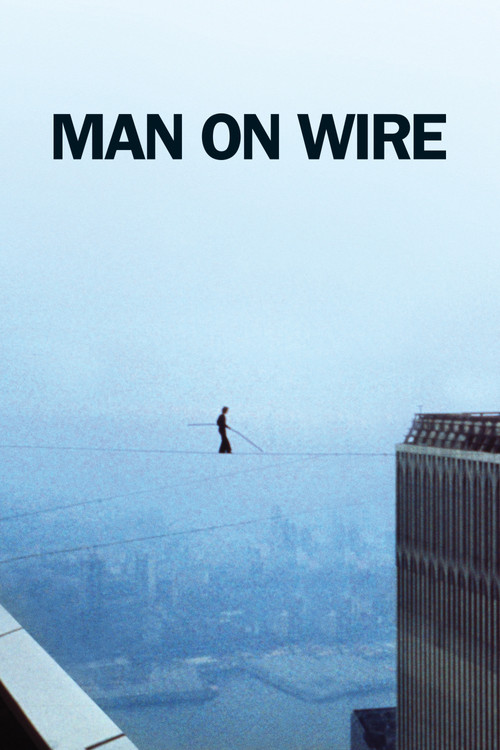
Standing on the edge of a rooftop 110 stories up isn't just a fear of heights; it’s a confrontation with the void. In 1974, Philippe Petit didn't just look into that void—he danced across it on a steel cable thinner than a thumb. I remember watching Man on Wire for the first time on a scratched DVD I’d rented from a dying Blockbuster, and even on a chunky CRT television, my palms were sweating so much I nearly dropped my glass of lukewarm ginger ale. I watched it again recently while my neighbor was power-washing their driveway—the relentless, distant drone of the machine weirdly heightened the humming tension of the high-wire scenes.
The Greatest Heist You've Never Seen
Directed by James Marsh (who later gave us The Theory of Everything), this isn't your standard talking-head documentary. It plays like a classic 70s caper. We’re talking fake IDs, disguises, sneaking tons of equipment past security, and hiding under tarps for hours while guards patrol nearby. Philippe Petit and his ragtag group of co-conspirators—including the stoic Jean-Louis Blondeau—weren’t trying to rob a vault; they were trying to break into the sky.
The film perfectly captures that "indie doc" energy of the late 2000s, where directors began blending traditional interviews with highly stylized reenactments. These scripted moments are shot with a grainy, 16mm texture that makes them feel like lost footage rather than modern reconstructions. It’s a testament to the cinematography of Igor Martinović that you often forget you’re looking at actors playing out a memory. The pacing is relentless. By the time they actually get the wire across the gap between the North and South towers, you’re as exhausted as the crew was after their sleepless night of illegal rigging.
A Protagonist Who Defies Gravity (And Logic)
Let’s be honest: Philippe Petit is a lot. He’s theatrical, obsessive, and probably a complete nightmare to have a casual dinner with. But as a cinematic subject, he is gold. He speaks about his "crime" with the intensity of a general and the whimsy of a poet. Watching him describe the moment he stepped onto the wire is like watching a man recount a religious experience. The documentary doesn't shy away from the friction he caused; his obsession eventually frayed his relationships with the very people who helped him achieve the impossible.
The supporting cast of real-life friends, like Jean François Heckel and Annie Allix, add a necessary layer of human cost. You see the toll the "coup" took on them. They were young, French, and doing something profoundly illegal in a foreign city. The film manages to make a 34-year-old event feel like it’s happening in real-time. I honestly think Petit would have walked across a wire made of dental floss if it meant getting the view he wanted.
The Ghost in the Room
There is an elephant in the room that James Marsh brilliantly refuses to acknowledge directly: the towers themselves. Released in 2008, the film is deeply rooted in a post-9/11 world, yet it never mentions the destruction of the World Trade Center. By focusing entirely on the 1974 "artistic crime," the film restores a sense of wonder to those buildings. It’s a deliberate choice that makes the ending feel incredibly bittersweet.
Looking back at this film from the perspective of our current era—where every documentary feels like it needs to be an eight-part "true crime" slog—the lean, 94-minute runtime of Man on Wire is a godsend. It’s a masterfully edited piece of storytelling that understands when to let the music (including some fantastic work by Michael Nyman) do the heavy lifting. The DVD era thrived on these kinds of "sleeper hits" that traveled by word-of-mouth, and this one earned every bit of its Oscar win.
This is a rare bird: a documentary that functions as a thriller, a character study, and a historical time capsule all at once. It reminds me why I fell in love with non-fiction cinema in the first place. You don't need a $200 million CGI budget to create genuine awe; you just need a Frenchman with a dream, a very long cable, and the sheer audacity to walk where no one was ever meant to go. If you haven't seen it, find the biggest screen you can, sit close, and try to remember to breathe.
Keep Exploring...
-

Grizzly Man
2005
-

Exit Through the Gift Shop
2010
-

Inside Job
2010
-
Blackfish
2013
-

One Direction: This Is Us
2013
-
Jackass Number Two
2006
-

Senna
2010
-

Citizenfour
2014
-

Fahrenheit 9/11
2004
-

Super Size Me
2004
-
An Inconvenient Truth
2006
-
This Is It
2009
-

The Theory of Everything
2014
-

March of the Penguins
2005
-

Waltz with Bashir
2008
-
Jackass 3D
2010
-

Searching for Sugar Man
2012
-

11:14
2003
-
Holes
2003
-
Matchstick Men
2003