Exam
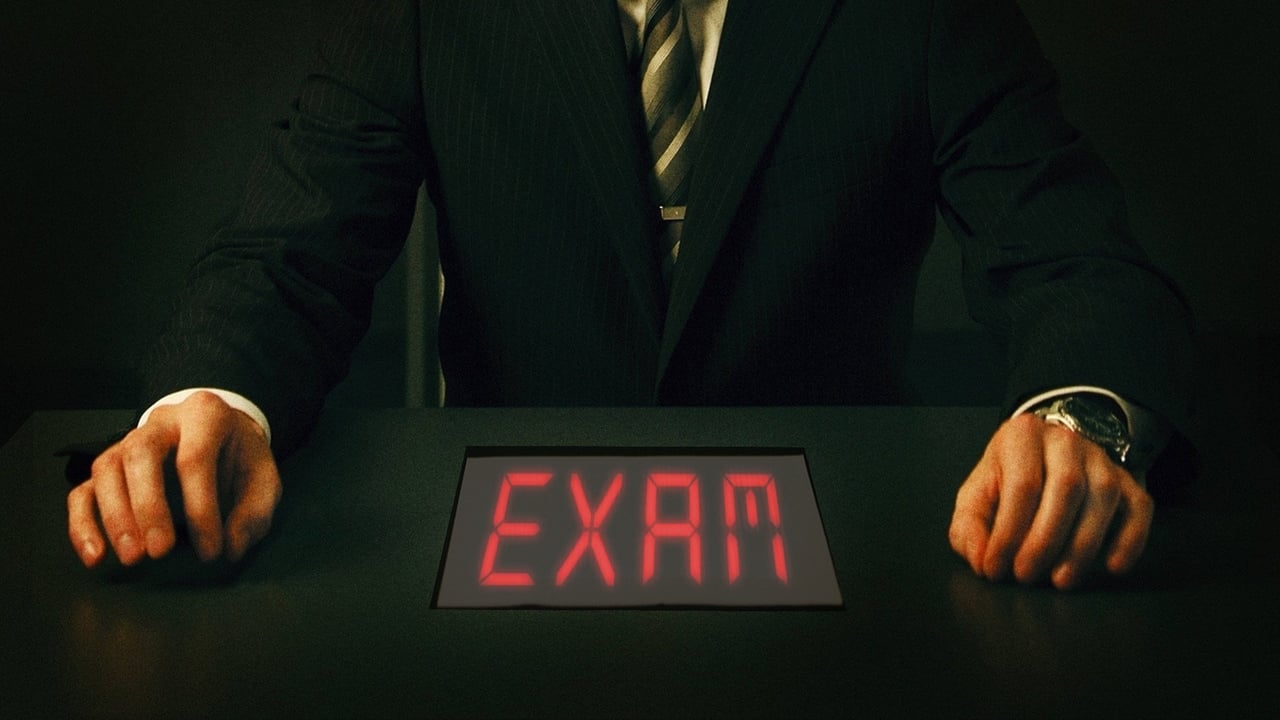
"Eight candidates. One room. No question."
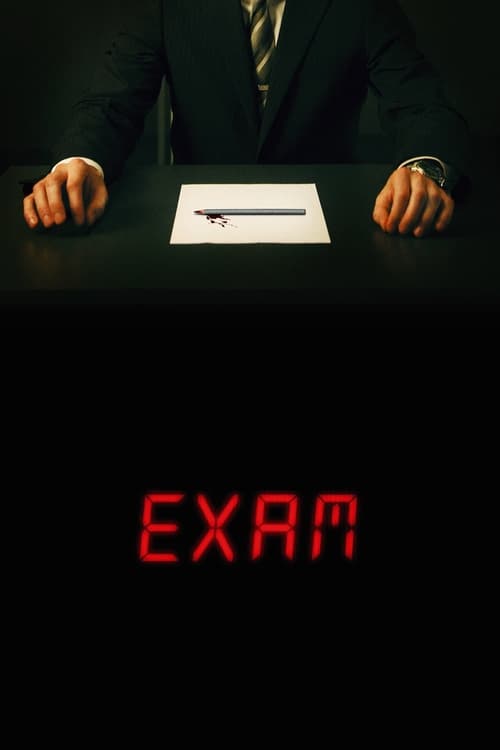
Imagine the most grueling job interview you’ve ever endured—the kind where your palms are sweating, your tie feels like a noose, and the HR manager is staring at you like you’re a bug under a microscope. Now, take that anxiety, lock it in a windowless concrete bunker, and add an armed guard with a hair-trigger temper. That is the opening gambit of Exam, a 2009 British thriller that managed to do more with a single room and eight chairs than most blockbusters do with a hundred million dollars and a green screen.
I first stumbled upon this flick during a particularly humid Tuesday evening when my air conditioner was making a noise like a dying blender, and honestly, the sweltering atmosphere of my apartment only made the movie’s claustrophobia feel more authentic. It’s a quintessential "bottle film," a subgenre that flourished in the late 2000s as indie filmmakers realized they didn't need a sprawling set if they had a killer hook.
The Ultimate Corporate Hunger Games
The premise is deceptively simple: eight candidates have reached the final stage of selection for a mysterious, high-powered corporation. They are given 80 minutes to answer one question. The catch? The paper in front of them is blank. The rules are strict: don’t talk to the guard, don’t spoil your paper, and don’t leave the room. If you do, you’re disqualified.
Director Stuart Hazeldine (who also penned the script) taps into a very specific post-2008 financial crisis anxiety here. In 2009, the world felt like it was shrinking, jobs were scarce, and the idea of "doing whatever it takes" to land a position wasn't just a tagline—it was a survival strategy. The characters aren't given names, only nicknames based on their appearance: White, Black, Brown, Blonde, Brunette, and so on. It’s a clever bit of dehumanization that mirrors the corporate machine they’re trying to join.
Luke Mably, playing "White," is absolutely magnetic as the arrogant alpha who immediately tries to hijack the room. He’s the guy we’ve all worked with—the one who thinks being the loudest person in the room is the same thing as being the smartest. Opposite him, Chukwudi Iwuji (who many will now recognize from Guardians of the Galaxy Vol. 3) provides a much-needed moral anchor as "Black." The chemistry between this ensemble is what keeps the engine humming; since they can't leave the room, the "action" is entirely psychological.
Minimalist Muscle and Indie Ingenuity
Looking back at this era of cinema, Exam represents a fascinating bridge. We were transitioning out of the gritty, handheld "shaky-cam" obsession of the mid-2000s and into a more sterile, digital aesthetic. Shot on a tiny budget of roughly $600,000, the film is a masterclass in making a lack of resources look like a deliberate stylistic choice. Tim Wooster’s cinematography turns a bland gray room into a shifting landscape of shadows and cold light.
There’s a certain "DVD-era" charm to the production. You can almost feel the filmmakers thinking about the special features while they shot it. It turns out the entire film was shot in just 20 days, and the cast actually stayed in the room for long stretches to maintain that sense of cabin fever. It’s effectively the best movie ever made about a literal piece of paper. While other films of the time were leaning heavily into early, often clunky CGI, Exam stays grounded in practical tension. It’s a reminder that human desperation is a better special effect than anything rendered on a hard drive.
The script is a clockwork mechanism. Every time you think the characters have figured out the "trick," Stuart Hazeldine pulls the rug out. It flirts with the "torture porn" tropes that were popular in the wake of Saw, but it’s far more interested in the cruelty of the human ego than the cruelty of a physical trap. It asks a pointed question: how quickly will civilized professionals turn into animals when the door is locked?

The "Gotcha" Moment
As with any high-concept mystery, the ending is the make-or-break moment. Without spoiling the reveal, I’ll say that it’s the kind of "Aha!" moment that will either make you clap or want to throw a shoe at the screen. It’s incredibly clever, perhaps a bit too clever for its own good, but it fits the film’s internal logic perfectly.
What really lingers isn't the solution to the puzzle, but the character breakdowns along the way. Adar Beck and Nathalie Cox turn in nuanced performances that prevent their characters from becoming mere archetypes. You start to realize that the "exam" isn't about intelligence at all; it’s a stress test for empathy. In the hyper-competitive landscape of the late 2000s, that felt like a radical statement.
If you’re looking for a tight, 97-minute exercise in tension that respects your intelligence, Exam is a top-tier choice. It’s a relic of a time when a simple, high-concept idea could carry a whole film without needing a franchise tie-in or a post-credits scene. It’s smart, mean, and wonderfully paced. Just don’t be surprised if you find yourself double-checking your own pens and paper the next time you sit down for a meeting.
Keep Exploring...
-
The Awakening
2011
-
Shutter
2004
-
After.Life
2009
-

The Girl Who Kicked the Hornet's Nest
2009
-
The Girl Who Played with Fire
2009
-
Buried
2010
-

Sinister
2012
-
You're Next
2013
-
Marshland
2014
-
Cube
1998
-
Pi
1998
-
The Crimson Rivers
2000
-

High Tension
2003
-
Tinker Tailor Soldier Spy
2011
-

Trance
2013
-
Before I Go to Sleep
2014
-

The Guest
2014
-

Locke
2014
-
Cube Zero
2004
-
The Secret in Their Eyes
2009