Robin Hood
"Before the legend, before the tights, there was mud."
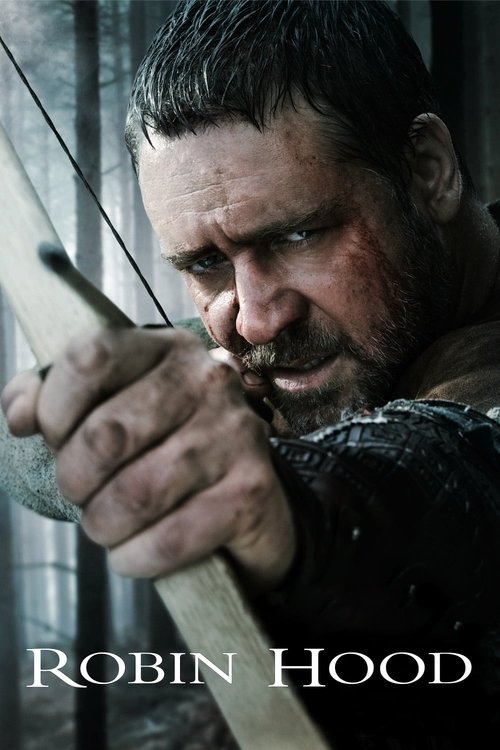
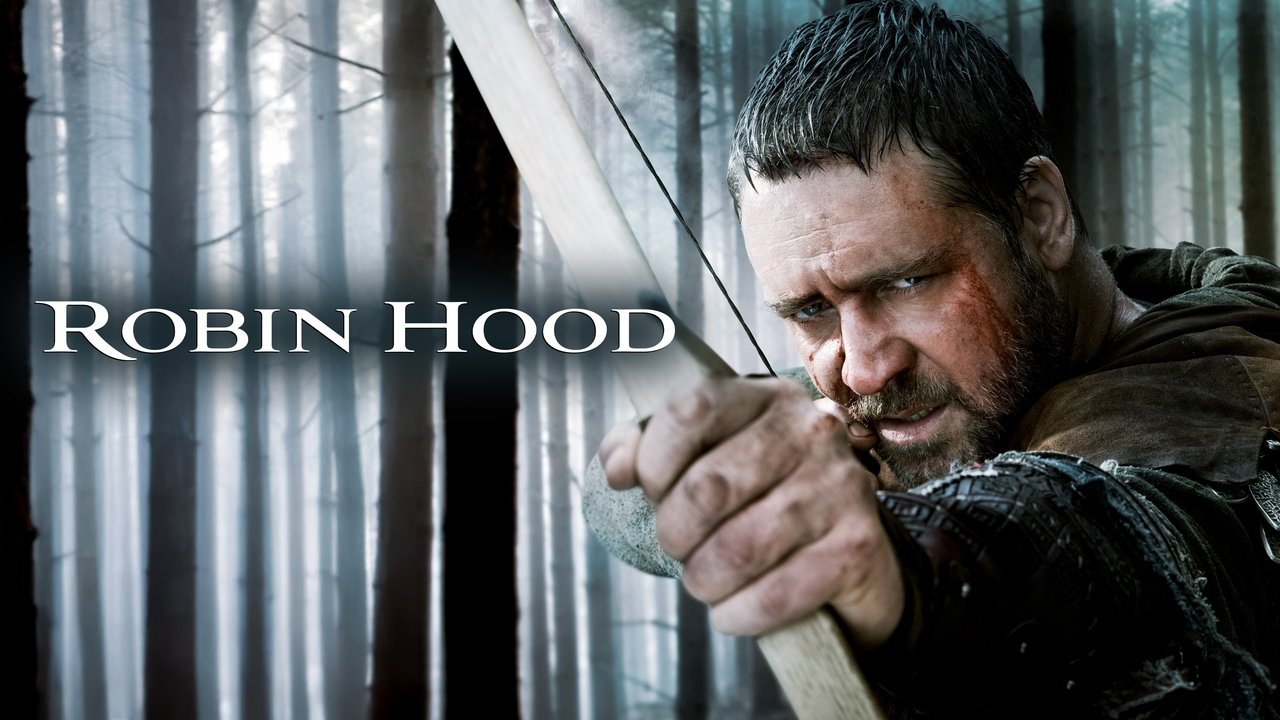
In the spring of 2010, the "gritty reboot" was the undisputed king of Hollywood. We were deep in the shadow of the Dark Knight effect, where every colorful folk hero had to be dragged through a puddle of grey slush and given a tragic, politically-dense backstory. So, when it was announced that Ridley Scott and Russell Crowe were re-teaming for Robin Hood, the collective expectation was basically Gladiator with longbows. I watched this again recently on a rainy Tuesday night while eating a bowl of cereal that had gone slightly soggy, and honestly, the dampness of the flakes perfectly matched the atmospheric dampness of 13th-century England on screen.

The Prequel We Didn’t Know We Wanted
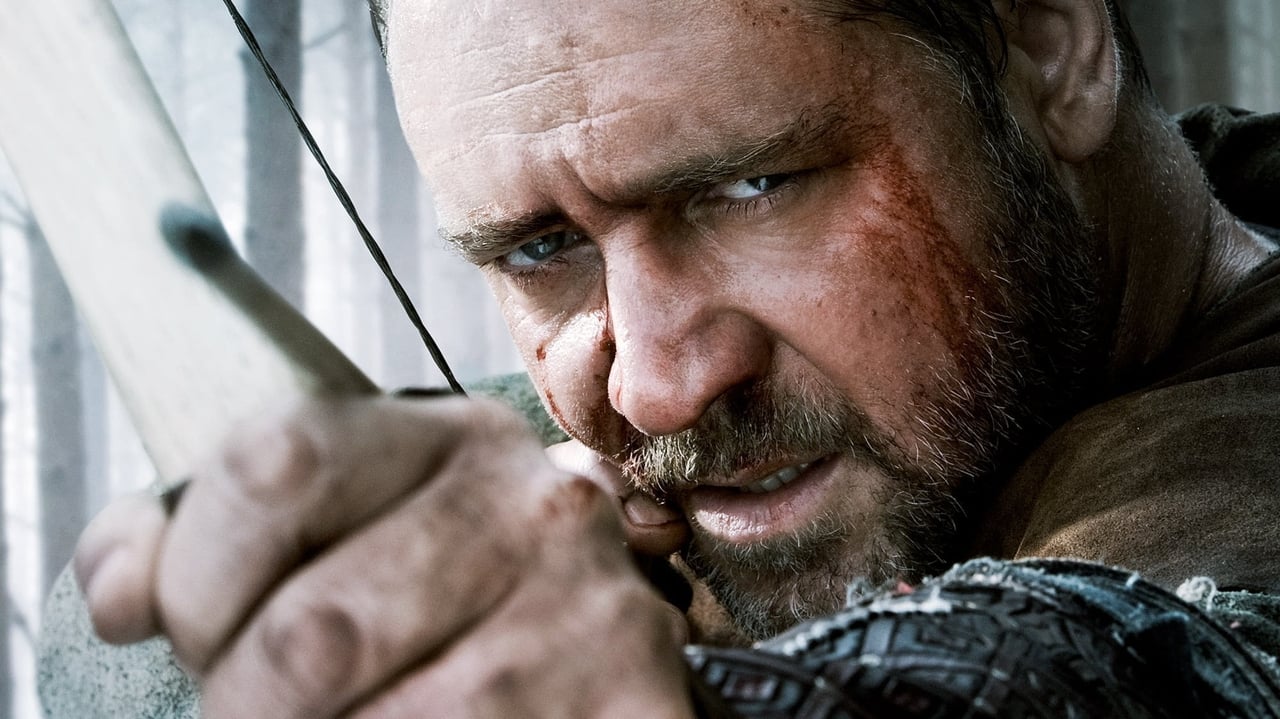
What’s fascinating about looking back at this film is realizing it’s not actually a "Robin Hood" movie in the traditional sense. It’s a "Robin Hood Begins" that stops right when the story we actually like—the robbing from the rich and giving to the poor—is supposed to start. Instead of a merry man in Lincoln green, we get Robin Longstride (Russell Crowe), a weary common soldier in King Richard’s army who just wants to get home.
The film has a weirdly complicated relationship with its own identity. It started life as a script called Nottingham, which featured a CSI-style Sheriff of Nottingham investigating a string of murders committed by a much more villainous Robin Hood. By the time it hit production, it had mutated into a historical epic about the birth of the Magna Carta. I’ll be honest: it’s essentially a legislative procedural disguised as a medieval war movie. There are more scenes of men discussing tax policy and land deeds than there are of people hiding in trees. Yet, there’s something oddly admirable about the scale of it. In an era before every blockbuster was a green-screen soup, Ridley Scott was still building massive, tactile sets that look like you could catch tetanus just by touching the screen.
D-Day in the 13th Century
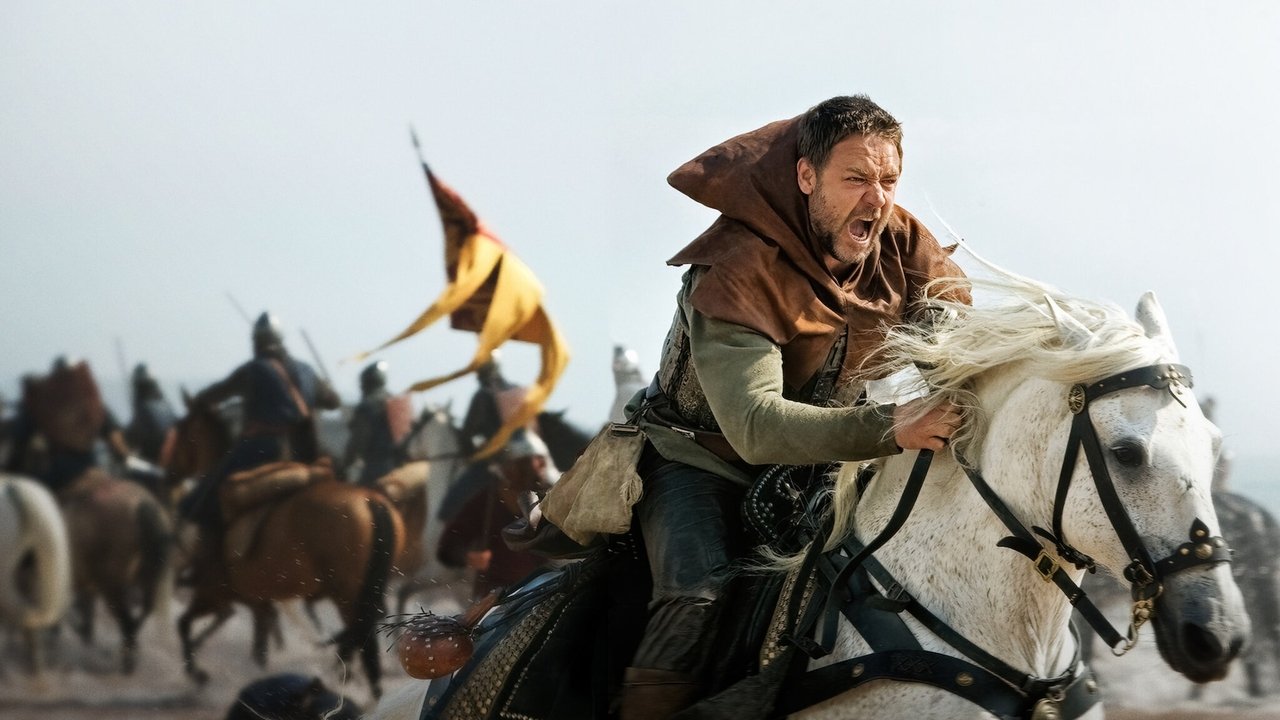
If there’s one thing Ridley Scott knows how to do, it’s stage a sequence that feels expensive. The action in Robin Hood is heavy, loud, and physically exhausting. The centerpiece is the French invasion of the English coast, which looks so much like the opening of Saving Private Ryan (1998) that you keep expecting Russell Crowe to look for Private Ryan in a thatched hut. We see flat-bottomed boats dropping ramps for horses to charge out into the surf, while arrows rain down with a terrifying, thwipping sound design that makes your ears ring.
The stunt work here is top-tier. There’s a scene where Mark Strong (playing the treacherous Godfrey) takes an arrow to the face, and the practical execution of the chaos feels far more grounded than the hyper-kinetic CGI battles we’d see just a few years later in the Hobbit trilogy. There’s a weight to the horses, a clatter to the armor, and a genuine sense of danger in the choreography. Russell Crowe, despite being a bit too old for an "origin story" role, brings a brutish physicality to the fights. He looks less like a nimble archer and more like a man who would rather beat you to death with the bow than shoot it.
A King Among Thieves
While the plot gets bogged down in the weeds of English succession, the cast keeps the engine humming. Cate Blanchett is predictably excellent as a tough-as-nails Marion Loxley, who spends more time managing a farm and fighting off starvation than she does being a damsel. But the real MVP—and the person I completely forgot was in this movie—is Oscar Isaac as Prince John.
Looking back from the era of the MCU and Star Wars, seeing a young Oscar Isaac absolutely chew the scenery as a petulant, vain, and strangely charismatic villain is a treat. He brings a weird, slinky energy to the role that balances out Crowe’s ultra-stoic performance. On the other end of the spectrum, you have legends like Max von Sydow and William Hurt lending a gravitas that the script perhaps doesn’t entirely earn. They treat every line about grain storage like it’s Shakespeare, and I love them for it.
Stuff You Might Not Have Noticed
The production of this film was notoriously chaotic, and the trivia reflects a movie that was being rewritten as the cameras rolled. For instance, did you know that at one point Russell Crowe was considered to play both Robin Hood and the Sheriff of Nottingham? They eventually scrapped that idea, but you can still feel the remnants of a more complex movie buried under the mud.
There was also the famous "accent-gate." During an interview with the BBC, Crowe famously walked out after the interviewer suggested his accent sounded a bit Irish. Looking back, he’s definitely doing a sort of "Northern England by way of everywhere" growl, but in the grand tradition of Kevin Costner’s Prince of Thieves, it’s a miracle he even tried one. Also, keep an eye out for a young Léa Seydoux as Isabella of Angoulême—it’s wild to see how many future stars were packed into the French royal court scenes.
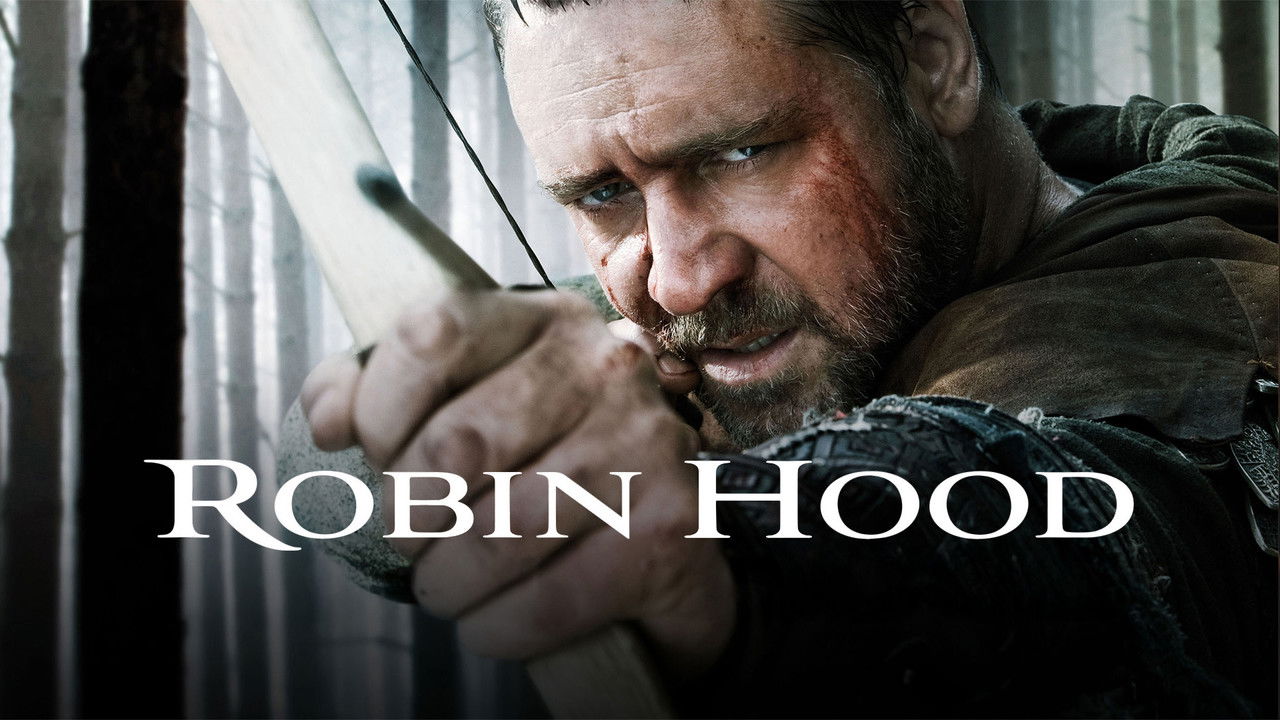
Ultimately, Robin Hood is a handsomely mounted, well-acted historical epic that suffers from a bit of an identity crisis. It wants to be Gladiator, it wants to be a history lesson, and it occasionally remembers it’s supposed to be a legend. It’s a relic of that specific 2010 window where we thought every hero needed to be "realistic" to be interesting. It’s not the most fun you’ll ever have with a bow and arrow, but for the production design and Oscar Isaac’s sneering alone, it’s worth a retrospective look. It’s the cinematic equivalent of a heavy wool blanket: a bit scratchy, a little too heavy, but it definitely keeps the chill out.
Keep Exploring...
-
Kingdom of Heaven
2005
-
Exodus: Gods and Kings
2014
-
1492: Conquest of Paradise
1992
-
Body of Lies
2008
-
Pompeii
2014
-
Black Hawk Down
2001
-

Alexander
2004
-
King Arthur
2004
-
Babylon A.D.
2008
-
The Incredible Hulk
2008
-

X-Men Origins: Wolverine
2009
-
The Three Musketeers
2011
-

John Carter
2012
-

Wrath of the Titans
2012
-
The Monuments Men
2014
-

The Host
2013
-
The Island
2005
-

16 Blocks
2006
-
Mission: Impossible III
2006
-

Poseidon
2006