Moneyball
"Winning isn't about the game, it's about the math."
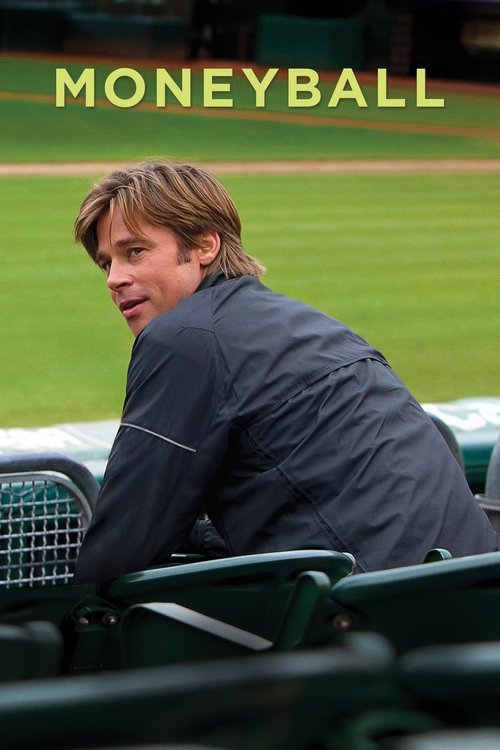
You wouldn’t think a movie about statistical regression and the logistics of a baseball front office would be "cool." On paper, Moneyball sounds like a two-hour HR seminar led by a guy who wears pleated khakis and drinks lukewarm Tab. But then you put Brad Pitt in the frame, give him a bag of sunflower seeds to aggressively chew, and let the screenplay be polished by Aaron Sorkin’s diamond-tipped wit. Suddenly, spreadsheets are the sexiest thing in cinema.

I watched this most recently on a Tuesday night while trying to fix a leaky faucet with a pair of pliers and a YouTube tutorial, and somehow Billy Beane’s struggle to fix a broken system made my plumbing failure feel like a noble, high-stakes pursuit. That’s the magic of this film. It takes the mundane—the phone calls, the scouting reports, the middle-management frustration—and turns it into a high-stakes thriller where the weapon of choice is an Excel file.
The Art of the Snack and the Stat
The film captures a very specific moment in the early 2000s when the "old guard" of baseball—the guys who scouted players based on how "clean" their swing looked or the quality of their girlfriend (yes, really)—ran head-first into the digital revolution. Brad Pitt plays Billy Beane, the GM of the Oakland A’s, as a man haunted by his own failure as a "five-tool" prospect who didn't pan out. He’s tired of losing to the New York Yankees’ checkbook, so he hires a socially awkward Yale economics grad named Peter Brand, played with incredible restraint by Jonah Hill.
This was the role that proved Jonah Hill wasn't just the "funny kid from Superbad." His chemistry with Pitt is the backbone of the movie. They are the ultimate odd couple: the aging golden boy and the data nerd. Watching them navigate a world of crusty old scouts—led by a delightfully grumpy Philip Seymour Hoffman as manager Art Howe—is pure procedural joy. Hoffman, as always, does so much with so little. He plays Howe as a man stubbornly clinging to the edge of a cliff, refusing to look down at the data-driven abyss below.
Sorkin’s Rhythmic Reality

We have to talk about the dialogue. While Steven Zaillian wrote the initial draft, the "Sorkin-ization" of the script is undeniable. The characters don't just talk; they spar. The scenes are edited with a rhythmic snap that makes a trade deadline feel like a heist movie. There’s a specific sequence where Beane is working the phones, trading players like Pokémon cards to force his manager’s hand, that is more exhilarating than any actual baseball game I’ve ever sat through.
Brad Pitt’s jawline is basically a third screenwriter in this film. He uses his physicality—the pacing, the constant eating, the throwing of chairs—to show a man who is vibrating with the fear of being wrong. It’s a masterclass in movie-star acting that doesn't feel like "acting." Even the supporting cast is stacked with future heavyweights; a pre-superstar Chris Pratt shows up as Scott Hatteberg, a broken-down catcher turned first baseman. Pratt plays the role with a soulful vulnerability that makes you forget he’d eventually be leading the Guardians of the Galaxy.
The Cult of the Spreadsheet
Looking back from 2024, Moneyball has aged into a genuine cult classic, specifically for people who love "process" movies. It’s the Apollo 13 of sports. It’s not actually about winning the World Series (spoiler: the A's don't); it’s about the soul-crushing difficulty of changing a culture. Fans of the film—myself included—tend to treat it as a management bible. We quote lines like "How can you not be romantic about baseball?" and "Adapt or die" with a sincerity that borders on the religious.

The production itself was almost a casualty of the very system it depicts. Originally, Steven Soderbergh was set to direct a much more experimental version of the film, involving real-life interviews with players. Sony famously shut it down just days before filming was supposed to start. When Bennett Miller stepped in, he grounded the film in a gorgeous, melancholic visual style, courtesy of cinematographer Wally Pfister. The Oakland Coliseum looks like a lonely cathedral of concrete and grass, echoing the isolation Beane feels.
Interestingly, many of the "scouts" in those boardroom scenes weren't actors; they were real-life baseball scouts, which adds a layer of grizzled authenticity you just can't fake. And for the real nerds: the "Peter Brand" character doesn't actually exist. He's a composite of Paul DePodesta, who didn't want his name used because he felt the Hollywood version of the story made him look a bit too much like a caricature.
Moneyball succeeds because it understands that the most interesting part of any sport isn't the trophy ceremony; it's the quiet desperation of the locker room and the frantic energy of the front office. It turns math into melody. Even if you don't know a bunt from a base hit, you’ll find yourself rooting for the guys with the laptops. It’s a rare drama that is as intellectually stimulating as it is emotionally resonant.
By the time the credits roll to the tune of a soft acoustic cover of "The Show," you realize you’ve just watched a movie where the climax is a walk-to-first-base, and yet, you’re breathless. It’s a testament to the era of the "adult drama" that Hollywood seems to have forgotten how to make. If you haven't seen it in a few years, it’s time to get back in the game.


Keep Exploring...
-
Foxcatcher
2014
-

The Curious Case of Benjamin Button
2008
-

American Gangster
2007
-
The Assassination of Jesse James by the Coward Robert Ford
2007
-

The Tree of Life
2011
-

Seven Years in Tibet
1997
-

Click
2006
-

Charlie Wilson's War
2007
-

A Christmas Carol
2009
-

Gangs of New York
2002
-

Inglourious Basterds
2009
-

Fury
2014
-

Capote
2005
-
The Boat That Rocked
2009
-
The Ides of March
2011
-
The Master
2012
-

Awakenings
1990
-
Blood Diamond
2006
-

The Fast and the Furious: Tokyo Drift
2006
-

Bridge to Terabithia
2007