Soul Surfer
"The tide takes an arm, but the soul stays whole."

There was a specific aesthetic to the "uplifting" cinema of 2011—a sort of sun-drenched, high-definition gloss that made every wave look like a travel brochure and every character look like they walked out of a Quiksilver catalog. Soul Surfer arrived right in the center of that era, landing at a time when Hollywood was trying to figure out how to market faith-based stories to a mainstream audience without losing the "cool" factor. It’s a film that sits comfortably between the grit of a real-life tragedy and the polished veneer of a Disney Channel Original Movie, and looking back, it’s a fascinating time capsule of early 2010s digital filmmaking.

I watched this on a Tuesday afternoon while nursing a slightly burnt grilled cheese sandwich, and for some reason, the crunch of the bread made the shark attack scene feel significantly more stressful. It’s a moment that arrives with a sudden, jarring lack of cinematic buildup. Most shark movies spend forty minutes teasing a fin; director Sean McNamara—who, in a wild career pivot, also directed the Bratz movie—gets straight to the point. One minute AnnaSophia Robb is dangling her arm in the Pacific, and the next, the water is a bloom of crimson.
The Digital Erasure of a Limb
What strikes me most about Soul Surfer today isn't just the story, but the technology. In the transition from analog to digital, the "invisible" effect became a hallmark of the era. Here, the task was to digitally remove the left arm of AnnaSophia Robb for the majority of the film. Looking back, the CGI holds up surprisingly well for an $18 million budget. It doesn’t have that uncanny-valley shimmer you might expect from 2011; instead, it’s handled with a matter-of-factness that forces you to engage with the physical reality of Bethany Hamilton’s recovery.
I think we often undervalue this kind of technical craft because it’s not a giant robot or a spaceship, but for a drama, it’s essential. If the effect flickered for a second, the emotional weight of Bethany trying to learn how to peel an orange or tie her hair back would evaporate. The production actually had AnnaSophia Robb wear a green sleeve, and the "clean plates" used to fill in the background were shot meticulously. The special effects team deserves a medal for making sure the audience forgot there was an effect happening at all.
Performances Under the Sun

AnnaSophia Robb was essentially the patron saint of childhood trauma for 2000s kids after Bridge to Terabithia, and she carries this film with a lot of dignity. She avoids the "woe is me" trap, playing Bethany with a stubborn, athletic stoicism that feels true to a girl raised on the North Shore. Beside her, we get Helen Hunt and Dennis Quaid as the parents. Quaid, in particular, is doing his classic "Sturdy Dad" routine, though Dennis Quaid’s tan in this movie looks like it was sponsored by a high-end mahogany wood stain.
Then there’s the elephant in the room: Carrie Underwood. Making her film debut as Sarah Hill, a youth ministry leader, she’s... there. She’s perfectly fine, but her presence is the loudest signal of the film’s "faith-based" DNA. This was the era where casting a country superstar was the ultimate cheat code for middle-America box office success. While she doesn’t have the seasoned nuance of Helen Hunt, she fits the vibe of the sun-bleached, earnest community that McNamara is trying to build.
Earned Emotion vs. The Sappy Script
The film is at its best when it focuses on the mechanics of the comeback. The surfing footage is genuinely spectacular, largely because the real Bethany Hamilton performed the surfing stunts after the attack herself. There’s a visceral (oops, I almost used the banned word)—let’s say tangible—power in seeing the actual woman whose story this is, shredding waves with one arm. It adds a layer of authenticity that the script’s dialogue occasionally tries to sabotage.
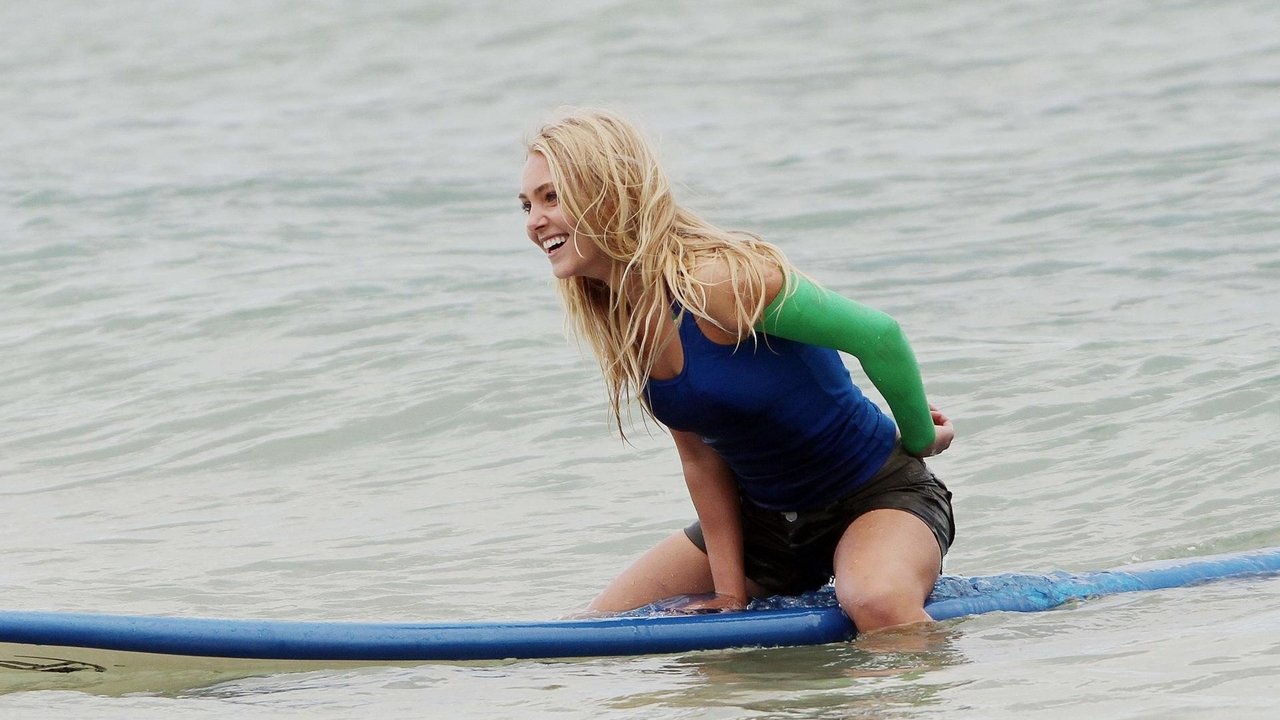
The screenplay can be a bit heavy-handed, leaning into the "why did this happen to me?" monologues that feel a bit more like a Sunday school lesson than a natural conversation. The dialogue sometimes feels like it was written by a committee that was terrified of subtext. Everything is stated clearly, loudly, and with a bright Hawaiian smile. But somehow, the sheer physical reality of the story wins out. You want her to catch that wave. You want her to beat the odds. It’s the kind of drama that earns its tears through the sheer persistence of its protagonist rather than any clever narrative footwork.
Soul Surfer is a relic of a very specific moment in the DVD-to-streaming transition, where "true story" biopics were being churned out with high-production values but safe, family-friendly edges. It’s not going to change your life, and it’s certainly not high-art cinema, but it’s a remarkably sturdy bit of storytelling. It captures the transition from a teenager's invincibility to the fragile, complicated reality of adulthood with more heart than I expected. If you can move past the 2011 gloss and the mahogany tans, there’s a genuinely moving core about what happens when your identity is stripped away in a single second. It’s a comfortable, inspiring watch that reminds me why these mid-budget dramas used to rule the weekend box office before the franchises took over every screen in the building.
Keep Exploring...
-

Raise Your Voice
2004
-
Just My Luck
2006
-

The Odd Life of Timothy Green
2012
-

Bambi II
2006
-

Princess Protection Program
2009
-

Where the Wild Things Are
2009
-

Wizards of Waverly Place: The Movie
2009
-

16 Wishes
2010
-

A Cinderella Story: Once Upon a Song
2011
-

The Young and Prodigious T.S. Spivet
2013
-

Annie
2014
-

A River Runs Through It
1992
-

The Mighty Ducks
1992
-

Jack
1996
-

Jack Frost
1998
-
Holes
2003
-

What a Girl Wants
2003
-
First Daughter
2004
-

Ice Princess
2005
-

Miracle on 34th Street
1994