PK
"Sometimes the wrong number leads to the right God."
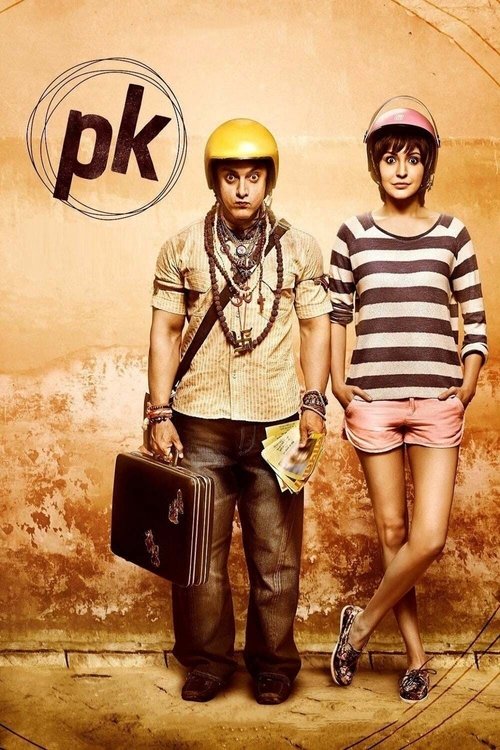
There is a specific, wide-eyed stillness to Aamir Khan in PK that feels less like a performance and more like a biological recalibration. He stands in the middle of a dusty Rajasthan landscape, naked except for a strategically placed transistor radio, possessing the kind of ears that look like they were designed to intercept satellite signals. It’s an image that defined the 2014 cinematic landscape in India, a year when Bollywood was pivoting from the loud, masala-drenched actioners of the early 2010s back toward the socially conscious dramedy. I recall watching this for the first time while nursing a lukewarm cup of ginger tea that had a literal fly swimming in it, and honestly, the absurdity of the movie made me forget to even be annoyed at the bug.

The Alien and the "Wrong Number"
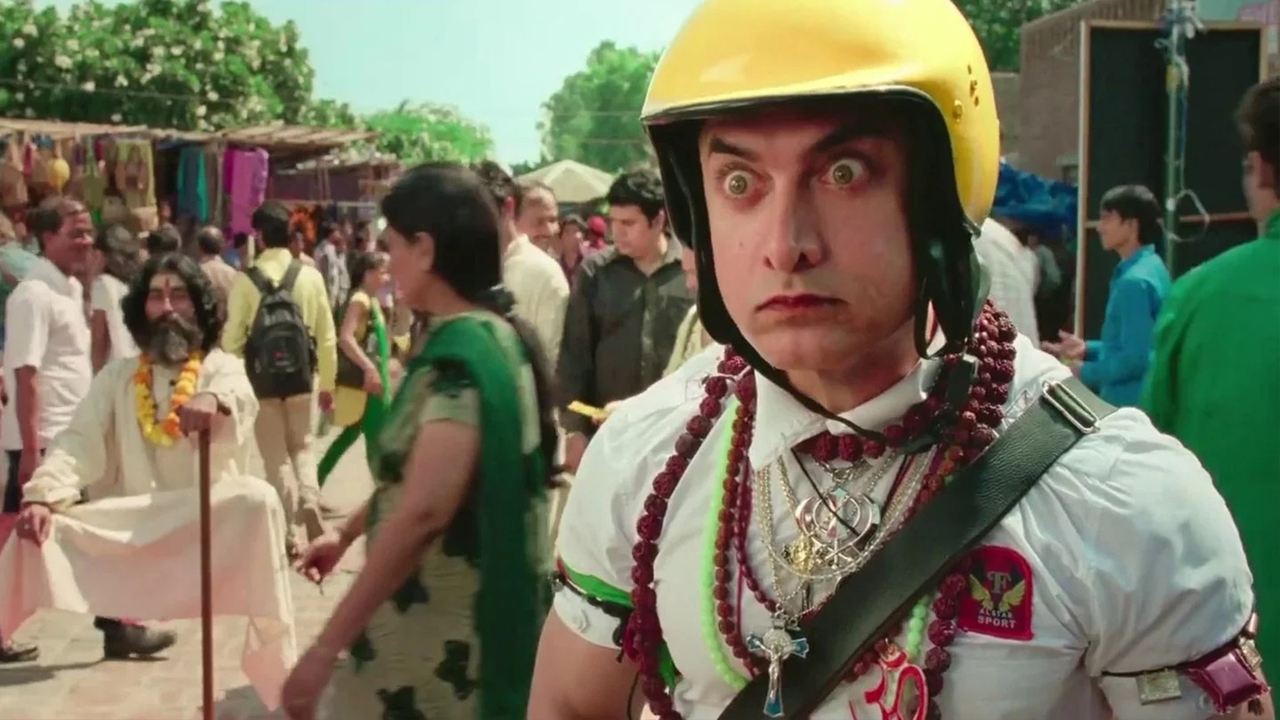
The premise is pure high-concept: an alien (Khan) lands on Earth, has his remote control stolen, and is left stranded in a world he doesn't understand. To get his "jewel" back, people tell him only God can help. Naturally, he starts looking for God—all of them. This leads to a series of escalating comedic misunderstandings where PK (a nickname derived from the Hindi phrase for "Are you drunk?") tries to navigate the labyrinthine rules of human religion.
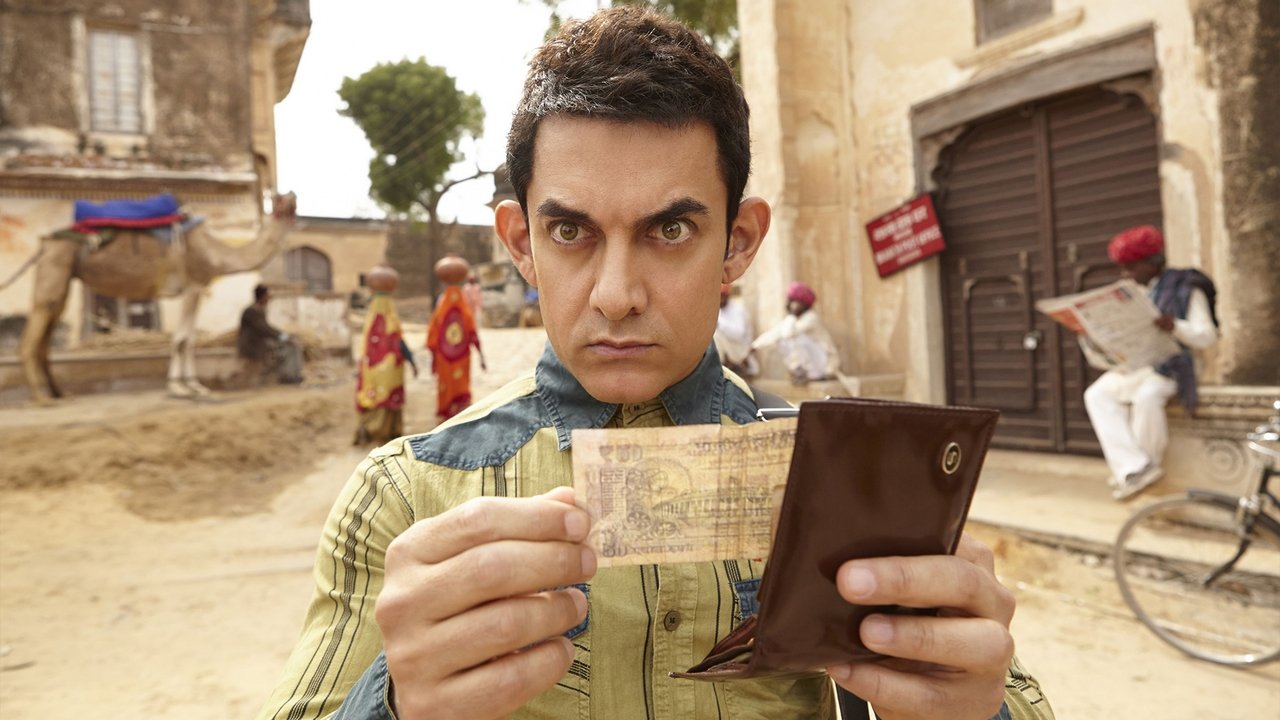
Director Rajkumar Hirani, who previously mastered the "social message via comedy" formula with 3 Idiots (2009) and Munna Bhai M.B.B.S. (2003), uses PK as a vessel for a specific kind of Socratic irony. By asking innocent questions, the film dismantles the artifice of organized religion. Why does one God require wine while another forbids it? Why does one require a shaven head while another demands a turban? It’s a cerebral exercise wrapped in a candy-colored blockbuster shell. Aamir Khan's choice to never blink throughout the entire film is a masterclass in physical commitment, making him feel genuinely "other." He essentially turned his face into a high-definition curiosity machine.
A Cast of Human Anchors
While PK is the heart, the film needs human anchors to keep it from floating off into pure whimsey. Anushka Sharma plays Jagat 'Jaggu' Janani, a journalist who finds PK and realizes his "delusions" are actually a perspective she desperately needs. Following her breakout in Band Baaja Baaraat (2010), this was the film that cemented her as a heavyweight who could hold her own against a perfectionist like Khan. Her chemistry with Sushant Singh Rajput, who plays the charming Sarfraz, provides the film's emotional stakes. Looking back, Rajput’s performance has a poignant, bittersweet quality that adds a layer of unintended weight to the romance.

Then there’s the opposition. Saurabh Shukla is brilliantly cast as Tapasvi Maharaj, a "Godman" who claims to have a direct line to the divine. He represents the corporatization of faith—the very thing the film seeks to satirize. The way Rajkumar Hirani pits PK’s logic against Tapasvi’s dogma is where the film finds its philosophical teeth. It’s not an attack on faith, but an attack on the middleman. The idea that "God created man, but man created a second God" is the kind of profound realization usually reserved for philosophy seminars, not $100 million blockbusters.
The Scale of a Cultural Phenomenon
Technologically, PK reflects the peak of the 2010s digital cinematography shift. The colors are saturated, the frames are crowded with life, and the visual effects—while sometimes a bit "uncanny valley" with the alien spaceship—serve the story rather than distracting from it. This was an era where Indian cinema was truly beginning to flex its global muscles. With a budget of roughly $13 million, it pulled in nearly $119 million worldwide. It wasn't just a movie; it was a watercooler event that sparked genuine national debates.
The production trivia is as legendary as the box office. To get into character, Aamir Khan supposedly ate over 100 paans (betel nut leaves) a day to maintain the stained mouth and specific Bhojpuri dialect he adopted for the role. The marketing was equally savvy; the first poster featuring a naked Khan caused such a stir that it was discussed in the Indian Parliament. It was a masterclass in "viral before viral was a science."
The Legacy of the Question
What stays with me after the credits roll—past the catchy Ajay-Atul score and the vibrant Delhi locations—is the "Wrong Number" theory. It’s a simple metaphor that simplifies a complex theological argument into something a child can understand. The film suggests that the messages we think we’re getting from the divine are often just "wrong numbers" dialed by those who profit from our confusion.
For a blockbuster, PK is surprisingly brave. It dares to be intellectually curious in a genre that often favors loud explosions over quiet questions. It captures that specific 2014 energy where the world was moving toward a more cynical, digital-first existence, yet we still craved a story that told us it was okay to be confused by the universe. Sanjay Dutt's supporting role as a bandmaster adds a final touch of old-school Bollywood warmth, bridging the gap between the classic eras of the past and the high-concept future.
PK remains a high-water mark for the satirical drama, proving that you can challenge deep-seated societal norms while still delivering a massive, crowd-pleasing spectacle. It’s a film that asks us to look at our own world through the eyes of an outsider, reminding us how strange we truly are. Even if you aren't a fan of the occasional musical number, the intellectual payoff and Khan's transformative performance make this an essential piece of modern cinema. It is a rare blockbuster that leaves you thinking long after you’ve finished your popcorn.

Keep Exploring...
-
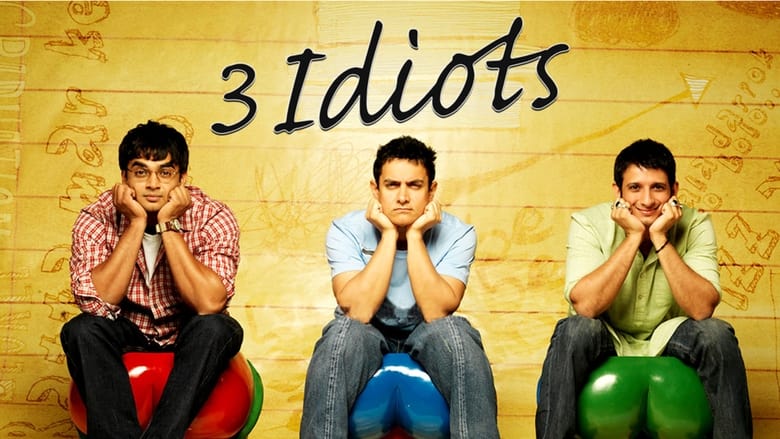
3 Idiots
2009
-

Little Miss Sunshine
2006
-

Evangelion: 2.0 You Can (Not) Advance
2009
-

Moon
2009
-

Mr. Nobody
2009
-

Moonrise Kingdom
2012
-

Instructions Not Included
2013
-

Robot & Frank
2012
-

Dilwale Dulhania Le Jayenge
1995
-

The Proposal
2009
-

Love & Other Drugs
2010
-

Arthur Christmas
2011
-

The Artist
2011
-

The Descendants
2011
-

Chronicle
2012
-
Silver Linings Playbook
2012
-

The Best Exotic Marigold Hotel
2012
-

Saving Mr. Banks
2013
-
Birdman or (The Unexpected Virtue of Ignorance)
2014
-

I Origins
2014