The Water Diviner
"The war ended. His search just began."
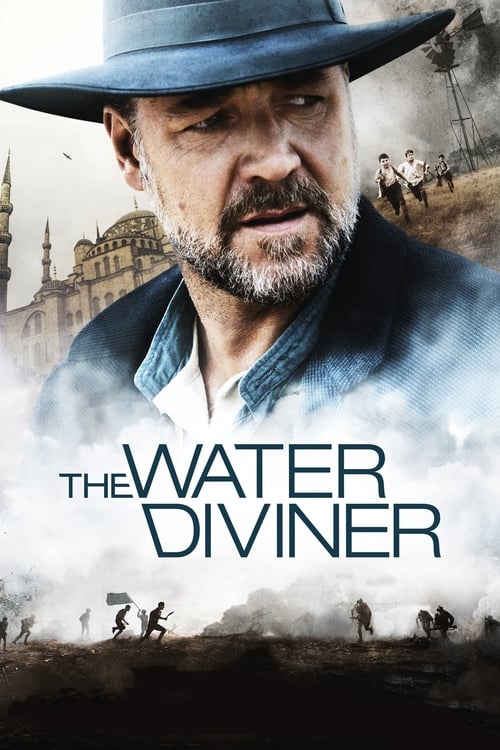
There is a specific kind of silence that only exists in the Australian outback—a heavy, baked heat that makes the horizon shimmer until you aren’t sure if you’re looking at trees or ghosts. This is where we meet Joshua Connor, a man who finds water hidden deep beneath the parched earth by the twitch of a divining rod. But the film’s real hook isn't about finding water; it’s about the impossible task of finding three sons lost to the meat-grinder of Gallipoli four years after the guns fell silent.

I watched this movie on a rainy Tuesday while eating a slightly stale piece of Turkish Delight I’d found in the back of my pantry, and the cloying sweetness of the candy felt like a weirdly perfect counterpoint to the dusty, grit-in-your-teeth reality of the film’s opening act. It’s a "dad movie" in the truest, most honorable sense of the term—stoic, sentimental, and obsessed with the idea of legacy.
The Actor-Director Pivot
In 2014, the cinematic landscape was pivoting hard toward the mega-franchise, yet Russell Crowe decided to step behind the camera for the first time to deliver a sprawling, old-fashioned historical epic. It’s a bold move for a debut. Most actors-turned-directors start with a quiet, two-room indie drama; Crowe went for a multi-continent war story with charging cavalry and period-accurate naval ports.
As an actor, Russell Crowe has always been at his best when he’s playing men who are fundamentally "competent"—men who know how to do a job, whether it’s winning a Roman war or solving a math equation. Here, his Joshua Connor is a master of the earth. When he eventually travels to Istanbul to find his sons, he treats the search like dowsing for water. He feels the ground; he listens to the wind. Russell Crowe’s best performance isn't when he’s shouting at the gods; it’s when he’s staring at a patch of dirt with the weight of a continent on his shoulders. He brings a quiet, bruised dignity to the role that reminds me why he was the biggest star on the planet at the turn of the millennium.
Bridges Over the Bosphorus

What makes The Water Diviner stand out from the crowded shelf of "Great War" movies is its perspective. Usually, films about the ANZAC (Australian and New Zealand Army Corps) experience at Gallipoli treat the Turks as a faceless, shadowy enemy. Crowe, however, leans into the Turkish experience with a surprising amount of grace.
The real stars of the film’s middle act are Yılmaz Erdoğan as Major Hasan and Cem Yılmaz as Sgt. Jemal. These aren't villains; they are tired men trying to rebuild a collapsing empire from the ruins of a war they also lost a generation of boys to. The chemistry between Crowe and Yılmaz Erdoğan is the film’s secret weapon. They share a weary, begrudging respect—two fathers and soldiers who realize that the dirt they fought over is just a graveyard for both their families.
Then there’s the romance. Olga Kurylenko plays Ayshe, the owner of the hotel where Connor stays. While she’s a talented actress, the romance subplot feels like it was mandated by a studio executive who was afraid men wouldn't watch a movie about digging in the dirt. It’s the one part of the film that feels "standard-issue Hollywood," complete with longing glances that feel a bit thin compared to the gut-punch flashbacks of the battlefield. It doesn't ruin the movie, but it does slow down a narrative that should have stayed focused on the search.
A Final Golden Hour

We have to talk about how this movie looks. It was the final film lensed by the legendary cinematographer Andrew Lesnie, the man who gave The Lord of the Rings its ethereal glow. Lesnie treats the Turkish landscape like a painting, using saturated ambers and deep, bruised blues. Even the harrowing flashback scenes of the "The Nek" battle have a terrifying beauty to them. There’s a scene involving a sandstorm that is so expertly shot you’ll find yourself subconsciously wiping your own forehead.
It’s a film that bridges the gap between the practical grit of 90s war dramas like Saving Private Ryan and the digital polish of the mid-2010s. The CGI recreation of 1919 Istanbul is impressive, though it occasionally has that "too clean" look that plagued a lot of high-budget dramas of the era. Still, the tactile nature of the production—the costumes, the steam trains, the sense of physical travel—makes it feel like a grand adventure from a bygone era of filmmaking.
The film did well in Australia and Turkey but vanished in the US, which is a shame. It’s a movie about the aftermath of grief—the "what happens next" when the heroes don't come home and the medals are put in a drawer. It’s sincere, occasionally to a fault, but in an era of ironic detachment, I found its earnestness deeply refreshing.
The Water Diviner is a film that wears its heart on its sleeve and its dust on its boots. It’s a gorgeous, melancholic debut for Russell Crowe that succeeds because it chooses empathy over jingoism. If you’re looking for a drama that feels like a big, warm, slightly sad hug from history, this is the one to track down. It’s a reminder that sometimes the most important things we find aren't what we were looking for in the first place.


Keep Exploring...
-

The Round Up
2010
-

'71
2014
-

The Flowers of War
2011
-

How I Live Now
2013
-

Courage Under Fire
1996
-

Behind Enemy Lines
2001
-

A Very Long Engagement
2004
-
Joyeux Noel
2005
-

Black Book
2006
-
The Wind That Shakes the Barley
2006
-

Rescue Dawn
2007
-
Defiance
2008
-
Master and Commander: The Far Side of the World
2003
-

A Good Year
2006
-

Unbroken
2014
-
Crimson Tide
1995
-

The Messenger: The Story of Joan of Arc
1999
-
Hart's War
2002
-
K-19: The Widowmaker
2002
-
Flags of Our Fathers
2006