Money Monster
"The stock market just took a hostage."

There is a moment early in Money Monster where George Clooney enters his high-tech television studio wearing a gold-sequined vest, flanking two hip-hop dancers, and gyrating like a man who has lost a bet with God. It’s a spectacular bit of cringe-comedy that perfectly captures the "finance-as-entertainment" rot of the mid-2010s. I remember seeing the trailer for this back in 2016 while sitting in a theater where the air conditioning had died; I was sweating through my shirt and accidentally dropped an entire tray of overpriced nachos, which honestly felt like a fitting metaphor for the financial "spillage" the movie tries to dissect.

Directed by Jodie Foster, Money Monster arrived at a curious crossroads in cinema. It was a mid-budget, star-driven adult thriller released by a major studio (TriStar)—a species that is now almost entirely extinct in theaters, having been hunted into the mountainous regions of Netflix and Apple TV+. It’s a lean, 99-minute exercise in tension that feels like a throwback to the 90s, yet its heart beats with the very specific, jagged anxiety of the post-2008 world.
The Smarm and the Struggle
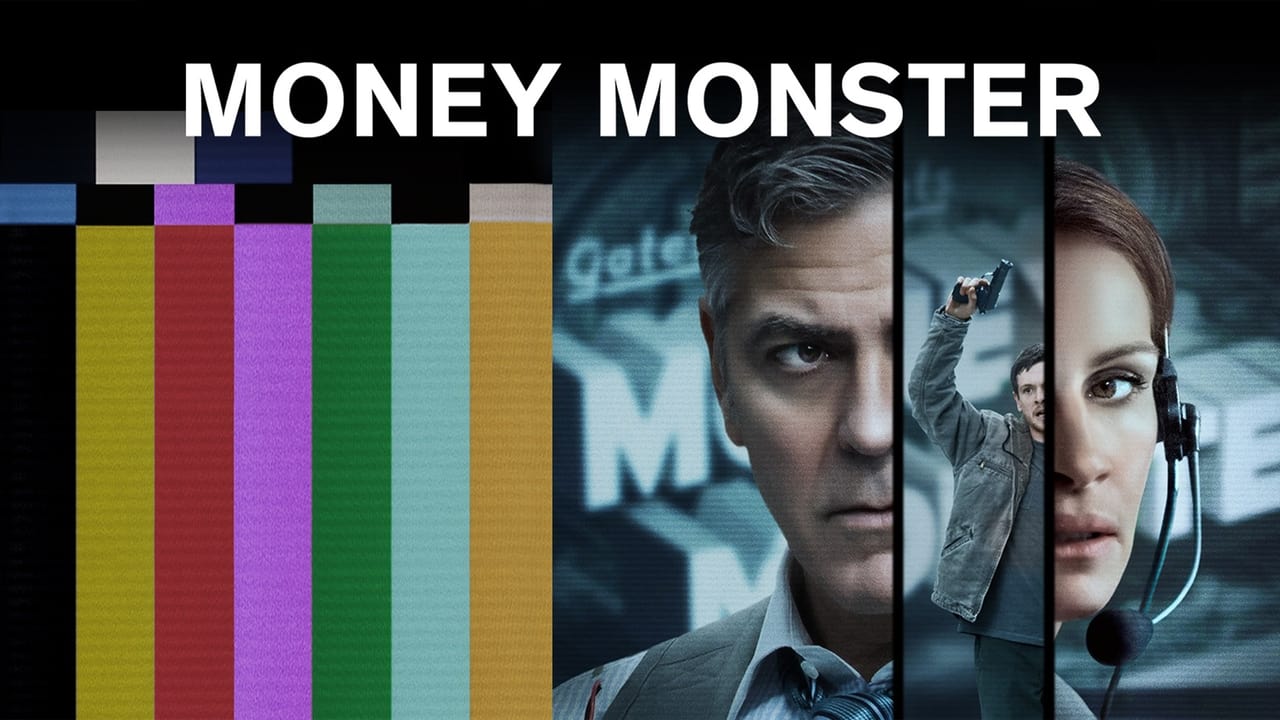
The plot is a pressure cooker. Lee Gates (George Clooney) is a Jim Cramer-style financial guru whose show, Money Monster, turns stock tips into a circus. His producer, Patty Fenn (Julia Roberts), is the weary architect in his ear, trying to keep the "edutainment" from careening off the tracks. Everything goes sideways when Kyle Budwell (Jack O'Connell), a delivery man who lost his life savings on a "glitchy" stock tip from Gates, wanders onto the live set with a pistol and an explosive vest.
The film lives or dies on the chemistry between the three leads. George Clooney is playing a variation of his "charming fraud" persona, but he allows Lee Gates to be genuinely pathetic when the sweat starts to bead. He isn't a hero; he's a salesman who realized too late he was selling poison. Across from him, Jack O'Connell is a raw nerve. While the movie occasionally leans into "angry blue-collar" tropes, O'Connell brings a vibrating, desperate humanity to Kyle that keeps the stakes from feeling purely academic.
Then there’s Julia Roberts. It is genuinely impressive how much she communicates while sitting in a dark control booth, staring at a monitor and speaking into a headset. She is the audience’s tether to reality, and her "long-distance" chemistry with Clooney—reignited years after their Ocean’s days—provides the film’s emotional spine.
A Glitch in the System
While the hostage drama plays out on live TV, the film attempts to solve a corporate mystery involving IBIS Clear Capital and its CEO, Walt Camby (Dominic West). A $800 million "glitch" wiped out the company’s value, and the movie pivots into a global investigation led by the company's PR head, Diane Lester (Caitríona Balfe).
This is where the film gets its "Contemporary Cinema" badge. In 2016, we were just beginning to grapple with the idea that the algorithms running our lives were both inscrutable and potentially malicious. The movie argues that "glitch" is just corporate-speak for "we stole it and don't want to tell you how." It’s a cynical take that feels even more relevant in our current era of "black box" AI and high-frequency trading.
Foster directs with a clear-eyed efficiency. She understands that the studio is a character itself—a neon-lit cage where the cameras never stop rolling. The decision to keep the cameras on during the hostage crisis reflects our modern obsession with "witnessing" tragedy in real-time via social media. I loved the cutaway shots to people in bars and offices around the world watching the feed; some are horrified, but many are just bored, waiting for the "money shot." It’s a biting indictment of a culture that treats human suffering as just another piece of content to be consumed during a lunch break.
Behind the Scenes of the Crisis
Despite the heavy themes, the production was surprisingly nimble. To keep the energy up, Foster often shot in long takes, allowing the actors to stay in the high-stakes headspace of a live broadcast. Interestingly, the film was a mini-reunion for the Ocean’s Eleven crew, but Clooney and Roberts actually spent very little time on set together. Most of their interaction was filmed exactly as it appears: Julia in a booth, George on the floor.
One of the best bits of trivia involves the "Money Monster" studio itself. It was built on a soundstage in Kaufman Astoria Studios in Queens, and the detail was so precise that real financial news producers reportedly commented on how authentic the "ticker" and control boards felt. Also, keep an eye out for Giancarlo Esposito as the hostage negotiator; he brings his trademark quiet intensity to a role that could have been a cardboard cutout in a lesser film.
The film was a modest hit, but it hasn’t quite entered the "classic" canon. It’s often dismissed as a "lite" version of Network or Dog Day Afternoon. However, I’d argue that its lack of pretension is its greatest strength. It doesn't try to be a philosophical treatise; it tries to be a damn good thriller that happens to be very angry about how the rich stay rich.
Money Monster is a sharp, well-acted reminder of why we used to go to the movies on a Friday night before the streaming giants swallowed the "middle" of the industry. It’s cynical, fast-paced, and features three movie stars operating at the top of their game. While the ending wraps things up a little too neatly for my liking—it offers a single villain to punch when the real enemy is an entire unfeeling mathematical system—the ride there is incredibly satisfying. It’s the kind of movie that makes you want to check your 401(k) and then immediately throw your laptop out the window.

Keep Exploring...
-
The Little Things
2021
-
The Gift
2015
-

Victor Frankenstein
2015
-

Nocturnal Animals
2016
-
Patriots Day
2016
-
Snowden
2016
-

The Circle
2017
-
Bad Times at the El Royale
2018
-
Bird Box
2018
-
Death Wish
2018
-
Widows
2018
-
The Highwaymen
2019
-

Uncut Gems
2019
-

Promising Young Woman
2020
-

In the Heart of the Sea
2015
-
13 Hours: The Secret Soldiers of Benghazi
2016
-
Jack Reacher: Never Go Back
2016
-
Shot Caller
2017
-
You Were Never Really Here
2017
-

The House That Jack Built
2018