The Man Who Knew Infinity
"His mind saw what the world couldn't calculate."

Most movies about geniuses follow a tired, dusty blueprint. You know the one: a blackboard, a frantic piece of chalk, a furrowed brow, and a supportive spouse who exists only to say, "Come to bed, John, you've been at it for hours!" The Man Who Knew Infinity almost falls into that trap, but it’s saved by the sheer, heartbreaking friction between its two leads. I watched this on my laptop while waiting for a plumber to fix a leak that was slowly turning my kitchen into a small pond, and honestly, seeing Dev Patel struggle with complex partitions made my soggy floorboards feel like a much more manageable problem.

Released in 2016, a year that gave us the high-octane math of Hidden Figures, this film took a much quieter, more somber route. It tells the true story of Srinivasa Ramanujan, a self-taught mathematical prodigy from Madras who writes to G.H. Hardy, a Cambridge professor, in 1913. Ramanujan has the answers to equations the Western world hasn't even dreamt of yet, but he doesn't have the "proofs." To Hardy, the proof is everything; to Ramanujan, the equations are literally the voice of God.
A Masterclass in Repression and Radiance
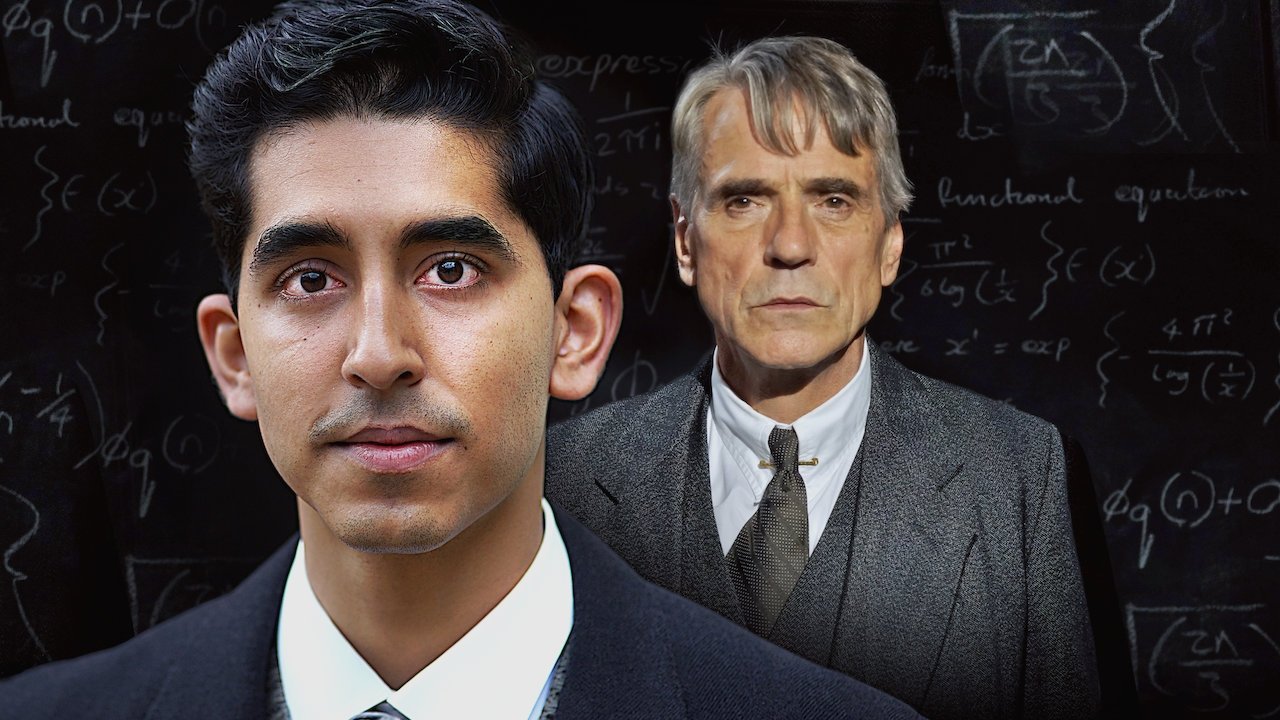
The movie lives or dies on the chemistry between Dev Patel and Jeremy Irons, and thankfully, they are fantastic. Patel was just beginning to shed his Slumdog Millionaire image here, bringing a tactile desperation to Ramanujan. He’s not just a "brain in a jar"; he’s a man suffering from the cold, the racism of World War I-era England, and the agonizing distance from his wife, Devika Bhise.
On the other side, Jeremy Irons plays "repressed British academic" with so much conviction I felt like I needed a tweed jacket and a glass of dry sherry just to watch him. His Hardy is a man who loves math because it’s the only thing that doesn't let him down, but his inability to connect with Ramanujan on a human level is the film's real tragedy. When they finally find a middle ground, it’s not because of a grand speech, but because of a shared reverence for the number 1729. It sounds nerdy because it is, but in the hands of these two, it’s genuinely moving.
The Problem with "Great Man" Math

The film struggles slightly with the "unfilmable" nature of its subject. How do you show a mathematical breakthrough without alienating everyone who failed high school algebra? Director Matt Brown leans heavily on the spiritual angle. Ramanujan claims his insights come from the goddess Namagiri. While this adds a beautiful, mystical layer to the story, it occasionally feels like the movie is terrified we’ll realize we don't actually understand a single thing on the blackboard.
We also get solid supporting work from Toby Jones as Littlewood, who provides a much-needed warmth to the sterile Cambridge halls, and Stephen Fry pops up as Sir Francis Spring. However, the film is at its best when it focuses on the cultural clash. Ramanujan isn't just fighting math problems; he's fighting a system that views him as an "oriental curiosity" rather than a peer. In our current era of cinema, where we’re finally seeing more diverse stories of intellectual history, The Man Who Knew Infinity feels like a vital, if slightly overlooked, entry. It doesn't have the flashy "Aha!" moments of The Imitation Game, but it feels more honest about the cost of genius.
Why This One Slipped Through the Cracks
Despite the talent involved, the film didn't exactly set the world on fire at the box office. It's a "Dad movie" in the best sense—sturdy, sincere, and deeply emotional. It suffered from being a traditional biopic in a decade where audiences were starting to experience "Great Man" fatigue. Plus, marketing a movie about partition theory is a tough sell when superhero franchises were hitting their peak saturation.
But looking at it now, in a streaming landscape crowded with loud, fast-paced content, there’s something refreshing about its pace. It’s a film that asks you to sit still and feel the weight of a life lived for the sake of a singular truth. It also serves as a reminder of Dev Patel's incredible range before he went full action-star in Monkey Man. It turns out, he’s just as compelling holding a pen as he is throwing a punch.
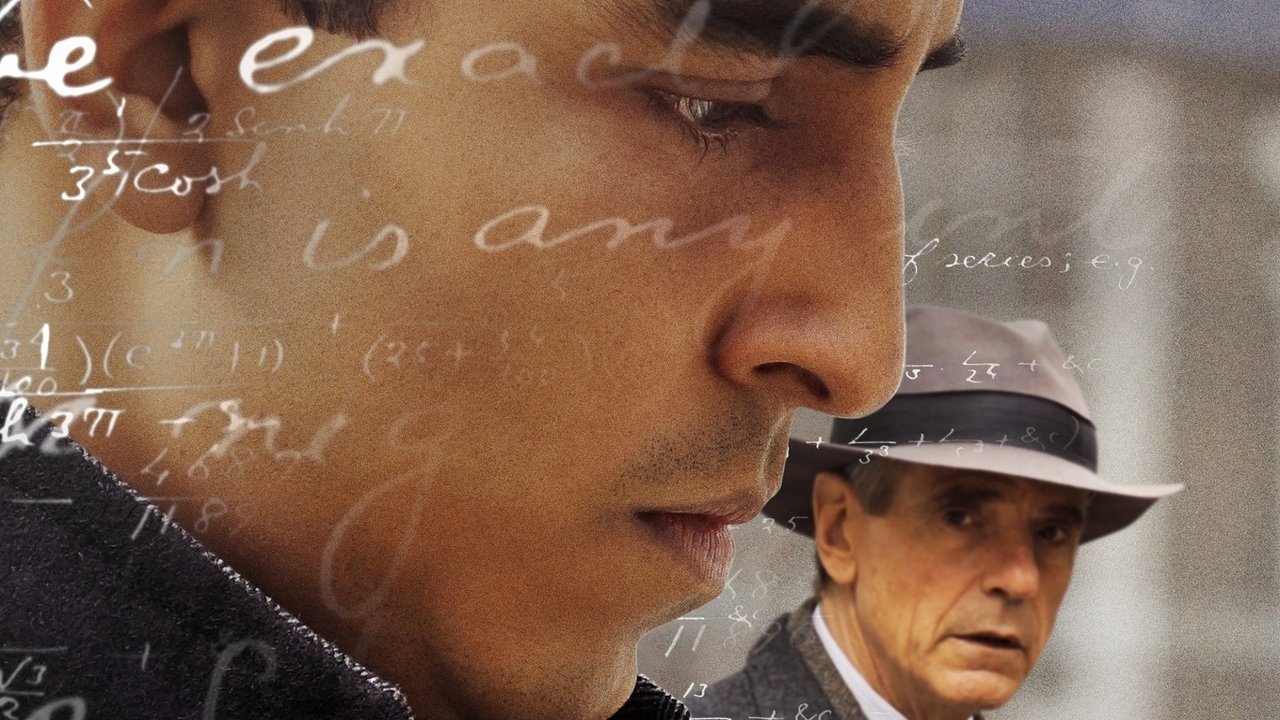
One of the coolest details I found out later is that the math in the film is actually real. The production hired mathematicians like Ken Ono to ensure the notebooks looked authentic. It’s that level of care that prevents the movie from feeling like a hollow "prestige" piece. Even if you can’t tell a prime number from a Prime Rib, the human cost of Ramanujan's journey is impossible to miss.
The Man Who Knew Infinity is a beautiful, if somewhat conventional, tribute to a man who saw the infinite in a world that insisted on keeping him small. It’s a story about the bridge between intuition and logic, and while it might not reinvent the biopic wheel, the performances by Dev Patel and Jeremy Irons make it a journey well worth taking. If you're looking for something that feeds the brain and the heart in equal measure, this is your next Sunday afternoon watch. Just make sure you have some tissues handy for the final act—it’s a reminder that while math is eternal, the people who discover it are tragically fragile.

Keep Exploring...
-

Hotel Mumbai
2019
-

Race
2016
-

Colonia
2015
-
The 33
2015
-

The Stanford Prison Experiment
2015
-

Risen
2016
-

The Finest Hours
2016
-

All Eyez on Me
2017
-

Battle of the Sexes
2017
-

Detroit
2017
-

The Zookeeper's Wife
2017
-

Victoria & Abdul
2017
-

Can You Ever Forgive Me?
2018
-

Mary Queen of Scots
2018
-

On the Basis of Sex
2018
-

Operation Finale
2018
-
The Current War
2018
-

The Guernsey Literary & Potato Peel Pie Society
2018
-

A Beautiful Day in the Neighborhood
2019
-

Dolemite Is My Name
2019