Molly's Game
"Win the game, lose your soul."
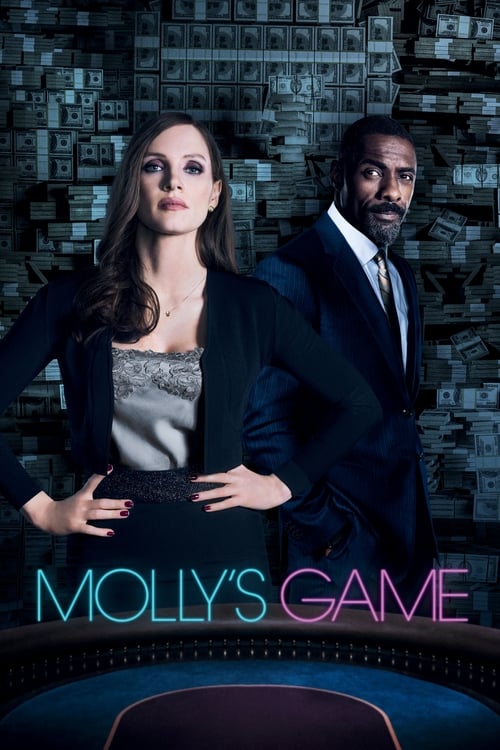
The first time I watched Molly’s Game, I was wearing a pair of incredibly itchy wool socks I’d bought on a whim at a gas station, and honestly, the sheer irritation of the fabric perfectly matched the high-wire anxiety of the film. You don't just watch an Aaron Sorkin movie; you try to keep up with it. It’s a cardiovascular workout for your ears. By the time the credits rolled, my feet were red, and my brain felt like it had been through a centrifuge.

This isn't just a "poker movie." In fact, it’s barely about the cards at all. It’s a contemporary tragedy about the price of being the smartest person in a room full of powerful, fragile men. Released in 2017, right as the cultural conversation around power dynamics and systemic misogyny was reaching a boiling point, the film feels even more pointed now. It’s a clinical dissection of how a woman can build an empire in a man's world, only to realize the men would rather burn the building down than let her keep the keys.
The Rhythm of the Hustle
Aaron Sorkin is a writer who has spent his career making people talk like they’ve had three weeks to prepare their best comebacks. In his directorial debut, he proves he knows exactly how to pace that dialogue so it feels like a sprint. Jessica Chastain plays Molly Bloom, a former Olympic-level skier whose career ended in a freak accident involving a stray pine branch. That opening sequence is brutal—a literal "fall from grace" that sets the tone. Molly doesn't do "moderate." If she’s going to fail, it’s going to be spectacular; if she’s going to win, she’s going to dominate.
Chastain is formidable here. She plays Molly with a rigid, armored exterior that only cracks in the privacy of her lawyer’s office. She isn't looking for sympathy, and the film doesn't ask you to give her any. Instead, it demands respect for her competence. Watching her navigate the transition from a cocktail waitress to the "Poker Princess" is a masterclass in observational intelligence. She learns the game, then she learns the players, then she learns how to exploit their egos without ever placing a bet herself.
The Wolves at the Table

The film shines brightest when it’s inside the windowless, smoke-filled rooms of the high-stakes games. This is where we meet Player X, played with a chilling, smug detachment by Michael Cera. It is a widely known open secret in film circles—and a favorite bit of trivia for the film's cult following—that Player X is largely based on Tobey Maguire (of Spider-Man fame). Cera plays him not as a card shark, but as a predator who doesn't care about the money; he just likes ruining people's lives. Michael Cera playing a sociopathic version of a beloved A-list actor is the kind of meta-casting that keeps me up at night.
Then there is Idris Elba as Charlie Jaffey, Molly’s reluctant defense attorney. Their chemistry is purely intellectual, a rapid-fire exchange of legal strategy and moral philosophy. Elba gets the "Sorkin Monologue"—the big, soaring speech toward the end—and he delivers it with a gravitas that anchors the movie’s more frenetic moments. He represents the audience’s growing realization that while Molly might have operated in a gray area, she was the only one in the room with a shred of integrity.
The Shadow of the Father
While the poker and the legal drama provide the "Crime" element, the "Drama" is rooted in Molly’s relationship with her father, Larry, played by Kevin Costner. Aaron Sorkin directs movies like a man who drinks eighteen espressos before breakfast, but he slows down just enough to let the psychological damage breathe. The climactic scene between Chastain and Costner on a park bench is polarizing—some think it’s too tidy, a "Psychology 101" explanation for Molly’s entire life. Personally? The bench scene with the father is a psychological car crash. It’s heavy-handed, sure, but in a world where everyone is lying to stay ahead, that blunt, painful honesty hits like a sledgehammer.

The film has developed a serious cult following in the years since its release, especially among those who appreciate the "competence porn" genre. We love watching people be exceptionally good at difficult things. Molly Bloom didn't just run a game; she curated an experience. The trivia surrounding the production is just as intense as the film itself. Apparently, the real Molly Bloom was so protective of her "customers" that she refused to name names even when facing jail time—a detail Sorkin kept as the moral backbone of the script. Also, the production had to move at a breakneck pace; they shot the entire film in just 45 days, which probably explains why everyone looks so authentically exhausted by the third act.
Molly’s Game is a sharp, jagged piece of contemporary cinema that refuses to offer easy redemptions. It’s about the exhaustion of excellence and the loneliness of being right. In an era of franchise dominance, seeing a mid-budget, R-rated drama driven entirely by performance and prose feels like a minor miracle. It’s dark, it’s intense, and it moves with the confidence of a player holding a royal flush. Just maybe wear comfortable socks when you watch it.
The ending doesn't give you the big "win" you might expect from a Hollywood gambling flick. Instead, it gives you something better: the sight of a woman who has been stripped of everything but her name, standing tall. It’s a film that understands that in the long run, your reputation is the only currency that actually matters. If you missed this one in theaters, find it on a streaming service, turn the subtitles on (you'll need them for the speed), and enjoy the ride.

Keep Exploring...
-
The Trial of the Chicago 7
2020
-

Wind River
2017
-
Hell or High Water
2016
-

Patriots Day
2016
-

Snowden
2016
-

The Hate U Give
2018
-

Just Mercy
2019
-

Uncut Gems
2019
-

Promising Young Woman
2020
-
Wrath of Man
2021
-

Miss Sloane
2016
-
Papillon
2017
-

The House That Jack Built
2018
-
El Camino: A Breaking Bad Movie
2019
-

The Irishman
2019
-

The Devil All the Time
2020
-
Sherlock: The Abominable Bride
2016
-

Dogman
2018
-

Shoplifters
2018
-

Joker
2019