Hotel Artemis
"Check in. Get patched. Don’t break the rules."

I watched Hotel Artemis on my laptop while waiting for a plumber who was three hours late, and honestly, the sight of a crumbling, leaky building on screen made my own domestic disaster feel like a curated aesthetic choice. There’s something perversely cozy about a "bottle movie"—a story where everyone is trapped in one location—especially when the world outside is literally on fire.

Released in 2018, Hotel Artemis arrived at a weird crossroads in cinema. We were at the absolute peak of the Marvel Cinematic Universe’s "Phase Three" dominance, and the mid-budget, original R-rated action flick was already becoming a rare species. It felt like a movie that desperately wanted to be a cult classic before it even hit theaters, which is usually a recipe for a try-hard disaster. Yet, despite being a box-office thud that vanished from the cultural conversation faster than a Snapchat message, it’s a film I find myself defending whenever someone complains that "they don't make movies for adults anymore."
A High-Concept Waiting Room
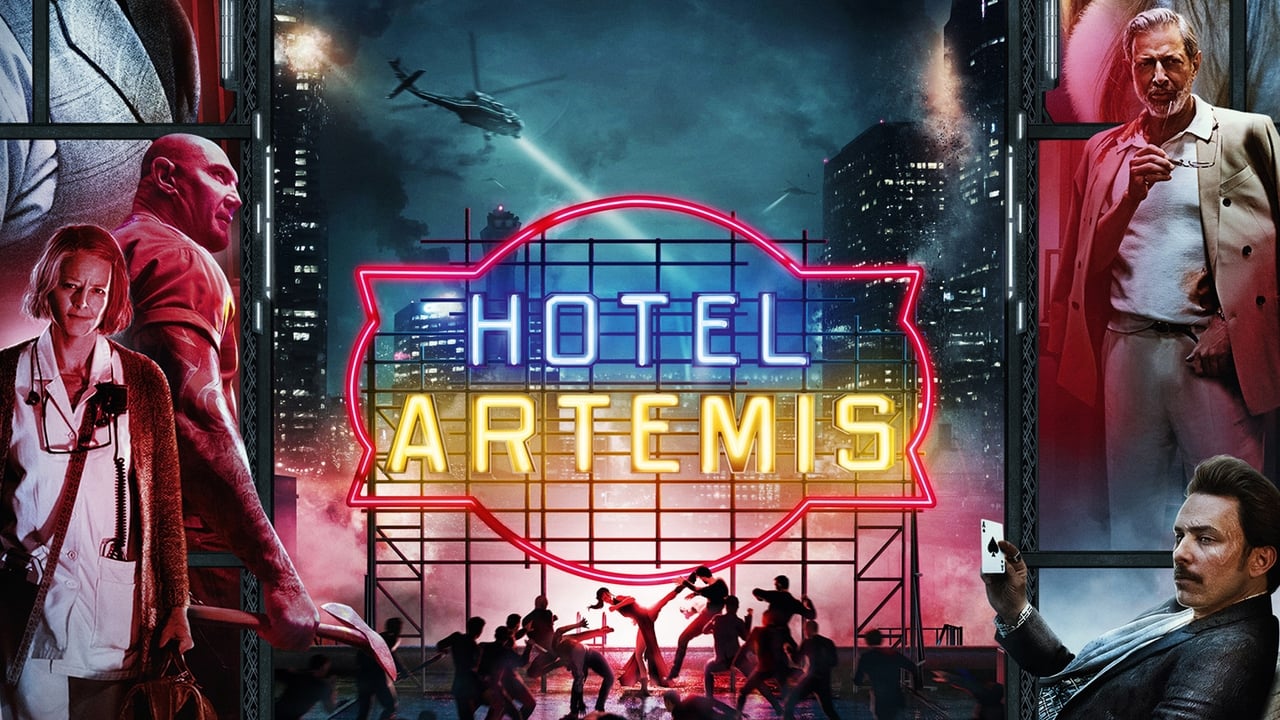
The premise is pure pulp: Los Angeles is tearing itself apart over water riots in the year 2028. High above the chaos, Jean Thomas—better known as "The Nurse"—runs a high-tech, members-only hospital for criminals in a converted Art Deco hotel. Jodie Foster plays the Nurse with a frantic, agoraphobic shuffle that is miles away from Clarice Starling. She hasn't stepped outside the hotel in twenty years, fueled by gin and a tragic backstory that the movie slowly peels back like a scab.
The rules are simple: no guns, no cops, and no killing the other patients. It’s a very John Wick conceit, and the film suffered immensely from those comparisons. Where John Wick is a symphony of motion, Hotel Artemis is a chamber play with occasional stabbings. It’s more interested in the "no-kill" rule being broken than the actual act of killing.
The cast is, frankly, absurd for a $15 million movie. You’ve got Sterling K. Brown (who most of us knew then as the emotional heart of This Is Us) playing a bank robber with a code of honor. You’ve got Sofia Boutella, who also appeared in Matthew Vaughn’s Kingsman: The Secret Service, playing a French assassin who looks like she was born in a neon-lit alleyway. Then Jeff Goldblum shows up as the "Wolf King" of LA, doing the full Goldblum—purring his lines and radiating a menace that is somehow both whimsical and terrifying.
The Physics of Neon and Steel

From an action standpoint, the film is a bit of a tease. Director Drew Pearce, who previously wrote Iron Man 3 for Shane Black, clearly loves the "tough guys talking in rooms" trope. When the action does pop, it’s handled with a gritty, claustrophobic clarity. The standout is a hallway fight involving Sofia Boutella that makes great use of her background as a dancer. It isn't the hyper-stylized "gun-fu" we’ve grown accustomed to; it feels desperate and messy, which fits the decaying surroundings.
The cinematography by Chung Chung-hoon, who shot Park Chan-wook’s Oldboy, is the real MVP here. He bathes the Artemis in jaundiced yellows and bruised blues. Everything looks expensive but rotting. It’s a gorgeous film to look at, even if the plot occasionally feels like it’s just three different pilots for a Netflix show stitched together with copper wire.
One of the more interesting "now" aspects of the film is how it handled its tech. In 2018, 3D printing organs felt like far-off sci-fi; watching it today, it feels like something a tech billionaire would announce on X (formerly Twitter) tomorrow morning. The film captures that specific late-2010s anxiety about privatized everything—even your sanctuary for criminals is a corporate-sponsored membership tier.
Why Did This Check Out Early?
So, why did nobody see it? It’s essentially a very expensive episode of a show that got canceled after the pilot. It builds a fascinating world but then ends right when things get interesting. In the era of "Cinematic Universes," audiences were trained to expect a sequel hook or a larger payoff. Hotel Artemis just… ends. It’s a self-contained story that doesn't care about your desire for a franchise.
There are some fun bits of trivia buried in the drywall, too. Apparently, Jodie Foster took the role specifically because she wanted to play a "cranky old lady" and leaned into the aging process, insisting on the grey hair and weathered skin. Also, the film's score was composed by Cliff Martinez, the guy behind the iconic synth sounds of Nicolas Winding Refn’s Drive. If the movie feels like it’s vibrating with a low-frequency hum of dread, you can thank him for that.
The film also features Brian Tyree Henry, who was just starting to blow up thanks to Atlanta, and Jenny Slate in a surprisingly dramatic turn. It’s a "Who's Who" of "Hey, I love that person!" which makes its status as a forgotten oddity even more baffling. It’s the kind of movie you find at 1 AM on a streaming service and feel like you’ve discovered a secret.
Hotel Artemis is a flawed, atmospheric, and fiercely acted slice of sci-fi noir that deserved better than a quiet death at the box office. It doesn’t reinvent the wheel, but it polishes the "criminal underworld" tropes until they shine under a blacklight. If you’re tired of world-ending stakes and just want to see Jeff Goldblum be a flamboyant crime lord while Dave Bautista (who plays the Nurse’s orderly) tries not to crush people, this is your 94-minute prescription. It’s a reminder that even in an era of massive franchises, there’s still room for a weird, messy, mid-budget dream.


Keep Exploring...
-

Heist
2015
-

Survivor
2015
-

The Transporter Refueled
2015
-

Wild Card
2015
-

Criminal
2016
-
Brawl in Cell Block 99
2017
-
Security
2017
-

Sleepless
2017
-

Anon
2018
-

Kin
2018
-

The Girl in the Spider's Web
2018
-

The Hurricane Heist
2018
-

Black and Blue
2019
-
Captive State
2019
-
Dragged Across Concrete
2019
-

Boss Level
2021
-

Copshop
2021
-

Gunpowder Milkshake
2021
-
Memory
2022
-

Batman vs. Robin
2015