Host
"Don't forget to mute your screams."
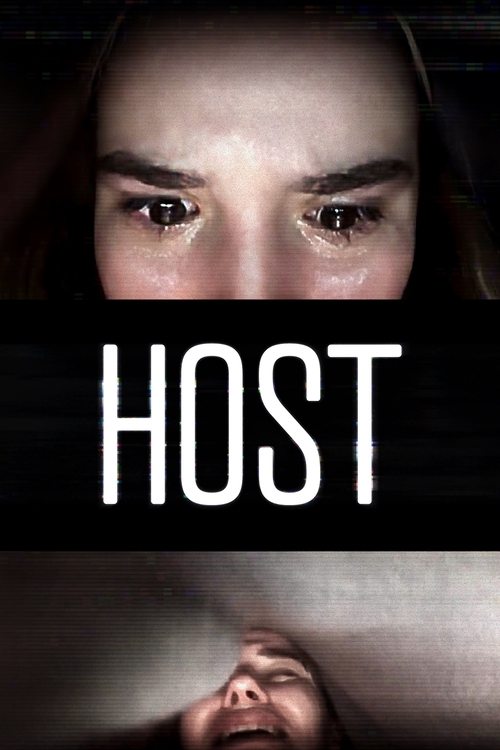
I remember exactly where I was when the world went quiet in 2020, and I’m willing to bet you do too. We were all trapped in a cycle of sourdough starters, Tiger King memes, and the inescapable purgatory of Zoom calls. It was a time of profound boredom mixed with low-grade existential dread. Then along came Rob Savage, a director who looked at our collective digital misery and thought, "I can make this much, much worse."
I watched Host on my laptop with the screen brightness cranked up way too high, while my neighbor was loudly pressure-washing their driveway outside. Every time the humming stopped, the silence in my living room felt twice as heavy, as if the movie was leaking into my actual apartment. That’s the magic of this film; it doesn't just ask for your attention; it hijacks the very hardware you’re likely using to watch it.
A Seance for a Shut-In World
The setup is aggressively simple. Six friends—Haley Bishop, Jemma Moore, Emma Louise Webb, Radina Drandova, Caroline Ward, and Edward Linard—decide to spice up their weekly video hang by hiring a medium for a virtual seance. It’s the kind of "let’s try anything" activity that defined the early pandemic era. Of course, someone doesn't take the rules seriously, a spirit gets offended, and suddenly the "End Meeting" button feels like a very flimsy shield against the supernatural.
What strikes me now, looking back from a safe distance of a few years, is how perfectly Host captures the specific anxiety of that moment. We were all tethered to these glowing rectangles as our only window to the world. Screenlife horror is usually garbage, but this proves the format can actually feel like high art. By using the Zoom interface—the timers, the "low battery" warnings, the digital background filters—Savage turns our everyday tools of productivity into instruments of terror. When a face filter unexpectedly snaps onto something invisible in the darkness behind one of the characters, it hits harder than any $100 million CGI monster ever could.
Stunts, Shadows, and DIY Sorcery
The production history of Host is the stuff of indie legend. Produced by Shadowhouse Films and BOO-URNS for a measly $100,000, it was famously conceived, shot, and released in about twelve weeks. Because of lockdown restrictions, Rob Savage couldn't actually be in the same room as his actors. He directed them via—you guessed it—Zoom.
This meant the cast had to be their own camera operators, lighting technicians, and even their own practical effects wizards. If a chair flew across the room or someone was yanked into the ceiling, the actors had to set up the rigs themselves. There’s a raw, frantic energy to the performances that I suspect came from the genuine stress of managing a film set while simultaneously trying to act scared. Haley Bishop and her co-stars aren't just playing friends; they were actually friends navigating a global crisis together, and that chemistry prevents the film from feeling like a cynical gimmick.
It’s a testament to the idea that creativity thrives under constraint. Without the budget for massive set pieces, the film relies on sound design and the "less is more" philosophy of horror. It understands that a flickering light or a door slowly creaking open in the background of a video feed is infinitely more unsettling than a full-frame reveal of a demon.
The Mercy of a 56-Minute Runtime

Can we talk about the runtime? At a lean 56 minutes, Host is shorter than some episodes of prestige TV, and honestly, it’s a revelation. In an era where every blockbuster feels the need to drag itself toward the three-hour mark, this movie is a masterclass in not overstaying your welcome. It doesn’t waste twenty minutes on backstory or "lore." It gives you just enough character flavor to make you care if they die, and then it gets straight to the business of shredding your nerves.
It’s the ultimate "Theatrical vs. Streaming" debate winner. While it did get a limited theatrical run later, this movie was born for the small screen. It’s designed to be watched in the dark, on a device that looks exactly like the ones on screen. It bridges the gap between the viewer and the viewed until you find yourself glancing at the "Participants" list on your own screen just to make sure no one extra has joined the meeting.
Host isn't just a horror movie; it’s a time capsule. It’s a reminder of a period when we were all desperately trying to stay connected while being terrified of the very air we breathed. It took the mundane boredom of the 2020 lockdown and turned it into a sharp, terrifying punch to the gut. It might not have the historical weight of a 70s slasher yet, but for anyone who lived through the "You're on mute" era, it’s a definitive piece of contemporary cinema.
Ultimately, Host succeeds because it respects the audience's time and intelligence. It uses its low budget as a weapon rather than an excuse, proving that a good scare only requires a clever idea and a solid internet connection. It’s a lean, mean, 21st-century ghost story that makes you want to throw your router out the window. Just make sure you check your background filters before your next work call. You never know who—or what—the software is trying to track.
Keep Exploring...
-
The Boogeyman
2023
-
The Autopsy of Jane Doe
2016
-
The Ritual
2017
-
I See You
2019
-
Bone Tomahawk
2015
-
Circle
2015
-
It Follows
2015
-
Hush
2016
-
Raw
2016
-
The Invitation
2016
-
The Witch
2016
-

Leatherface
2017
-
The Endless
2017
-
Cam
2018
-
Climax
2018
-

Revenge
2018
-
Summer of 84
2018
-

Terrifier
2018
-
Unfriended: Dark Web
2018
-
Unsane
2018