20 Days in Mariupol
"A nightmare you aren't allowed to look away from."
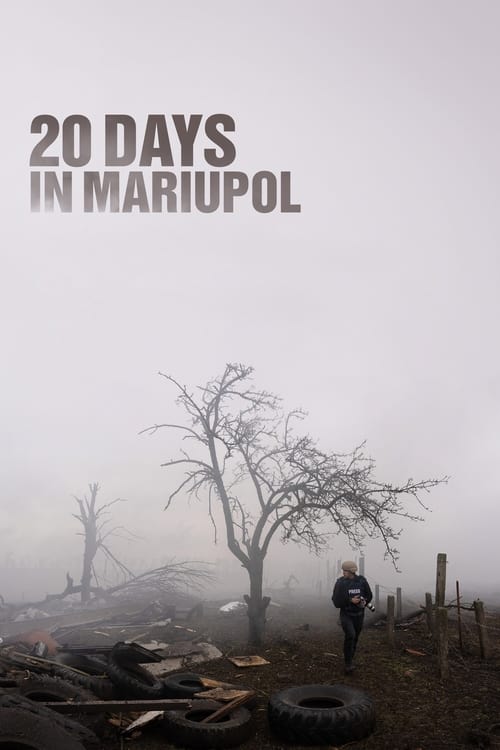
The first thing that hits you isn't the sight of the tanks or the smoke rising over the skyline of Mariupol; it’s the sound of the breathing. Specifically, the heavy, ragged breath of Mstyslav Chernov behind the camera. It’s a constant, rhythmic reminder that what we’re watching isn’t a polished production with a safety net. There is no "cut" that saves the protagonist here. As a seasoned journalist for The Associated Press, Chernov knows how to frame a shot, but as the Russian shells begin to turn his city into a graveyard, the professional distance collapses. This isn't just a documentary; it’s a 94-minute countdown where the prize for winning is simply making it out alive with a few digital memory cards hidden in a car seat.

I watched this on a Tuesday afternoon while my neighbor was outside power-washing his driveway. That mundane, aggressive hum of suburban maintenance felt like a sick joke echoing against the screen, a jarring reminder of the safety I take for granted while watching a city be systematically erased. It’s a difficult, heavy experience, but in an era where we are drowning in "content," this is one of the few things I’ve seen recently that feels like it actually demands to exist.
The Death of the Front-Row Seat
We live in a time where everyone has a 4K camera in their pocket, yet the truth feels harder to pin down than ever. Chernov, alongside photographer Evgeniy Maloletka and producer Vasilisa Stepanenko, found themselves as the last international journalists left in Mariupol. That context is vital. In our contemporary "fake news" landscape, the film documents not just the war, but the immediate, cynical attempt to discredit reality. We see the horrific aftermath of the bombing of a maternity hospital—images that traveled the globe—and then we see the Russian state media clips calling those same victims "crisis actors."
Watching this play out in real-time is infuriating. It highlights a specific trauma of the modern age: the realization that even when you capture the worst day of someone’s life on film, someone else will use a Twitter algorithm to tell you it never happened. Chernov captures the faces of ordinary citizens like Liudmyla Amelkina and Zhanna Homa with a raw, unblinking eye. He doesn't look away when the doctors are frantically pumping the chest of a child who will never wake up. Honestly, watching this makes every ‘gritty’ Hollywood war epic look like a sanitized theme park ride. There’s no slow-motion heroism here, just the cold, grey reality of concrete dust and grief.
The Logistics of a Miracle
One of the most fascinating aspects of the film, from a production standpoint, is how it even reached us. This wasn't a "festival-to-streaming pipeline" project in the traditional sense; it was a desperate salvage operation. Chernov and his team had to find spots of connectivity in a dying city—often risking their lives to climb to a specific floor of a bombed-out building—just to send a few seconds of footage to their editors at the AP and FRONTLINE.
The score by Jordan Dykstra is worth mentioning because of how it doesn't try to "movie-fy" the tragedy. It’s an ambient, low-thrumming dread that feels like the vibration of an incoming jet. It avoids the melodramatic swells that lesser documentaries use to tell you how to feel. The film trusts you to feel the weight of it on your own. There’s a sequence involving a local policeman, Vladimir, who risks everything to help the journalists because he understands that if the cameras stop, the city dies in total silence. It’s a high-stakes drama that happened to be real life, and the tension is more suffocating than any thriller I’ve seen in the last decade.
A Relic of the "Now"
While we often look back at classic war cinema through a lens of nostalgia or "never again" sentimentality, 20 Days in Mariupol refuses that distance. It’s a film of the current moment—captured on digital sensors, transmitted via satellite, and contested in the comments sections of social media. It hasn't had time to become a "classic" because the wounds it depicts are still open.
There is an inherent darkness here that goes beyond the violence. It’s the darkness of moral exhaustion. You see it in the eyes of the doctors who are working by flashlight, their floors slick with blood, as they scream at the camera to show the world what is happening. The film asks a haunting question about the value of the image: if the world sees this and nothing changes, what was the point? It’s a question that lingers long after the credits roll. I walked away from the screen feeling physically drained, the kind of exhaustion that comes from witnessing something you can’t un-see.
20 Days in Mariupol is a staggering achievement that justifies the existence of the documentary form in a saturated digital age. It’s a brutal, necessary piece of history that functions as both a memorial and a warning. You don't "enjoy" a film like this, but you are transformed by it. It’s the kind of cinema that strips away the artifice and leaves you standing in the cold, hard light of the truth. If you can stomach the intensity, it is perhaps the most important document of the 2020s so far.
Keep Exploring...
-

Seaspiracy
2021
-

Devotion
2022
-

Girl in the Picture
2022
-

The World Will Tremble
2025
-

Warfare
2025
-

Т-34
2018
-

Escape from Mogadishu
2021
-

Firebird
2021
-

The Champion
2021
-

The Forgotten Battle
2021
-

The Shadow in My Eye
2021
-

The Last Kingdom: Seven Kings Must Die
2023
-

Amaran
2024
-

Land of Bad
2024
-

Number 24
2024
-

Sisu: Road to Revenge
2025
-

The Tank
2025
-

Beasts of No Nation
2015
-

Anthropoid
2016
-

The Siege of Jadotville
2016
-

Land of Mine
2015
-

Suite Française
2015
-

A Bag of Marbles
2017
-

See You Up There
2017