Emilia Pérez
"To find herself, she must disappear."

Jacques Audiard is 72 years old, an age where most legendary directors are content to settle into a comfortable groove of "late-style" dramas or nostalgic retreads. Instead, the man who gave us A Prophet and The Sisters Brothers decided to drop a Spanish-language, transgender narco-musical thriller that feels more alive than almost anything else released this year. It sounds like the kind of elevator pitch that would get you laughed out of a studio executive’s office in 2005, but in our current era of "prestige streaming" and genre-mashing, it’s exactly the kind of high-wire act that demands a theater screen—or at least a very large TV and no distractions.
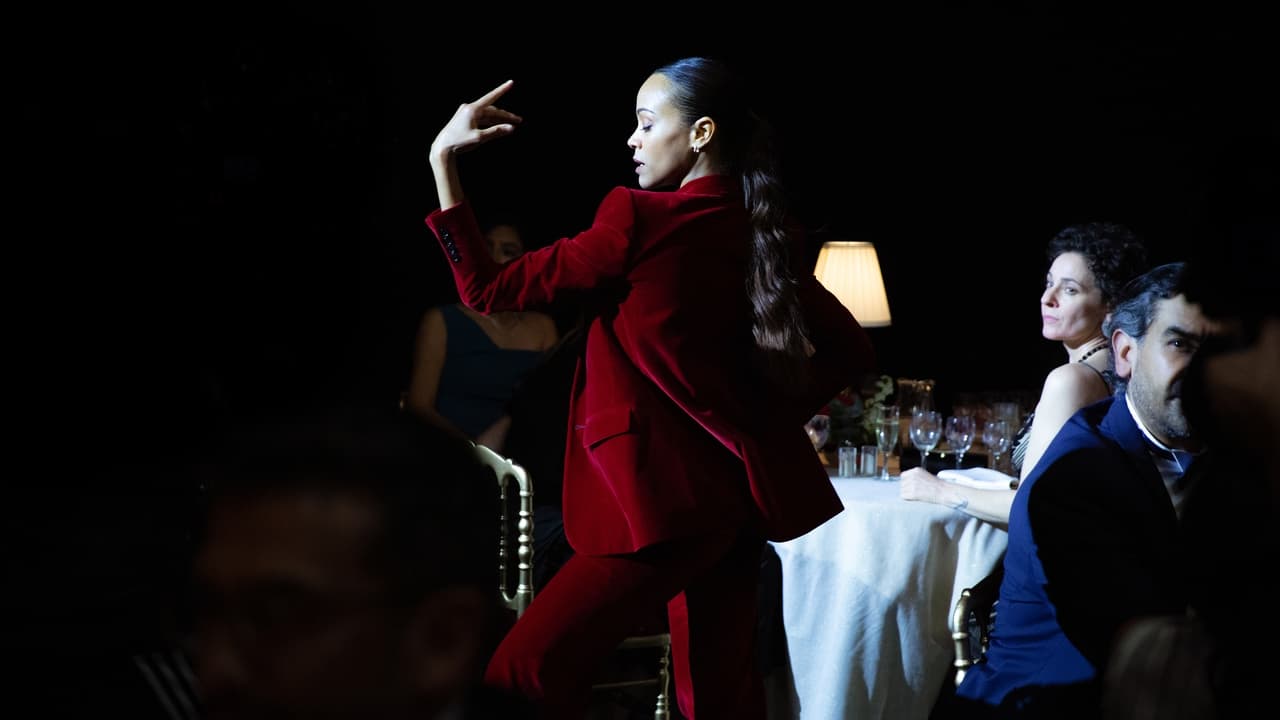
I watched this on my laptop while wearing exactly one wool sock because I couldn’t find the other, and honestly, that lopsided, slightly uncomfortable feeling matched the film’s chaotic energy perfectly. Emilia Pérez is a movie that shouldn't work. It starts as a gritty legal thriller and then, without warning, characters start singing about rhinoplasty and the moral rot of the Mexican judicial system. It’s like a telenovela directed by someone who hates tropes, and I couldn't look away.
A Genre-Bending Gamble That Actually Pays Off
The story follows Rita, played by a fiercely competent Zoe Saldaña, a lawyer who is tired of being the smartest person in a room full of corrupt men. She gets a mysterious call from Manitas, a terrifying cartel leader who wants out of the business—but not for the usual "witness protection" reasons. Manitas wants to undergo gender affirmation surgery and vanish, finally living life as Emilia. Rita is the architect of this disappearance, and the film jumps ahead to show us the fallout of that choice.
What surprised me most wasn't the plot, but the music. These aren't your typical "I Want" songs from a Disney flick. Composed by the French artist Camille, the tracks are rhythmic, often chanted, and deeply percussive. They feel less like performances and more like internal monologues leaking out of the characters' chests. When Zoe Saldaña breaks into a song-and-dance number at a high-society gala, it’s a revelation. We’ve spent a decade watching her in blue or green makeup in franchises; seeing her use her actual body and voice reminds you that she’s a formidable performer when she isn’t tethered to a CGI rig.
Performance as a Political Act

The heart of the film, however, is Karla Sofía Gascón. Transitioning both as a character and as a presence on screen, she has to play the terrifying Manitas and the soulful, repentant Emilia. It is a massive task, and she nails it by not making Emilia a saint. This isn't a simple "bad man becomes good woman" story; it’s a "violent person tries to find a new way to exist" story. Gascón brings a gravelly, grounded weight to the role that keeps the movie from floating off into musical theater fluff.
Then there’s Selena Gomez as Jessi, the wife Manitas leaves behind. I’ll be honest: I wasn't sure if she could hold her own in a gritty Audiard project, but the Disney kid finally grew up and found some grit. She plays Jessi with a desperate, suburban loneliness that acts as a necessary anchor to the more operatic elements of the plot. When she and Adriana Paz (who plays a woman Emilia helps) share the screen, the movie shifts into a domestic drama that feels just as high-stakes as the cartel shootouts.
The Netflix Pipeline and Modern Relevance
In our current landscape, where theatrical releases are often reserved for superheroes or sequels, Emilia Pérez is a fascinating case study. Netflix picked it up after a massive splash at Cannes, and while it’s great that it’s accessible, this is a film that thrives on the collective "did that just happen?" energy of a crowd. It tackles representation not as a box to be checked, but as a visceral, complicated engine for a thriller. It asks what it means to truly change—not just your appearance, but your soul—in a country ravaged by the "disappeared."

The third act gets a little messy, leaning into some "thriller" conventions that feel a bit more standard than the brilliant first hour. There are moments where the tonal shifts might give you whiplash, but I’d rather have a movie that tries to do everything and stumbles than a movie that tries to do nothing and succeeds. It’s a film about the "now"—about identity politics, the drug war, and the search for peace in a violent world—all wrapped up in a package that refuses to stay in its lane.
Emilia Pérez is a neon-soaked fever dream that proves there is still room for genuine weirdness in contemporary cinema. It manages to be a tragedy, a celebration, and a nail-biter all at once, anchored by three performances that should be dominating the awards conversation for months. If you’re tired of the same old formulas, give this one a look. Just make sure you find both your socks first; you’re going to want to stay planted in your seat for this one.


Keep Exploring...
-

The Sisters Brothers
2018
-

An Officer and a Spy
2019
-

Black Box
2021
-

The Vault
2021
-
Titane
2021
-

November
2022
-

Black and Blue
2019
-

Motherless Brooklyn
2019
-

The Professor and the Madman
2019
-

Lost Bullet
2020
-

Riders of Justice
2020
-

Stillwater
2021
-

Crimes of the Future
2022
-

The Outfit
2022
-

Missing
2023
-

Rust and Bone
2012
-

Gold
2016
-

Dark Places
2015
-

Blood Father
2016
-

Elle
2016