STRAW
"One bad day. One final snap."
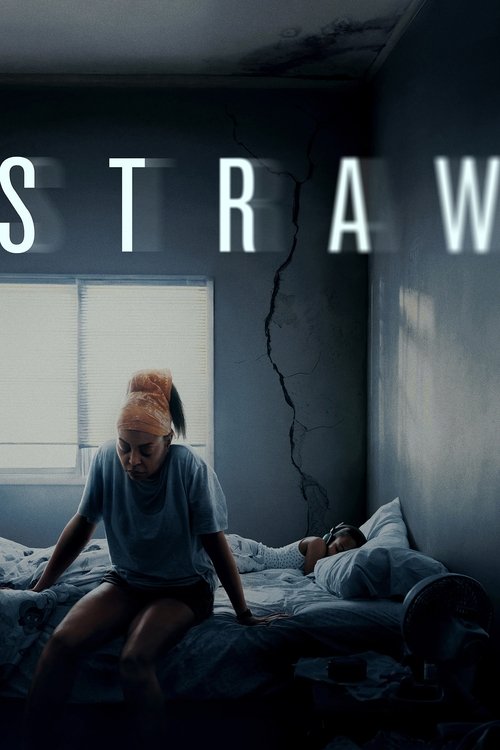
There is a specific frequency of silence that only exists right before someone ruins their entire life. It’s that heavy, vibrating stillness in the air when the internal monologue finally stops asking why and starts asking why not? In Tyler Perry’s STRAW, that silence belongs to Janiyah Wilkinson, and when it finally breaks, the sound is deafening.

I watched this on a Tuesday night while my neighbor’s car alarm kept going off every twenty minutes, and honestly, that external layer of minor, repetitive irritation made Janiyah’s descent feel about ten times more immersive. You don’t just watch this movie; you endure the cumulative weight of her Tuesday until you’re just as ready to scream as she is.
The Anatomy of the Breaking Point
The setup is a classic "bad day" thriller, a subgenre that feels increasingly relevant in our current era of "hustle culture" and the evaporating middle class. Taraji P. Henson plays Janiyah, a woman who is essentially the human embodiment of a fraying rope. She’s a single mother working a thankless corporate job, dealing with a landlord who has the empathy of a brick, and trying to keep her son’s head above water in a world designed to sink them.
Henson, who previously worked with Perry on the high-camp intensity of Acrimony (2018), brings a much more grounded, weary energy to Janiyah. You can see the mental math happening behind her eyes—the constant calculation of bus fares versus grocery costs. When the "straw" of the title finally lands, it’s not a grand, cinematic tragedy; it’s a series of mundane, soul-crushing indignities that pile up until her survival instinct takes a sharp, jagged turn into criminality. Tyler Perry’s pacing is often just 'Stress: The Movie,' and here he leans into the claustrophobia of being poor in a city that demands you be invisible.
The Supporting Cast and the Perry Polish
While Henson carries the emotional heavy lifting, the ensemble adds some much-needed texture. Sherri Shepherd shows up as Nicole, providing a warmth that highlights just how cold the rest of Janiyah’s world has become. It’s also a genuine joy to see Sinbad back on screen as Benny. After his real-life health struggles, his presence here feels like a warm hug in a movie that is otherwise trying to choke you. He brings a vintage, lived-in gravity to the screen that reminds you why he was a staple of 90s cinema.

On the other side of the law, we have Teyana Taylor as Detective Kay Raymond. Taylor has been on an absolute tear lately (if you haven't seen A Thousand and One, fix that immediately), and she brings a sharp, skeptical edge to the proceedings. She isn’t playing the "hero" cop so much as a woman doing a job that forces her to look at the wreckage Janiyah leaves behind. The chemistry between the cast feels natural, though Rockmond Dunbar, as Chief Wilson, is somewhat saddled with the "stern boss" tropes that often haunt Perry’s screenplays.
Streaming Stakes and Visual Choices
In the landscape of contemporary cinema, STRAW is a fascinating artifact of the Tyler Perry Studios machine. It’s built for the streaming era—high concept, star-driven, and designed to ignite social media discourse about "what would you do?" It lacks the glossy, detached feeling of a major studio blockbuster, opting instead for a gritty, almost televisual intimacy. Justyn Moro’s cinematography leans into sickly greens and harsh overhead fluorescents, making the office spaces look like holding cells and the streets feel like a labyrinth.
However, the film does struggle with some of Perry’s habitual weaknesses. The dialogue occasionally veers into the didactic, with characters explaining their motivations as if they’re reading from a psychology textbook rather than having a conversation. There are moments where the film treats its themes with the subtlety of a sledgehammer hitting a gallon of milk. We get it—life is hard—but the movie sometimes feels like it's wagging a finger at the audience rather than letting the story speak for itself.
The Moral Gray Zone

What makes STRAW work, despite its melodramatic flourishes, is its refusal to provide a clean exit. As the thriller elements kick in and the "shocking act of desperation" occurs, the film moves into a moral gray zone that feels very "now." We are living in a moment where the "good guy/bad guy" binary is being dismantled in favor of stories about systemic failure. Janiyah isn't a criminal mastermind; she's a person who ran out of options, and the film is at its best when it forces us to sit with the discomfort of her choices.
It’s an intense, often draining experience. It’s the cinematic equivalent of a high-interest payday loan—it gives you an immediate rush of adrenaline and drama, but it leaves you feeling a bit depleted by the time the credits roll. It’s not a "fun" watch, but in the context of Tyler Perry’s evolution as a filmmaker, it shows a willingness to engage with darker, more complex psychological territory than his earlier, more broad comedies.
STRAW is a blunt-force instrument of a movie, fueled by a powerhouse performance from Taraji P. Henson that deserves a more refined script than the one she’s given. It perfectly captures the modern anxiety of the breaking point, even if it occasionally trips over its own theatricality. If you’re looking for a thriller that feels like a heavy sigh followed by a scream, this is your ticket. Just make sure you’ve paid your electric bill before you sit down to watch it—you won’t want any extra stress.


Keep Exploring...
-
A Fall from Grace
2020
-
The Outfit
2022
-
November
2022
-
Batman vs. Robin
2015
-
Suburra
2015
-

Miss Sloane
2016
-
22 July
2018
-
The Guilty
2018
-

The Traitor
2019
-

The Devil All the Time
2020
-
Wrath of Man
2021
-

To Catch a Killer
2023
-
The Courier
2020
-
Cherry
2021
-
The Mauritanian
2021
-
The Unforgivable
2021
-
Thirteen Lives
2022
-
Missing
2023
-

The Accountant²
2025
-
Patriots Day
2016